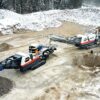
A team of construction workers has descended onto a sprawling site in Moosonee, a town of about 1,500 people in northeastern Ontario, to lay the groundwork for a state-of-the-art, $1.8-billion health care campus that will serve the western James Bay and Hudson Bay regions.
Numerous piles have already been driven into the dusty brown dirt to support the foundations for the facility, and several excavators, rollers and concrete trucks are now on site.
Known as the Weeneebayko Area Health Authority Redevelopment (WAHA) Project, the complex is Ontario’s most remote health infrastructure project. The plan calls for a new regional acute care hospital with 24-hour emergency department, 32-bed elder care lodge, patient rooms, a mental health and addictions space, visitor hostel and staff accommodations.
The 419,000-square-foot hospital and campus will also have a facility for dialysis, a lab, pharmacy and diagnostic imaging facility as well as residences for staff and traditional healing space. A new ambulatory health clinic is also being built on nearby Moose Factory Island.
The design of the hospital has been heavily influenced by the traditional healing, cultural values and voices of the local Indigenous population. Community-led events and engagement sessions were held with local First Nations to find out how to incorporate cultural elements and reflect the values, identity and needs of the communities.

The orientation of the hospital building aligns with the cardinal directions of the Cree Medicine Wheel. It will have a circular front entry pavilion that faces east and a design that reflects the four sacred medicines: tobacco, cedar, sage and sweetgrass. Inside, the healing space will be a focal point in the lobby, featuring a two-storey centrepiece with clerestory windows.
Pomerleau Healthcare Partners was selected to build the campus. The team is comprised of Pomerleau Inc. and design team Kasian Architects Ontario Inc. and Bertrand Wheeler Architecture Inc. Completion is slated for 2030.
“The new regional health care campus is being built with the First Nations people living in this region in mind – from the ground up,” the WAHA explains in a statement. “Traditional healing, cultural values, and community voices have shaped every step of the planning process. Input from community members and local Indigenous leadership has helped ensure that these new spaces are culturally safe and meet the growing health needs of our region.”
Renderings show the facility will have a large curved front entranceway with a canopy and plenty of windows throughout. Around the structure, there is ample parking and lots of greenspace.
The campus aims to achieve a Leed 4 Silver rating. Environmental considerations are being incorporated through the implementation of erosion and sediment controls, integration of energy efficient HVAC, electrical and water systems and enhanced indoor air-quality measures. Architectural elements have been included in the design to allow ample natural daylight into the building.
The builders will be using modular construction, with prefabricated components and advanced technologies like BIM 3D-modeling, virtual reality and drone imaging to streamline building processes. Innovations such as vibration detection sensors will also minimize site disruptions.

WAHA chose modular construction as it offers significant advantages for building hospitals in remote regions where infrastructure is limited. It allows for much of the construction to occur off-site in controlled environments and reduces the impact of harsh weather while minimizing onsite labour needs. Access to the area is limited as there are no paved roads to Moosonee.
The town is accessible by air, rail and ice road. Additionally, there is limited accommodations in the region, requiring the construction of a temporary workers camp.
Since the region experiences extreme cold and seasonal access restrictions, Pomerleau has developed contingency plans to keep the project on track.
More than 4,206 metric tons of steel and 1,659 foundation piles will be used on the project and about 400 workers will be employed at peak construction
The project is being delivered using the Progressive Public-Private Partnership Design Build Finance (DBF) model which relies on a high level of collaboration between all parties to deliver health care and housing facilities that meet all the project requirements and specifications at the lowest possible cost.
Based on previous project experience, a DBF procurement model typically has delivered a value for money savings in the range of 10 to 15 per cent, compared to undertaking the same projects using traditional delivery models.
To support construction of the complex, Pomerleau has selected Abitibi Connex, a former paper mill in Iroquois Fall, to be the logistics hub for the building materials. Ontario Northland Rail is upgrading 11.5 kilometres of rail spur to create a direct connection from Iroquois Falls to the Cochrane junction, where materials will be moved north to the Moosonee site.
Over a three-year period, roughly 3,000 rail cars will be handled at the Abitibi Connex site, creating about 120 jobs during peak construction.