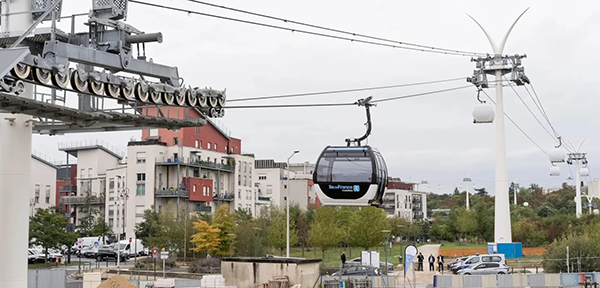
The overhead cable car system that serves the congested outer suburbs of Paris began construction in the spring of 2023 and opened to the public last month. The comfortable cabins cover 4.5 kilometres in a total of 18 minutes, about 15 km/h, with five stations along the way.
As a matter of comparison, the recently opened Finch West light rail transit (LRT) line in Toronto currently covers its 10.3 kilometre route in about 55 minutes, just over 11 km/h, with 18 stops en route. That’s 25 per cent slower than Paris’ cable cars. At the same time, the Finch West light rail is expected to carry about 51,000 passengers each day, five times the expected passenger load for Paris’ overhead cable car system.
Nevertheless, there are other important differences that make the discussion of cable cars for public transit relevant in Canada.
First, overhead cable car systems like those in Paris need a very small footprint and cause little change to the existing surface traffic underneath. In fact, they pass overhead, above intersections, rivers, parks and over varying terrain, through a series of strategically located stations, and arrive at terminals where passengers can connect with other modes of public transport. On the other hand, light rail systems are disruptive to surface traffic. They require a dedicated centre lane and traffic right-of-ways in order to maximize efficiency.
Second is the time and cost of construction.
Toronto-based independent transportation planner Reece Martin, told CBC Radio Day 6 host Brent Bambury cable car systems are not very expensive to operate.
“And frankly, they’re not very expensive to build, either,” he said. “You install some poles, you string some cable and then it’s good to go. It’s a lot faster to build than some of the transit projects we might be familiar with.”
For example, the Finch West LRT took about six years to construct and cost an estimated $3.7 billion. Paris’ cable car system was completed in three years for about 15 per cent of that, approximately $250 million.
Perhaps this explains why cable cars as public transit people movers are back in the Canadian news.
Pierre-Léo Bourbonnais, a mobility researcher at Polytechnique Montréal, told LaPresse an overhead cable car system could replace the proposed third highway link in Québec City as well as spanning Frédéric-Back Park on the Island of Montréal.
“Much less expensive, with roughly the same capacity,” he said.
In fact, a plan in the works since 2020 may see Burnaby, B.C., become home to Canada’s first commuter cable car system.
A new aerial link would connect Simon Fraser University’s 7,000 main campus residents on Burnaby Mountain with Vancouver’s SkyTrain. It’s only a 2.7 kilometre straight-line route, but proponents of the proposed system say the Burnaby Mountain Gondola would move more people per hour than other types of transportation, reduce greenhouse gases (GHGs) and other emissions, with lower operating costs than buses. However, the plan awaits further study, assessment and approvals.
In Ontario, the City of Oshawa is seriously considering Aerial Cable Car Transit (ACCT) for its busy Simcoe Street corridor. Projections suggest annual ridership would significantly outstrip alternatives like high-frequency buses and LRTs. Oshawa’s project team is continuing to engage with councils, stakeholders and the public, and is expected to report back with a recommendation in late 2027.
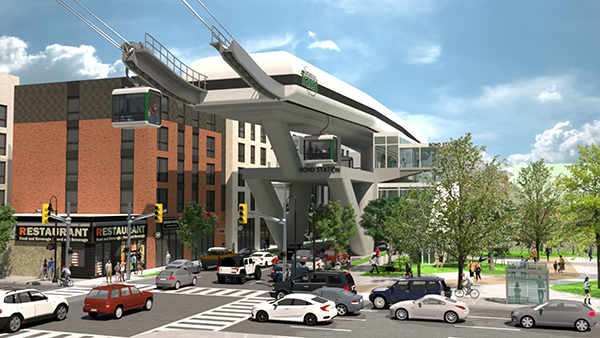
Houston, Texas is taking a serious look at a cable car system called Whoosh to make its southwestern suburb of Sugarland more accessible. The area has experienced rapid growth along with the accompanying increase in traffic, making it an ideal candidate for a modern transit solution like Whoosh.
What’s different about the proposed Whoosh concept is that it offers an on-demand, Uber-like experience.
“Whoosh creates personalized, point to point transportation for passengers or goods traveling in autonomous electric vehicles on a light and flexible elevated cable and rail guideway,” the company says. “Whoosh networks are modular and can include small pull-off stops, larger hub stations or combinations of both to create a variety of journey options across a region. Vehicles travel across cable sections to span over geographic obstacles without interference to the area below. They seamlessly transition from cable to rail support structure, changing elevation, or turning to create countless route options.”
While the Paris system receives high attention due to the city’s international notoriety, one could also consider the success of Mexico City’s overhead Cablebus, the longest aerial system in the world. The first cable cars opened in 2021 in the city’s north end and were followed quickly by a second system. Together they cover 20 kilometres with 13 stations. A recently added third line has added another 5.5 kilometres and six stations.
When it comes to daily capacity, it’s important to understand that cable car systems can move many more people per day than in Paris. Systems in Bogota, Colombia, and La Paz, Bolivia, move about 70,000 and 80,000 people a day respectively.
So why not cable cars in Canada? It seems only a matter of time before Canada’s busy urban centres make the move to cable in order to more effectively move their residents.
John Bleasby is a freelance writer. Send comments and Inside Innovation column ideas to [email protected].