
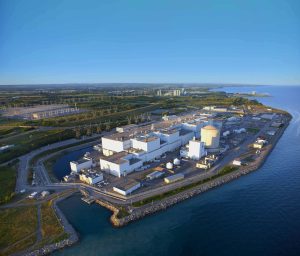
When Ontario Power Generation (OPG) committed in 2016 to refurbishing the Darlington Nuclear Generating Station, the stakes could not have been higher.
The four-unit station supplies roughly 20 per cent of Ontario’s electricity, and the $12.8-billion project would determine whether the province could rely on nuclear power as the backbone of a growing, increasingly electrified economy.
In April of that year, then-OPG president and CEO Jeff Lyash made a bold declaration as the project moved from planning to execution.
“We are ready to go, and we will deliver the job safely, on schedule, on budget, and at the highest level of quality,” he declared.
“We have a leadership team relentlessly focused on delivering results, a workforce committed to excellence in project execution and homegrown suppliers and partners who understand the importance of this effort. We all understand refurbishing Darlington is about the future of this province.”
Nearly 10 years later, that promise has been fulfilled.
OPG announced recently that construction on the refurbishment is complete, with the overall project forecast to finish four months ahead of schedule and $150 million under budget. The refurbishment will extend the station’s operating life to at least 2055.
It’s an outcome that stands out in a global nuclear industry where delays and cost overruns have often been the norm.
The success of the refurbishment was rooted in the years that preceded the first reactor shutdown and before the first bolt was turned.
More than a decade of detailed planning and preparation took place before Unit 2 was removed from service in October 2016. Central to that effort was the construction of the world’s first full-scale, reconfigurable reactor mock-up, allowing workers to train, test tools and refine procedures in a non-nuclear environment.
By the time work officially began, OPG and its partners had mapped out a unit-by-unit strategy that would allow the lessons learned from initial work to be applied later.
Unit 2 would go first, followed by Unit 3, then Unit 1 and finally Unit 4 – an approach designed to reduce risk and improve performance as the project advanced.
The philosophy was put to the test almost immediately. In the early stages, OPG introduced new technologies, including automated guided vehicles – essentially mobile robots – to transport heavy tools and radioactive components within the reactor vault.
Unit 2 became the proving ground for the entire program. Crews replaced hundreds of critical components, including fuel channels and feeder pipes, while refining techniques for reactor disassembly and reassembly.
When Unit 2 returned to service in June 2020, it did more than meet expectations. In the three years following its refurbishment, the unit achieved a record 529-day continuous run – industry-leading performance for a post-refurbishment CANDU reactor – and exceeded generation targets by more than 10 per cent.
Refurbishment of Unit 3 began in 2020, overlapping with later stages of the work on Unit 2. Major turbine-generator overhauls were completed faster, thanks to lessons learned on Unit 2.
Three years later, Unit 3 was reconnected to Ontario’s electricity grid 169 days ahead of schedule, providing an additional three terawatt-hours of clean electricity, enough to power 350,000 homes for a year.
Unit 1 followed a similar trajectory. Taken offline in February 2022 after a world-record run of more than 1,000 consecutive operating days, refurbishment of the 875-megawatt unit was completed five months ahead of schedule. By late 2024, it was ready to rejoin Units 2 and 3.
Unit 4, the last reactor to be refurbished, marked the culmination of nearly a decade of construction work. The refurbishment wrapped up in early in February, clearing the way for final testing and a return to full commercial operation well ahead of its original August 2026 target.
Across the project, crews replaced 1,920 fuel channels and 3,840 feeder pipes and logged more than 23 million work hours without a lost-time incident.
Refurbishment work also included replacing calandria tubes and end fittings as well as rehabilitating other critical components. System improvements and plant upgrades were also carried out to meet current regulatory requirements.
Aaron Johnson, senior vice-president, nuclear, at Aecon Group Inc., says delivering the project safely and months ahead of schedule provides a model for major nuclear projects on a global scale.
“This trailblazing project significantly contributed to the evolution of Ontario’s world-class nuclear supply chain and the growth of Ontario’s skilled workforce – providing lasting economic benefits.”
Beyond schedule and cost performance, the Darlington refurbishment has delivered substantial economic benefits. More than 6,000 Ontario workers were involved directly in the construction phase, with 96 per cent of project spending retained within the province. During the construction phase, the project contributed an estimated $14.9 billion to Ontario’s GDP.
From an energy perspective, the payoff is equally significant. With all four units refurbished, Darlington will deliver more than 3,500 megawatts of electricity until at least the mid-2050s.
The Darlington project is now widely viewed as a global benchmark for nuclear refurbishment.


