
There is a growing demand to build a lot of data centres and to build them quickly. Builders are pulling out all the stops using, for example, structural prefabrication and precast concrete. The need for speed has also opened the door for robotic devices like never before.
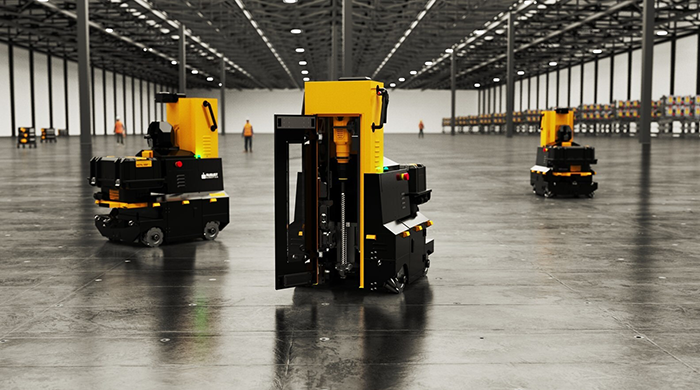
In response, DEWALT, a Stanley Black & Decker brand, launched a pilot project using robot drills to speed up the installation of the hundreds of server racks inside these facilities as well as the supports for various mechanical services.
Powered by August Robotics’ autonomous drilling and fleet orchestration platform, this robotic drilling solution cut 80 weeks from data centre construction timelines for one of the world’s largest technology companies, and achieved 99.97 per cent drilling accuracy on more than 90,000 holes throughout the pilot program.
The Daily Commercial News spoke with Gordon Brookes, Senior robotics field implementation manager at Stanley Black & Decker, about the program’s performance results.
How does the robot know exactly where to drill holes?
One of the advantages of our robotic system is that we don’t need to have the floor pre-marked. Our client was spending about a week doing that physical layout on the floor. Instead, we input the CAD plan for the BIM model with all the co-ordinates for the hole locations. That provides the robot with the X-Y it needs to know.
How long can run a robot run on a single charge?
It depends on the size and depth of the hole. The battery lasted up to four hours for the smaller holes at a rate of maybe 40 to 50 holes per hour, so perhaps 200 holes. For larger holes, they needed more power, so we saw about two hours run time.
How many robots were involved at each location?
We operated the robots in teams of four, depending on the number of holes needed. To give you an idea, on one of the data centre sites, 7,000 holes was the average number of holes for each phase. But on another project, there were four times that number, so we deployed eight robots.
How long did it take the team of robots to complete the job from start to finish compared to the traditional drilling method?
For our site with 7,000 holes, the contractor would have scheduled about six to eight weeks for the hand drilling and layout of the data centre hall. The robots did that same work in seven days.
Construction robots are expensive and contractors have to justify the cost of a robot. Is it getting to the point where it’s financially viable for a contractor to use this machine?
You want a large project where you’ve got thousands of holes. We were approached by a client building data centres, so that was a natural starting point. But we also see applications in industrial, manufacturing and warehousing situations.
There were a couple areas where the contractor saw value. First, the schedule savings when a data centre can be switched on a couple weeks earlier are huge for the owner. Second, if we looked at cost per hole, we were seeing around about $20 per hole with the robot versus $65 per hole normally. That’s calculating the equipment, the people and general budgeting. Another perspective is when contractors were bidding for this work, they were usually estimating anywhere from 4,000 to 5,000 hours to complete this work. The robots were able to do it in about 400 to 500 hours.
What level of oversight is required by a human?
There’s not a lot of intervention that humans need to do — mostly replacing consumables on the robot, like the carbides for doing the holes, the bags that were filling with silica dust and doing battery swaps. That way, one human can tend to a number of robots simultaneously. The robots also have obstacle avoidance built into them, like a LIDAR camera and sensors around the edges.
What happens if the robot can’t drill in a location or move an obstacle out of the way?
The operators have an interface on a tablet that shows the location of all the holes and their status, so they would see if the hole hasn’t been completed. The robots will retry that hole if they couldn’t do it the first time. If they are not able to do it after a couple of times, it will show up on the tablet that the hole has not been done.
What did the contractors learn about using the robots?
Over the course of the first two projects, the contractors learned how to competently run the robots as long as they had accurate control points on the ground. They could set up all the equipment themselves and break everything down.
These robots drill downwards. Are they adaptable to other purposes?
We specifically targeted downward drilling as our first foray into the robotics world. Our leadership team at DEWALT recognized that there were a lot of applications that we could go after, but decided to pick one and do it really well to prove that it works before moving on to the next thing.
Based on your perspective, do you see more robots being involved in construction work in the future, given the shortage of workers around North America?
Yes, particularly with repetitive tasks. But we don’t want to replace workers with machines. We want to enable those workers to use these machines to extend their career and develop a new set of skills.
John Bleasby is a freelance writer. Send comments and Inside Innovation column ideas to [email protected].


