Hurricanes, winter storms, widespread fires, prolonged power outages and flooding. The list of environmental catastrophes is growing. Much of it is driven by climate change.
“As climate change intensifies, there is no question that the intensity and frequency of extreme weather—often resulting in disasters—is increasing,” says the World Wildlife Fund.
As far back as 2020, commercial real estate leader CBRE estimated 35 per cent of global REIT properties had exposure to hazardous climate events, such as inland flooding and hurricanes.
More project designers are paying attention to this and are now using increasingly sophisticated data analysis to correctly plan the location, design and construction of both residential and ICI projects.
The integrity of buildings and structures over the long term is not the only matter at stake. Insurance costs have skyrocketed by an estimated 7.6 per cent annually from 2017 to 2023, says Moody’s Analytics, affecting annual operational costs. Interruptions to the occupancy or operation of a building or facility due to a severe event and the time required for repairs can also impact the owners and operators.
“To truly understand and manage climate risk, owners need an intentional strategy that first quantifies the impact on property value and overall portfolio risk, and then outlines strategic solutions in response,” says international real estate company Jones Lang LaSalle (JLL). “Proactively quantifying climate risks can also give investors an opportunity to take action and prepare.”
Rather than assessing climate risk on a one-time evaluation basis, climatic stress testing of real estate portfolios should be an ongoing component of active property management.
“We are analyzing multiple sources of climate and property data to construct our own method and provide timely insights to investors,” says Tyrone Hodge, JLL’s global head of risk advisory.

Owners of existing assets also need to consider the long term risk of failing to address climate resiliency and therefore mispricing existing real estate assets, says McKinsey. They reference an analysis by a major North American bank that found “dozens of assets in its real-estate portfolio that would likely be exposed to significant devaluations within the next 10 years due to factors including increased rates of flooding and job losses due to the climate transition.”
As protection, owners and developers need to “map, quantify and forecast climate change’s asset value impact,” continues McKinsey.
From there they can understand and quantify risks and then prioritize the assets within their portfolios, using advanced modelling to detail these physical risks and transfer them onto an economic impact map.
To guide the planning of future projects or to manage existing assets, a variety of Global Information System (GIS) technologies are available. These can capture, store, analyze, manage and visualize all types of geographic data such as cartographic data, photographic data, digital data or data in spreadsheets. This can be developed into reporting and analytical tools for use in the project decision-making process. GIS data is generally available free of charge through government agencies such as Natural Resources Canada, NASA or from Carbon Brief, and as part of a customized package commercially available through consultancies like ESRI Services.
Joe Rozza, chief sustainability officer at commercial real estate developer and builder Ryan Companies, writes once developers integrate climate risk assessments into their decision-making processes during the early stages of site selection, they can “devise a design plan that is environmentally sound for the long term, with the intent of increasing the physical and operational resilience of the asset.”
This might include intentionally “exceeding local building code requirements for wind loading, water and energy efficiency, onsite renewable energy and irrigation, as well as acute tactics such as raising finished floor elevations and locating critical equipment on higher floors.”
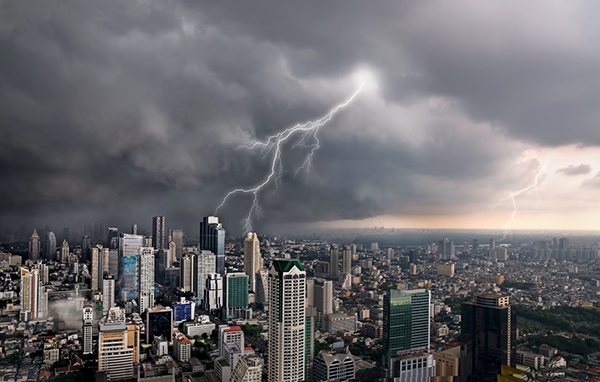
Underestimating the physical risks to real estate assets due to severe climate events can be very costly.
Sometimes developers, insurance companies and communities need to work together to develop mitigation strategies, write architects Michael Padavic and Dan Sokolosky.
Developers can also factor in the resiliency efforts made by those cities that are investing in infrastructure redundancy systems for power and water, McKinsey says, and determine which have enacted policy changes to reduce vulnerabilities. These can all be part of decision-making considerations concerning future locations.
Padavic and Sokolosky also recommend resilient design strategies that might include, for example, implementing flood management tactics, even for areas outside traditional floodplains. Design and material selection should consider roofs than can better resist wind, hail and increased snow loads.
“Building resilient communities is not just about preparing for worst-case scenarios,” they write. “It’s an opportunity for innovative builders and developers to differentiate themselves in a competitive market before it becomes the norm.”
John Bleasby is a freelance writer. Send comments and Climate and Construction column ideas to [email protected].