Canadian environmental advocate David Suzuki knows how to get a headline when it comes to climate action. His current frustration with the lack of conviction at the national level was clearly evident in an exclusive interview with iPolitics.
“We have failed to shift the narrative and we are still caught up in the same legal, economic and political systems. I’m not giving up in the sense of not doing anything. For me, what we’ve got to do now is hunker down.”
Top-down leadership regarding environment protection and the reduction of carbons associated with human activities including construction may be faltering in the United States and Canada. As Suzuki puts it, “Trump’s election was the dagger in my heart.”
Moving forward, he believes, “the units of survival are going to be local communities.”
This is evident in various parts of the United States and Canada. Lower level jurisdictions have championed energy efficiency at all phases of construction for some time and are continuing their efforts towards better buildings for the future in the absence of federal follow-through. Many are being guided by Passivhaus standards, widely regarded as the gold standard certification for the operational energy efficiency and interior comfort of buildings.
Just over the Canadian border, the New York State Energy Research and Development Authority (NYSERDA) developed the annual Buildings of Excellence Competition (BOE) back in 2019. This recognizes and rewards the design, construction and operation of resilient, climate-friendly multifamily buildings that are healthier for residents and their communities. Over its past five rounds, $83 million in BOE monetary awards have been distributed.
In its latest annual round of competition announced last month, the NYSERDA awarded nearly $7million to nine recent projects. Six are slated for construction in New York City. All nine BOE award winners are multi-family projects designed to serve low-to–moderate-income or disadvantaged communities. Each is committed to Passivhaus certification and will be zero emissions and carbon neutral ready, meaning they will be highly efficient with no use of fossil fuel combustion onsite for daily operations.
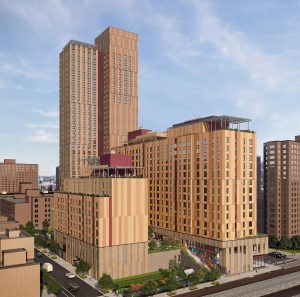
The 709-unit Sendero Verde complex in Harlem, completed in April 2024, is the largest Passivhaus-certified multi-family residence in the United States.
New York City is already home to the largest Passivhaus-certified multi-family residence in the United States, the 709-unit Sendero Verde complex in Harlem completed in April 2024.
Outside of New York State, the largest Passivhaus-certified residential building in the United States is the 276-unit Second + Delaware apartment building in Denver, Colo. Passivhaus standards have even arrived in Missouri, with a 330,000-square-foot development that spans an entire city block.
The State of Massachusetts now mandates new multi-unit residential buildings over 12,000 square feet must meet Passivhaus levels of energy efficiency in those municipalities that have opted into the state’s new three-tiered energy code. To date, 55 Massachusetts communities, including the City of Boston, have already adopted the “specialized” tier of the state’s building energy code. Energy efficiency requirements are also increasing in New York State and Pennsylvania.
While various green building and energy efficiency standards proliferate across Canada, no province has gone as far as Massachusetts by fully adopting Passivhaus standards into their building code. British Columbia’s Energy Step Code comes close by aligning somewhat with Passivhaus principles. Toronto and Vancouver have also shown energy efficiency leadership at the municipal level. The Town of Caledon, a smaller municipality north of Toronto, has implemented a one-year green development standards pilot.
National leadership, bolstered by provincial regulations, would be the preferred route in order to develop a level of consistency across the country, something that Passive House Canada advocates. It points out while the federal government, “provides support for provinces, territories and municipalities to implement their own regulations,” it questions whether the federal government will “step in to force them to meet” Canada’s international climate obligations.
Referencing Suzuki’s lament about the disappointing direction of top-level climate change initiatives, Passive House Canada CEO Michael Quast writes, “If ‘hunkering down’ becomes part of our future, let’s ensure people can do so in comfort, safety and dignity — not in stifling apartments or freezing homes. Let’s build homes, schools and workplaces that remain stable and resilient, no matter what comes.”
John Bleasby is a freelance writer. Send comments and Climate and Construction column ideas to [email protected].