Dicke Hall, a new mass timber (MT) addition to the Business and Humanities District of Trinity University in San Antonio, Texas that opened in late September 2022, is being celebrated for its acknowledgement of the university’s past, present and future.
Lake Flato Architects led the Dicke Hall design team, resulting in what was San Antonio’s first Cross-Laminated Timber (CLT) structure. As a result of the success of the project, Dicke Hall was named one of nine winning projects in the 2025 Wood in Architecture Awards recognized for design excellence, inventive wood use, sustainability and broader market impact.
The university asked that Dicke Hall’s design visually complement and blend with two existing faculty buildings, also under renovation by Flato. Like over 30 other buildings and structures across the Trinity campus, these were designed by renowned mid-century Texas modernist architect O’Neil Ford back in the 1960s.
Ford believed architecture should blend seamlessly with their environment and become an integral part of the landscape rather than dominating it. This philosophy led him to practice sustainability long before the term was known and became fashionable.
Interestingly, the founders of Lake Flato had first met as young architects while working in Ford’s office. In accepting the Dicke Hall commission, they recognized Trinity University’s wish to maintain its design heritage as well as offering their own tribute to Ford’s leadership.

“Our goal was never to replicate what O’Neil Ford had done decades ago with Halsell Center and Chapman Center, the two buildings we renovated,” Lake Flato partner Ryan Jones told Architectural Record magazine. “Instead, we tried to tap into the underlying ethos and ask ourselves, how would O’Neil have tackled this project were he alive today?”
The Lake Flato design team imagined Ford would have chosen MT for Dicke Hall.
The designers also wished to meet the university’s sustainability goals for the future.
Ford was an early adopter of passive design strategies. His clean-lined buildings were oriented to modulate heat gain and capture predominant summer breezes, with glass vertical surfaces shaded by deep overhangs.
“We wanted to honor the legacy of Trinity University’s campus while meeting their goals for responsible, sustainable design. Mass timber allowed us to do both,” said Jones.
Trinity outlined their functional needs to the architects as well.
As Lake Flato explains, the university wanted Dicke Hall to contain, “highly adaptable spaces such as a lecture auditorium, classrooms, film screening room, and common spaces where technology, furniture, and environmental controls work in unison.”
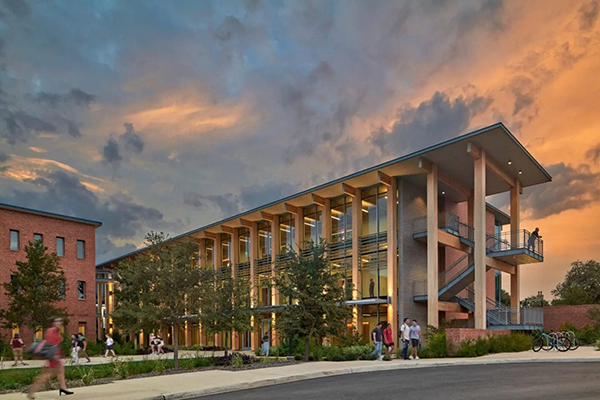
As described by Architectural Record, the result are various spatial typologies, including a raked auditorium and screening room, stepped activity-based learning classrooms, highly flexible flat floor active classrooms, student support labs and seminar rooms.
Intimate, informal and transformable spaces are created with mobile furniture on wheels. Symposium rooms enclosed in clear glass, combined with the building’s long glazed façade, allow daylight to reach deep into the interior. Open balconies overlook the three-storey circulation-and-commons interior zone.
Glulam columns made from naturally-durable Alaska yellow cedar flank the exterior, while inside, Douglas Fir glulam beams and columns support CLT floor and ceiling panels. The interior walls, including structural shear walls and elevator shafts, were also created with five-ply CLT, and left exposed to reveal both their beauty and strength.
Another innovation is Dicke Hall’s raised floor system. Electrical and mechanical systems such as ventilation are hidden by five-ply CLT floor panels covered with two inches of lightweight concrete, an acoustical mat and then topped by an eight-inch-deep plenum. Only overhead sprinklers and lighting are left exposed.
The initial cost of using MT was first estimated to be 13.5 per cent higher than steel. However, savings that brought costs down to within 1.0 per cent were achieved through lower interior finish costs, a less expensive foundation due to the lighter weight of the MT and faster assembly time.
Dicke Hall’s view towards the future begins with the carbon reduction realized with MT. Lake Flato says the carbon sequestered by Dicke Hall’s MT structure is equivalent to 374 acres of U.S. forest land for one year.
The three-storey Dicke Hall added nearly 35,000 square feet, or 36 per cent, to the Business and Humanities District’s space. However, Lake Flato says due to the structure’s tight building envelope and rooftop solar array, campus energy demand increased by only 0.4 per cent, 90 per cent less energy than a similarly sized concrete and steel building.
Dicke Hall connects to the two buildings also renovated by Lake Flato through a new courtyard that offers collaborative meetings areas. Lake Flato says the landscape design incorporates all-native plants and drought-tolerant grasses that are well-adapted to the Texas climate, along with permeable pavers and other “water-wise landscaping”.
Commenting on the project’s various achievements, John Scherding, former university architect and director of sustainability at Trinity University said, that Dicke Hall, “pays homage to the historic legacy of Trinity architecture while embracing the need for environmentally responsive design and does so like no building I have seen before…a building that is a perfect complement and addition to the Trinity campus.”