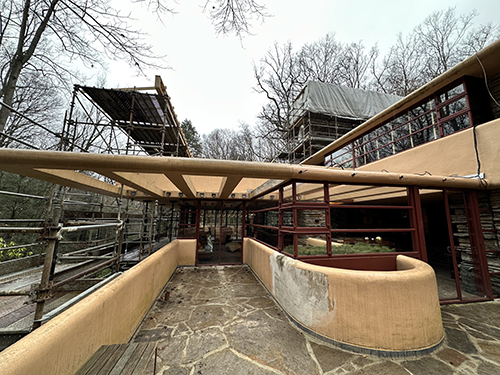
Often considered Frank Lloyd Wright’s crowning achievement, Fallingwater is undergoing a $7 million restoration to ensure the famous house built over a waterfall and nestled in the Bear Run Nature Reserve in Pennsylvania 89 years ago will be watertight for decades to come.
Expected to be completed next year, it is a comprehensive preservation project by the Western Pennsylvania Conservancy (WPC), Fallingwater’s steward since 1963, on the entire envelope of the building.
Like some Frank Lloyd Wright houses and other houses designed with modern innovations, Fallingwater has experienced various water and moisture leaks.


“Wright was pushing boundaries of traditional construction and materiality,” says Justin Gunther, director of Fallingwater.
“That inherently creates issues with waterproofing.”
Water issues can partly be attributed to the microclimate created by the waterfall, but Wright’s innovative design and the age of the home are also factors. The house has a series of flat roofs and cantilevered terraces that can be a source for water penetration over time.
But there are other points of entry.
“One of the interesting challenges is water coming in through the sides (walls),” says Gunther.
The problem is notable at load-bearing sandstone walls where the stone makes up interior walls as well, often resulting in a cavity between the walls.
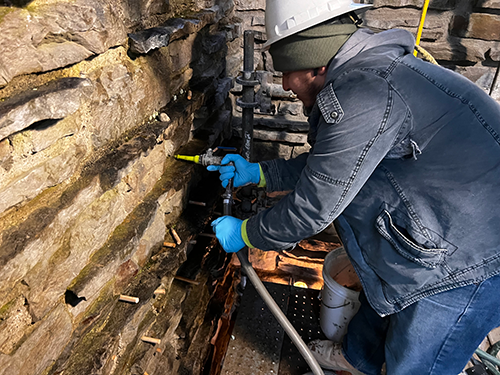
To stop water from seeping through hairline cracks and mortar joints into those cavities and then into the house, the project team has turned to a waterproofing solution employed by engineers sometimes to stop moisture incursion in stone bridges: injecting grout to fill the cavities or voids in the stone or concrete.
At Fallingwater up to 12 tons of grout is being injected through mortar joints to “flow like water, filling the cavities of the stone walls to create solid masonry units,” says Gunther.
The process is devised by the project’s chief consultants Architectural Preservation Studios of New York City and consulting engineer John Matteo, principal of Virginia-based Matteo Ferran Structural Engineers PLLC.
Other work includes repairs to deteriorating reinforced concrete on some of the parapets, extensive re-flashing, remediation of the rust built up on steel and window door frames and replacement of rooftop waterproofing systems.
The “particularly intensive work” required to replace the roofing system on the terrace adjacent to the bedroom of Liliane Kaufmann, who lived in the house with husband Edgar, will be done this winter when the house is closed to the public. It will be performed under a heated enclosure to ensure the workability and curing of materials.
Gunther, who explains it is not easy finding contractors that can meet the historic restoration standards for the work at Fallingwater, says a selective process was “heavily bid by multiple contractors.”
The conservancy turned to contractors with previous experience at the house, including Allegheny Roofing & Sheet Metal Co. Inc. near Pittsburgh; Maryland’s Masonry Solutions International, grouting; and Graciano Masonry of Pittsburgh.
Gunther says over the span of decades the conservancy has resorted to simpler solutions to stop leaks such as patch jobs but even they at times “have been a huge undertaking.”
As an example, halting a leak into the living room from the rooftop terrace above can prove an involved process of flagstone removal on the terrace just to find the leak.
Sometimes staff has turned to an easier but temporary solution: catching water drips with buckets in the house, he says.
Part of the project’s funding is through private donations but Fallingwater has also received help through a state grant.
Gunther says the project started with a $3 million budget in 2019 but was put on hold through the pandemic.
“Post-pandemic we had to rebid everything and the budget jumped to $5.5 million and inflationary pressures, everything happening in the world, pushed it up to $7 million.”
The WPC is working with local preservation firm Case Technologies to laser scan the house for a precise digital record, helpful for any future preservation efforts.
“It’s another way of using technology to ensure preservation,” says Gunther, who has been Fallingwater’s director since 2018 and was previously the home’s curator.