
How dramatically can light impact art? Lutron recently showcased the way illumination can alter perception with a special collaboration with Brooklyn artist Dustin Yellin.
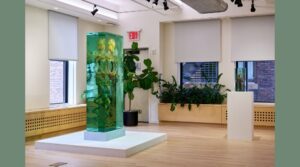
“Prisms of Light,” an exhibition in Lutron’s Global Experience Center in New York that closes today, highlights four of Yellin’s pieces from his Psychogeographies and Cave Painting series.
The Lutron showroom, which opened in 2019 on 28th street, is “a white box for light,” allowing visitors to experience different color temperatures and light intensities with the touch of a button, said Cecilia Ramos, senior director, architectural market, at Lutron. It also allows the company the opportunity for artist collaborations such as this one to show how light can impact art.

Yellin became aware of Lutron during Covid, when he saw how “fabulous” one of his pieces looked in a client’s home, which was lit with Lutron’s Ketra lighting system. He then had a Ketra system installed in his own studio.
People typically install the Ketra system because they want natural light indoors, Ramos said, as the system can automatically change the indoor light to mimic the outdoors. People also want the ability change the light to match the activity, such as cooking, doing homework or relaxing, as well as to fine tune how artwork is lit.

While Yellin works across mediums, he is known for creating visually complex, three-dimensional collages with stacked sheets of laminated glass, three of which were in the exhibit: God Shaped Hole (2024) and The Willow Next Door (2024) – both of which weighed 2,000 pounds and required a special support platform – as well as the smaller Kykeon Drift (Study for Psychogeography, 2024). In addition, Yellin’s painting Werner’s Crater (2025) was also displayed.
Related: How light and dynamic imagery are reshaping wellness design
In a press tour this week, Ramos toggled between different color temperatures to show how each piece changed. “One of the things we discovered in this collaboration was the idea that light can shift perceptions of reality,” she said; light with a pink hue, for example, can result in faded greens in artwork.
“We’re always learning from others of how these tools can be used,” she said. “Giving the power to the artist or the homeowner, to shape their space as they wish – we might have our ideas – but we have to make it easy and intuitive for them to shape their environments.”