NEW YORK — After a spring market mired in tariff worries and deliberations, the fall edition of the New York Tabletop Show held last week was more product-focused.
Tariffs are still part of wholesale-retail discussions and have become woven into the fabric of new tabletop presentations. A few manufacturers noted the new factories they are working with outside of Asia, which has been a mainstay for tabletop production for nearly two decades. Others have tweaked their go-to-market strategies or have widened assortments using different finishing techniques to meet different price points.
“Things have settled down into a new normal,” said David Nicklin, senior vice president of marketing and licensing for Gibson Homewares. “We’re still figuring out that new normal.”
“In April, the sky was falling,” said Bill Robedee, president of Portmeirion Group USA, whose brands include Spode, Portmeirion, Royal Worcester and Nambé. “A lot of the gloom and doom didn’t materialize. We’re upbeat and confident. Let’s hope we’ve hit the new normal and things stay predictable.”
Michael Close, senior vice president of sales for Portmeirion Group, said he had a decent number of retail appointments, and on the opening day of the show was looking forward to a positive week. “Everyone’s here, everyone’s coming,” he said.

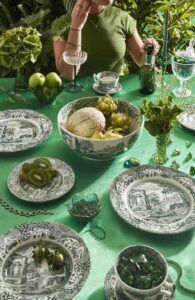
“Business is challenging but we’re finding our way,” he added. “We’re keeping our brand positioning in the right place for the long-term. We have a lot of stories to tell and are headed in the right direction.” The company — which introduced Green Italian dinnerware in Spode, BG Sketchbook for Portmeirion’s Botanic Garden franchise, and a new bread-baking collection in Nambé — is focusing on craftsmanship and design, and as previously reported, its return to English manufacturing for Spode.
It’s been a mixed year for Gibson, according to Nicklin. The company has maintained a healthy inventory and has been able to fill gaps at retail with pre-tariff pricing, he said. But now, in the world of price adjustments, it is testing the waters.
“The days of creating a whole line of product in a vacuum are gone,” he said. “We work directly with key retailers to create relevant programs they will support.
“Going out and speculating is not where this market is going,” he added.
Product focus
Retailers are concentrating on product details once again, according to David Mackrell, president of tabletop at Lifetime Brands. “It’s back to ‘What’s trending? What’s selling? and Where do you see the market going?” he said.
Newness is driving Lifetime’s business, according to Mackrell. The company has doubled down on product development, diversified its sourcing over the past few years (to Colombia, Turkey and Pakistan, among other countries) and is widening some of its product lineups to appeal to Gen Z, the leading edge of which has started to live on their own.
Lifetime launched Four Sixes, a new licensed cross-category lifestyle collection with Western and cowboy themes. In Pfaltzgraff, it highlighted its evolution in pad printing. The technique mimics a reactive glaze on ceramics but gets much more consistent results and is thus more cost-effective than reactive glazes, according to Mackrell. Reactive glazes remain a signature of the Mikasa brand, however, as does bone china. In fact, Mikasa debuted a reactive glaze on bone china; it pairs the lightness and durability of bone with the surface variation and interest of a glazed ceramic design.

“I think it will be appreciated buy the customer who appreciates bone china,” said Mackrell.
Zrike Brands’ forte is licensing. At this market, it featured Winnie the Pooh figural ceramics. Pooh is now 100 years old and is thus having a moment. “That tends to propel things,” said President David Zrike. Also, “in these times, Winnie the Pooh is comforting.”

Zrike also introduced its new Laura Ashley licensed collection of dinnerware, glassware and hydration products. Eight floral patterns from the iconic brand are featured, and they tap into the grandmillennial trend, according to Zrike. The company, which has long worked in China as well as Portugal, has re-engaged with a factory in Colombia, Loceria Colombiana, which can now produce 2.4 million plates per month, Zrike said. Transit time from Colombia to the U.S. is 7 to 10 days, and the duties are 10%. A larger assortment of products made in partnership with this factory will debut at the housewares show in the spring, Zrike said.
Noritake also featured a new license, with the Frank Lloyd Wright Foundation. Imperial Cabaret dinnerware, in either a multicolor or a blue and white colorway, is based on the designs that Wright created for the Imperial Hotel he designed in Japan that opened in 1923. Noritake made the original tableware for the hotel, and it has been a continuous license for the company in Japan for 100 years. Now, it debuts in the United States. It will be a core opportunity for Noritake USA in 2026, noted Jay Fingert, senior vice president.
In addition to Imperial Blue Cabaret, there is March Balloons, another design from Wright, and Imperial Peacock, a premium porcelain, tone-on-tone collection featuring patterns deconstructed from Wright’s artwork.

Elsewhere, Kosta Boda reintroduced a candleholder design from 1974 called Sunflower that is made from repurposed glass; new colors for Berry Tales vases; and Meadow, a series of glass vases loosely based on the four seasons. Orrefors introduced a stemware line with a Swedish chef, in handmade and machine-made versions. Riedel introduced the All American Bourbon Glass that comes in a set of two for $85.
Fortessa highlighted Estiva, a ribbed everyday glassware collection in amber, clear and palm green, and a new stackable glassware collection. It is tracking the rising popularity of mocktails and juice shots, which, Debbie Parker, director of merchandising, noted, require the same glassware and barware tools as alcoholic drinks. The company also introduced two placemat collections, one made from PET felt (from recycled water bottles) and one made from recycled leather. It is a new category for the company.

Villeroy & Boch introduced Fleur, a dinnerware collection with a mod daisy-like design in several colors. Over & Back added new shapes to its stackable ceramic dinnerware line. Costa Nova added a terra cotta colorway to its Pacifica collection and introduced Siovina, a sculptural leaf design in pumpkin and off-white colorways. Bordallo Pinheiro added a pink colorway to its popular Cabbage dinnerware line.
Lenox put its Studio 1414 collection of whiteware from the April market front and center; it will available beginning in November through January. Most of the company’s newness was in Oneida dinnerware, which included the bulbous-shaped Quirk, Aweigh We Go sea-themed melamine and Botanica, a pencil-sketch floral design with a mint colorway. The company’s biggest newness, as reported last week, is its new CEO, Michael Pacharis, who said he is eager to build on the strong brand heritage of the company through new product development.