Michal Woch, managing director at Vzor, left; Monika Boruch, Key Account Manager at 366 Concept
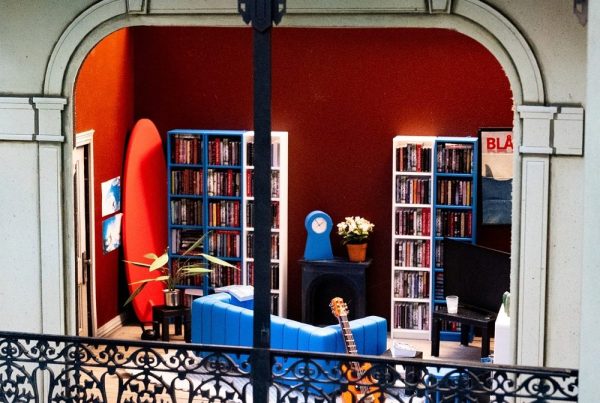
WARSAW, Poland — In a quaint historic building in the heart of Warsaw, a curated collection of iconic Polish furniture designs stands on display, creating an interior ambiance where furnishings made in Poland and the surrounding architecture meld into a cohesive aesthetic.
However, despite the historical visual cues, the setting is not that of a museum. Instead, it is a compact home furnishings store where retailers and consumers alike can purchase new furniture and décor with vintage Polish design roots from two brands, Vzor and 366 Concept.
“Vzor mostly focuses on the furniture designs that have never been put into serial production,” said Michal Woch, managing director at Vzor. “They have been known as a good, cutting-edge example of mid-century design; however, they have never been produced on a mass scale.”
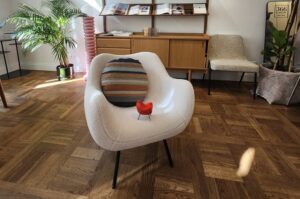
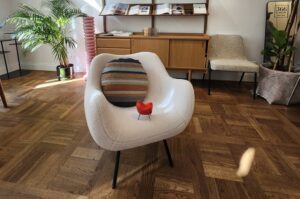
Woch points to Vzor’s best-selling piece as an example of the brand’s design ethos. A chair originally designed in 1958 by Roman Modzelewski, the original included prototypes that were an experimentation with fiberglass. At the time, Modzelewski was working with Le Corbusier, who wanted to produce it in France, but the eastern European authorities weren’t supportive of a partnership, and the chair was never produced on a large scale.
“In the case of Vzor designs that we focus on, very often the materials or the shape of the design was, let’s say, too advanced in terms of the technology that would be used to put it into production,” Woch said. “At that time, fiberglass was very advanced material and in eastern bloc countries, it was seen as a material for military use, very modern, synthetic, so socialist authorities would not see it as a material to be used for furniture making.”
Bringing the material heritage and the pieces produced only for a brief time to the mainstream market has elevated the brand in Poland and beyond. Currently, some of the product line is sold at the Museum of Modern Art (MoMA) in New York, and the goal is to continue the upward trajectory of growth.
“We see it as our duty to try to guarantee the proper place for these designers and their products,” said Woch. “So, they become known by the wider public, not only on the Polish market, but also internationally.”
In European markets where Vzor has not developed a dealership framework yet, 366 Concept represents the product line. Additionally, 366 Concept adds a contemporary twist to traditional designs, creating reinterpreted Polish classics to align with modern living and workspaces.
“We’re about 13 years old, both companies,” said Monika Boruch, key account manager at 366 Concept. “We started at the same time, and both represent one of the trends in Polish furniture design, which is a revival of old-time, mid-century design.
“366 started with the furniture that was designed in the 1950s, but we focus on the furniture that has already been manufactured on a mass scale in Poland only, pieces that kind of live in the Polish consciousness. Everybody has a grandma or some relative who has one of these pieces in their spaces.”
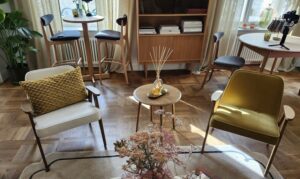
Like the U.S. consumer marketplace, Boruch said that some people purchase the originals and reupholster them. 366 Concept takes it a step further, using exclusive rights to produce the designs with modern materials, proportions and livability.
“We buy the exclusives, so we buy the rights, modify them and produce them,” said Boruch. “So, for example, the 366 armchair, that’s our first model and where the name of the company is coming from, a classic of Polish design recreated into a future piece.”
Some of the product adjustments include building for taller consumers and updating fabric options to align with current trends. Along with the 366 armchair, the 290 dining chair is a perennial favorite with consumers, and Boruch explained that the company focuses on adding value to the original designs with all the pieces it produces.
Consumer profiles for each brand highlight unique perspectives and opportunities, according to Boruch. For 366 Concept, buyers often include younger to middle-aged consumers — those in their 30s and 40s — who appreciate mid-century aesthetics without the accompanying memories of socialism that some older Poles might feel. Internationally, the draw is authenticity — design-savvy buyers in the U.S., Germany, Ireland and Asia see 366 Concept as a chance to own a timeless original without the high costs or discomfort of restoring vintage pieces, Boruch noted.
Vzor attracts a slightly different demographic. Its customers often include older design enthusiasts — those in their 60s and 70s — who see these rediscovered prototypes as proof that their country produced world-class design. Abroad, Vzor appeals to collectors, architects and institutions seeking iconic, museum-worthy pieces, and in markets such as China — where a growing middle class desires authentic European goods — Vzor’s pricing provides an accessible entry point into the world of European design, according to the pair.
“One of the key things we focus on is serial production,” said Woch. “There are plenty of furniture prototypes that look quite nice but are so difficult to manufacture on a large scale. We don’t want to offer gallery, high-end, handmade furniture only for the wealthy and people who invest in furniture and art. We want to offer furniture of good quality and good design with a nice story behind it.”