Tourism is important to the economic development of Texas.
The revenue associated with hotel accommodation, meals, drinks and other social activities is measured in the billions of dollars each year.
This explains why three of the state’s largest cities, Austin, Houston and Dallas, have committed significantly to the expansion or even replacement of their convention center facilities.
In 2024, Austin City Council awarded $1.6 billion in contracts for pre-construction and construction of a new facility, scheduled to open in time for the 2029 spring festival season.
The new Austin Convention Center (ACC) design is a joint venture of LMN Architects and Page Southerland Page. Construction over the next four years is another joint venture involving JE Dunn Construction and Turner Construction.
The current ACC was closed in April and largely demolished by June to make way for the larger facility. Although some demolition work remained in September, construction of diaphragm walls, or D-walls, was underway, marking one of the first steps required for vertical construction.
On Sept. 25, Austin City Council approved site plans creating development regulations that move the project into the second phase of installing permanent utility connections and undertaking further construction work involving infrastructure upgrades and street improvements.
When complete, the new ACC is expected to have 620,000 square feet of rentable space, about 70 per cent more than the current facility’s capacity. Public art, open-air terraces and plazas will combine with large windows and increased interior-exterior connections to maximize natural light.
In the interim, Austin tourism officials will deal with the absence of a main convention center by using a network of smaller event spaces.
However, it’s worth the wait. Mayor Kirk Watson is convinced the new ACC is a “sure-fire way” to boost the city’s tourism, hotel, restaurant and retail industries. Projections suggest it could boost Austin’s overall annual economic impact by $285 million and support over 1,600 additional jobs, while providing nearly $13 million in additional annual tax revenue to the city.
Over in Dallas, the $3.7-billion facility expansion of the Kay Bailey Hutchison Convention Center broke ground in 2024. A joint venture led by AECOM Hunt and Turner Construction was named to undertake the first of seven phases that encompass the overall development.

These also include renovations to other facilities such as the Dallas Memorial Arena and The Black Academy of Arts and Letters. When complete in 2029, the expanded convention venue will add more than to million square feet and have a transformational impact on downtown Dallas. In the near term, the current facility is to serve as the International Broadcast Center for the 2026 FIFA men’s soccer World Cup.
Meanwhile, the City of Houston plans to break ground this December on the first $140 million phase of a new 700,000-square-foot convention facility to complement the George R. Brown Convention Center. Completion is expected by mid-2028.
The overall larger convention center expansion project is scheduled to be built in several phases over the next decade and ultimately cost $2 billion. A second convention center building is to be designed by Missouri-based Populous. Rhode Island-based Gilbane and Oklahoma-based Flintco will serve as construction managers, with Jacobs Advance Planning Group named as the landscape architect. It will ultimately offer about 690,000 square feet of ballrooms, exhibit halls, meeting rooms and associated public spaces.
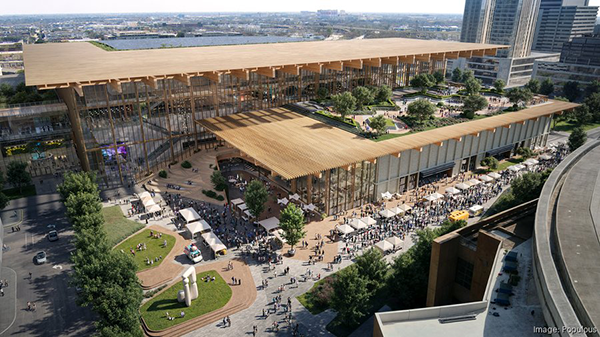
According to studies commissioned by Houston First, the convention center expansion will result in an annual addition of more than 337,000 group hotel room nights in the central business district, and could increase “citywide equivalent” meetings and conventions by 62 per cent. It is also projected to drive $20.6 billion in other new investments over the next three decades, potentially including a new 800-room hotel.
“Nobody’s taxes are being raised,” said Houston First president and CEO Michael Heckman, commenting on the financing behind the project. That’s because the City of Houston, like Austin and Dallas, are positioned to benefit from Texas’ tourism-related infrastructure financing environment.
State and local governments have committed as much as $7.8 billion toward the expansion and modernization of convention centers, with an additional $900 million under consideration. Much of this flows from Hotel Occupancy Taxes (HOT) and Project Financing Zones (PFZ), an innovative funding program unique to Texas.
Cities and counties in Texas may levy a general HOT of up to seven per cent on any one of nine statutorily authorized categories like conventions, and may add special HOTs for other eligible projects.
The PFZ funds for the Dallas and Houston convention centers flow from a mix of state hotel occupancy, sales and use taxes, and the state’s mixed beverage taxes collected from eligible businesses within a three-mile radius of a qualified project.
In Dallas’ case, revenue bonds, backed by pledged revenues from the local HOT and PFZ funds, are expected to generate approximately 67 per cent of the required convention center expansion funding. Houston’s $2 billion convention center project is similarly drawing on PFZ funds. According to its media release, costs for the redevelopment and expansion of the Austin Convention Center will be funded both by HOT and Austin Convention Center revenues.
Texas is never happy when it doesn’t hold a first place standing. Although currently behind Las Vegas, Chicago and Orlando in national convention rankings, Austin, Houston and Dallas are on a path to challenge that.