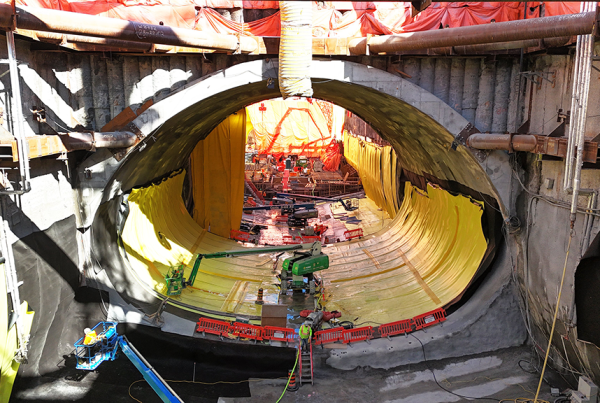
The question, “Will that be one staircase or two?” remains a point of discussion surrounding multi-unit residential buildings across Canada and much of the United States. While taller developments are seen as one answer to Canada’s housing shortage, the layout of units on each floor is haunted by the matter of egress staircases.
Under the current National Building Code (NBC), new apartment buildings over two storeys must have two staircases. An exception in the code does exist, however, allowing for single-stair designs in buildings up to three storeys (under Part 9 or six storeys under Part 3 of the NBC) if the occupant load is limited and the building meets specific safety measures like sprinkler systems.
The main argument in favour of two staircases in taller residential buildings is founded on the long-standing perception that two-is-safer-than-one when fire forces an evacuation.
1/2
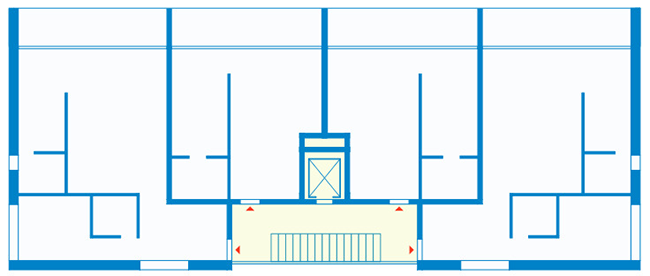
LARCH LAB — This suggested “Point Access Block” floorplan offers a 93 per cent efficient floorplate.

2/2
LARCH LAB — The two staircase design results in narrow apartments and a “bowling alley” hallway.
To address this, the National Fire Protection Association hosted an international symposium in September 2024 that specifically focused on the single exit stair issue for buildings as tall as six storeys.
Symposium attendees from the United States, Canada, the United Kingdom and Australia identified a number of longstanding concerns.
The objective of the symposium was to ensure robust technical debate to properly consider the latest research, current practices and use of the latest technologies.
“When this process is substituted by uninformed legislative action, special interests, or misguided local policy decisions, there is a great risk to the protection and safety of people and property.”
Some of the main issues discussed involved the matter of how single exit stairs might become susceptible to a single point of failure, how a single exit stair might impact on the operational capabilities of emergency responders and possible conflicts when occupants are egressing while first responders are trying to ingress.
A Canadian perspective was presented by Michael Lewis, the New Brunswick director at the Office of the Fire Marshal, Justice and Public Safety.
Lewis emphasized, “important considerations are ingress by the fire department in the event manual suppression is needed, housekeeping and maintenance.”
He also noted, “current fire trends threaten some of the assumptions held about egress and appear to rely on human factors over engineered solutions.”
Chief Keven Lefebvre, chair of the codes committee for the Canadian Association of Fire Chiefs, reiterated the concern, “one way out is also one way in for first responders.”
At the same time, Lefebvre acknowledged the current political pressure in Canada to build more affordable housing on smaller lot sizes, not only to increase the country’s housing stock but to also increase densification in urban areas where people want to live.
In fact, smaller building lots are a reality across much of Europe where single staircases in taller residential buildings have been allowed in many countries.
There it has been argued multi-storey residential buildings would not be financially feasible on typical 50- foot-by-50-foot footprints if two staircases were required, due to unit layout restrictions.
Greg Rogers, chair of the International Association of Fire Chiefs’ Fire and Life Safety Section, said in an interview that due to code restrictions in most parts of the United States, a similar-sized urban lot would likely either remain vacant or perhaps have a two-unit townhouse or single-family home.
In Canada, the two-staircase requirement has resulted in residential buildings with hotel-style layouts with “bowling alley” hallway apartments.
A single central staircase would free up space to allow better unit layouts and improve cross ventilation, among other benefits.
Seattle-based architect Michael Eliason issued a 27-page report in 2021 for the City of Vancouver that explained the many benefits of “Point Access Blocks,” those being “compact single stair buildings with units centered around the stairway.”
Pressure to allow single staircases in taller buildings in Canada continues. However, only British Columbia has updated its building code to now allow single-stair apartment buildings up to six storeys.
Toronto’s Planning and Housing Committee has been considering a 2024 feasibility report to make it easier to construct buildings of up to four storeys using only one exit staircase as a means to trigger provincial or national code change.
In the U.S., Los Angeles is drafting an ordinance to permit single-stair multifamily buildings up to six storeys, while for decades Seattle and New York have allowed single stairways under strict fire protections without catastrophic outcomes.
Nevertheless, among his multiple fire safety concerns, Lefebvre questioned why single exit apartment buildings are being used as a “silver bullet” solution. He felt evacuation times could actually increase should the number of exits decrease.
Furthermore, he said the egress behaviour of occupants is complicated by age and mobility issues. At the same time, fires in exit areas can and do occur, he said, while also noting concerns over limited municipal resources and a resultant lack of firefighters.
These views conflict somewhat with a study conducted by Pew Charitable Trusts that suggests buildings built after 1999 are far safer than their predecessors. Deaths due to fire across the United States in 2023 were 1.2 per million residents in a modern building versus 7.7 in older buildings and 7.6 in single-family homes.
Unfortunately, the current one-or-two staircase standoff between fire chiefs and legislators is preventing the full harmonization of building codes, leaving efforts to build more efficient new housing units somewhat restricted.
John Bleasby is a freelance writer. Send comments and Climate and Construction column ideas to [email protected].