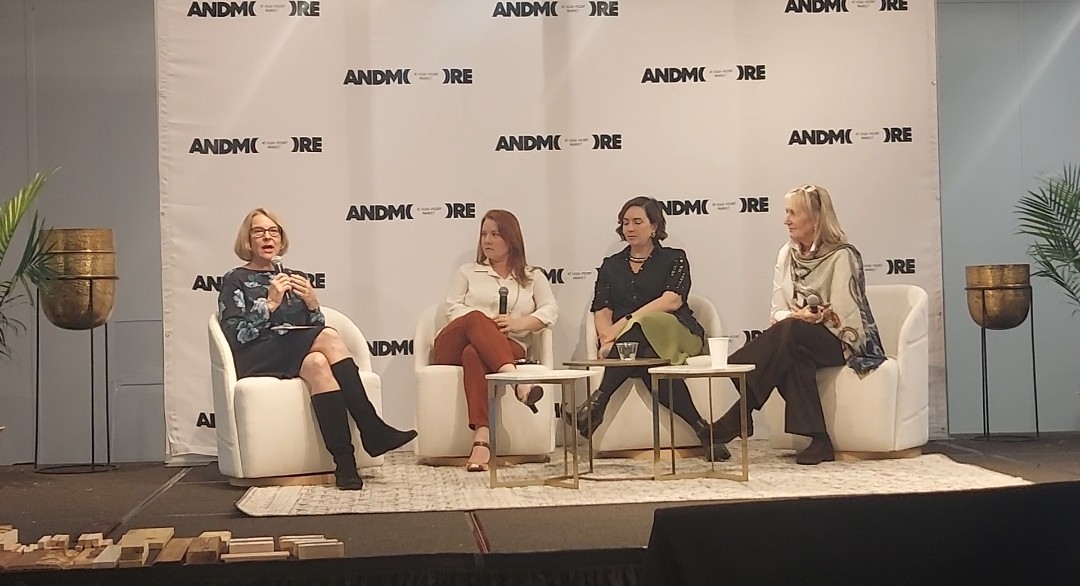
From l-to-r, moderator Allison Zisko and panelists Julia Reinert, Jaye Anna Mize and Linda Kafka.
A panel moderated by Home Accents Today editor-in-chief Allison Zisko during the recent High Point Market explored how elements like cultural memory, sensory details and personal stories are influencing modern design trends.
The panel consisted of lifestyle historian and brand strategist Julia Reinert, global trend forecaster and founder of Future Snoops, Jaye Anna Mize and Linda Kafka, founder of the NeuroDesign Academy and a pioneer in neuroaesthetics,
During the discussion, panel members unpacked how memory, emotion, and sensory experience have shaped the spaces we inhabit and why the past continues to feel so relevant.
Mize believes that nostalgia isn’t a single, shared experience anymore, it’s deeply personal.
“Baby Boomers’ nostalgia is rooted in a specific time and place,” she explained. “For Millennials and Gen Z, nostalgia is fragmented. It’s not about recreating the past; it’s about personalizing it.”
She described younger generations reinterpreting traditions through their own lens. For example, many crochet not to replicate their grandmother’s patterns, but to make a piece that feels uniquely theirs.
“It’s an evolution, not a revolution,” she said. “We’re all cycling through the same visual memories, but what matters now is how we make them our own.”
For her part, Kafka feels that nostalgia’s power is more than cultural. She believes it’s biological.
“When we walk into a space that feels good, the amygdala asks first: ‘Are we safe?’ Then the hippocampus starts storing memories,” she said. “That’s why a certain smell, color, or texture can transport us instantly.”
Kafka described this as “emotional anchoring”, objects that trigger dopamine, serotonin, and oxytocin, creating a sense of safety and joy.
“When people surround themselves with nostalgic or vintage items, they’re subconsciously grounding themselves,” she said.
Reinert believes that the modern craving for nostalgia is also a reaction to mass production.
“We’ve lost the richness of meaning,” Reinert said. “When people made furniture or clothing by hand, they made it with pride. You can feel that difference. Today’s products often lack a story.”
She sees a revival of that storytelling impulse among younger generations, especially through restoration and craft.
“There’s a surge of 30- and 40-somethings refinishing furniture, restoring antiques, or mixing an old mahogany table with modern chairs,” she said. “Brown wood is the poster child for nostalgia right now.”
Across the conversation, a common theme emerged. Namely, that nostalgia isn’t about clinging to the past. It’s about finding safety and identity in it.
“Your four walls are all you’ve got,” Reinert said. “People want to feel in control, warm, and connected. Design can give you that through the objects and stories you choose to live with.”
Kafka agreed, emphasizing that keeping sentimental objects isn’t clutter; it’s emotional continuity.
“A cat-shaped cookie jar, a framed recipe, a family heirloom, they all tell stories that remind us of who we are,” she said.
Even as technology reshapes design, through automation, AI, and touchless features, Mize said she believes the human instinct for nostalgia will endure.
“We’re merging tech-forward homes with heritage cues,” she said. “We crave both safety and innovation. That’s the evolution of design.”
Ultimately, the panel agreed that nostalgia is not regression but renewal, a bridge between where we’ve been and where we’re going.
As Reinert said, “Every object holds a story. When we bring those stories into our homes, we’re not just decorating, we’re grounding ourselves in meaning.”
For the panelists, in a world of endless newness, the past remains one of design’s most powerful tools for connection and for comfort.