The Moodyville area on the north shore of Vancouver Harbour has evolved from an industrial past to become a mix of older homes and new townhouses popular with families and young professionals. It’s a district that has attracted the specific attention of Vancouver-based Creo Developments.
Creo’s first Moodyville project was The Morrison, a 40-unit townhouse community completed in 2020, followed by the 63-unit Morrison on the Park in 2023.
Its third area development, scheduled for completion in 2027, is a 70-unit project called Morrison Walk. All three, including the Morrison Walk project, have been designed by SHAPE Architecture of Vancouver, a company known for its modern esthetic.
As Dwayne Smyth of SHAPE explains, “Morrison Walk’s architecture balances an active North Shore lifestyle with a warm and inviting park-like feel.”
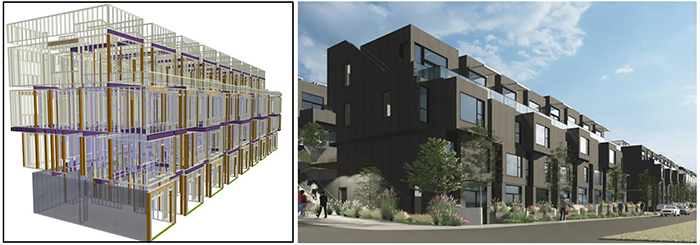
A beautifully landscaped central courtyard, two welcoming entrances and private walk-up front doors give Morrison Walk the feel of a true neighbourhood, one that is thoughtfully integrated into its surroundings. The project’s lean, modern lines and a warm, park-side presence combine with flexible, informal spaces that connect directly to Moodyville Park’s four hectares of green space, playgrounds, courts and viewpoint trails.
Prices for the two- and three-bedroom townhome units start at around $1.2 million, clearly not aimed at the affordable housing market.
However, it is Creo’s commitment to advanced digital modelling and precision modular fabrication for Morrison Walk, in collaboration with the NuFrame Group, that warrants attention. These design and construction processes demonstrate the multiple benefits of modular residential construction span all occupant income categories.
“Prefabrication with NuFrame gave us confidence in meeting our schedule for the build while maintaining quality,” Creo Developments CEO Harald Sinow told the Daily Commercial News. “We were also focused on reducing waste, minimizing the project’s environmental footprint and ensuring that the neighbouring community experienced minimal traffic and noise during construction.”
Efficiencies are being delivered in several ways.
Every component of Morrison Walk has been “designed virtually upfront” before manufacture, Sinow continued. That means, “Every piece of timber is measured and optimized to the exact centimetre. This cuts down the material waste common on traditional sites. Instead of framing by approximation onsite, the structure arrives ready to assemble with far fewer offcuts.”
Even at NuFrame’s manufacturing facility in Chilliwack, B.C., any small amounts of wood waste are sorted and recycled through “established industrial streams,” rather than ending up in mixed material construction bins.

NuFrame has invested heavily in CAD layout software and the latest prefabrication machinery. This includes automated plate marking machines, squaring tables, bridge nailers and panel saws as well as integrated equipment to compress walls before sheeting to reduce onsite settling and prevent drywall cracks in the future. The company annually produces 1,500 condominium units and 325 townhomes.
Working in a sheltered factory environment also improves safety, lighting, consistency and overall craftsmanship, NuFrame said.
“Those controlled conditions make it easier to maintain tolerances and reduce errors. By the time panels reach the site, they are already quality-checked.”
NuFrame also emphasizes what it terms the human dimension.
“Prefabrication shifts a sizable portion of the work into sheltered environments, improving conditions for trades talent. Better lighting, safety and consistency lead to higher-quality output and greater efficiency. It’s one of those rare adjustments that benefits both the bottom line and the workforce.”
That bottom line benefit is reflected in Creo’s estimation of onsite time reductions and increased efficiencies onsite during Morrison Walk’s assembly that could net daily savings of $10,000.
“Because so much of the work happens off site, there’s less traffic, fewer material deliveries and much less noise,” Creo told the Daily Commercial News.
For an infill site only a few steps from Moodyville Park this is important, shortening the most disruptive phase of construction and keeping activity contained.
Morrison Walk has been targeted to meet Tier 3 of B.C.’s Energy Step Code. This means units will be 20 per cent more energy efficient than the standard 2018 BC Building Code minimums and a significant performance improvement over the current application of Canada’s National Building Code requirements.
The Tier 3 targets will be achieved through insulation values of R22 in walls and R40 in ceilings, windows with U-values of 1.4, and a continuous air barrier that delivers air tightness less than 2.0 ACH50. In this way, Morrison Walk will share certain core principles of airtightness and insulation that approach Passivhaus standards.
Each Morrison Walk home will also include a Level 2 EV-ready parking stall. And because the community is registered under RBC’s Green Mortgage Program, Creo says buyers are eligible for multiple benefits such as a 35-year amortization option.
John Bleasby is a freelance writer. Send comments and Climate and Construction column ideas to [email protected].