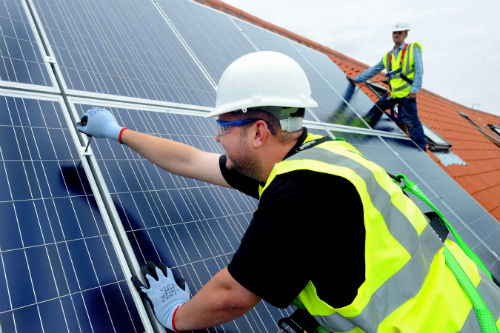
The Warm Homes Plan promises to invest £15bn of public money by 2030 to support the installation of domestic solar panels, heat pumps, batteries and insulation.
Low-income households will get free upgrade packages, with whatever technologies are most suitable for their homes.
Others will be offered government-backed, zero and low interest loans to install solar panels and a £7,500 grant for heat pumps.
New rules under the Future Homes Standard will also mean that all new homes – where practicable – will be fitted with rooftop solar panels. According to the Department for Energy Security & Net Zero (DESNEZ) , this will triple the number of homes with solar panels on their rooftops by 2030.
A new Warm Homes Agency is being set up, bring together existing functions from Ofgem and other government s bodies, to offer consumer support.
Prime minister Keir Starmer said: “Today’s plan marks a turning point. It will help to slash energy costs and lift up to a million people out of fuel poverty.”
Adam Scorer, chief executive at National Energy Action, said: “People struggling in fuel poverty desperately need the Warm Homes Plan. Cheaper energy costs, efficient heating systems and homes that keep the warmth in are all essential for the plan to succeed. There is a lot of work to be done, but today’s publication and commitment to lift a million households out of fuel poverty is a welcome, landmark occasion.”
Federation of Master Builders chief executive said: “The launch of the government’s long awaited Warm Homes Plan is a critical step forward. A £15bn programme to cut bills and upgrade homes, with the ambition to improve up to five million properties with energy efficient upgrades by 2030, is something which the FMB welcomes, but we must keep sight on the remaining 25 million UK homes that will still need upgrading at some point to make them fit for the future. While this intervention from government is needed, there must be incentives to get the industry moving, to make sure they are competent and skilled up to upgrade the majority of the UK’s homes.”
Berry continued: “Focusing on the now, the task will be delivery. The new Warm Homes Agency must get up and running quickly to coordinate programmes and consumer protections, with procurement routes that give SMEs a fair chance to win work. The creation of a new Workforce Taskforce is also an important step. If the plan is to succeed, the government must give industry a genuinely stable pipeline: multi-year funding, a clear timetable, and certainty over future standards and regulations. Consistency will be essential if small builders are to invest in skills.”
The GMB trades union – representing boilermakers originally but today a wide range of trades – is not at all impressed. The UK simply does not have the supply chain to deliver the plan, it pointed out.
GMB national secretary Andy Prendergast said: “This is exactly the kind of muddle-headed top down bureaucracy that gives the green transition a bad name. We will never hit net zero in the country if ministers don’t listen to the voices of the people who work in energy, keeping our lights on and our homes warm.
“Handing out massive heat pump subsidies to a sceptical public doesn’t work but the government seems hell bent on doubling down. The idea that we will deploy more than one and a half million heat pumps a year within a decade is a fantasy; we don’t have the supply chains, skills or public appetite.
“This is money that could have been spent decarbonising a popular, successful gas network. Instead we are throwing good money after bad to a public who don’t want what DESNEZ is selling.”
Got a story? Email [email protected]