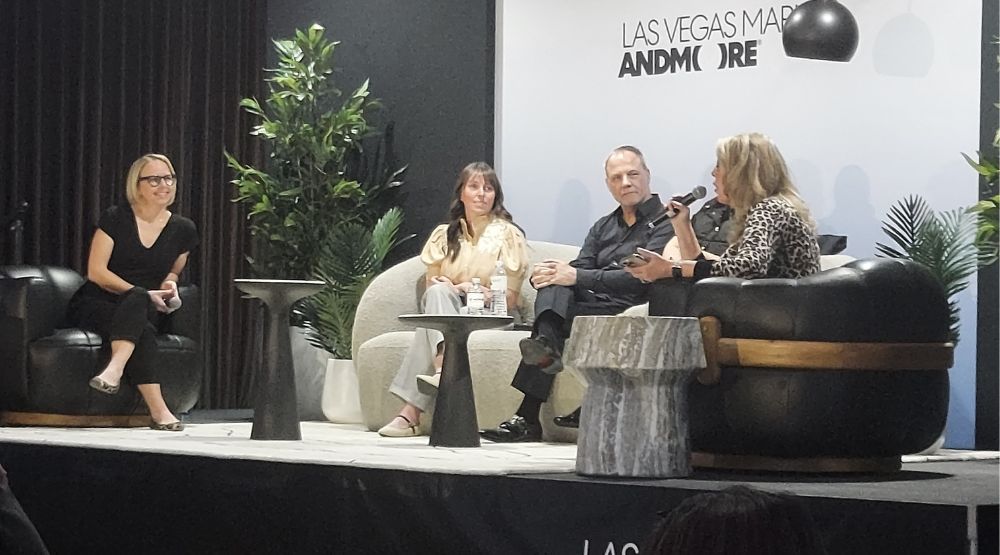
Panelists Jessica Nelson, Stephanie Lindsey, Christopher Grubb and Laurie Laizure. (Not pictured, Jeanne Chung)
When are interior designers using AI – and when are they avoiding it? Designers discussed how they are adopting the evolving technology in their businesses during a panel at the recent Las Vegas Market.
Panelists included Christopher Grubb, founder of the Beverly Hills, Calif.-based Arch-Interiors Design Group Inc.; Jeanne Chung, founder of design firm Cozy, Stylish, Chic based in Pasadena, Calif.; along with Jessica Nelson and Stephanie Lindsey, founders of Etch Design Group in Austin, Texas. It was moderated by the founder of the Interior Design Community, Laurie Laizure.
Automation, blogging and repetitive tasks
“AI has been a game changer for me,” said Laizure. “I want to spend time doing what I enjoy doing, which is actual design.” She incorporates AI automation to help her write blogs, according to rules she sets up and GEO (generative engine optimization) so that the blogs feature higher on AI search platforms. She also has AI create Instagram posts from the most-liked answers to the Interior Design Community‘s Question of the Day. “I’ve been able to produce seven blogs a week now, which is insane.”
Nelson added that AI is a time saver, able to do simple tasks for you, especially if you’re at the point that you are considering hiring someone to do them.
Related: Window coverings expo in Raleigh to offer CEU courses on AI and wellness
“I think it’s tremendous when it comes to anything on the back end of the business,” Nelson said. She works with business owners who want to start incorporating AI, so “the one question that I always ask any business owner and their team is: Where do you find the most time spent in repetitive tasks that you are doing over and over again? And if you are doing something repetitively more than 99% of the time, AI can fix that for you.”
But panelists also cautioned designers about using proprietary information, since many times it can’t be erased from ChatGPT.
According to Nelson and Lindsey, there are many AI tools out there that can help designers, especially with the beginning process of a project.
AI in early design stages and client analysis
“Designers don’t need creative help but do need tech help with updating the website and conducting a personality analysis on their client,” Nelson said. “ChatGPT can do this for you.”
Nelson added that, for example, if you have 10 Pinterest boards from a client, AI can boil those down to the points that stand out, the things that the client likes. “And you can use that to be able to create really good prompts.”
Concerns about authenticity and spec homogenization
Grubb said, however, he wasn’t as comfortable with using AI to create prompts.
“What makes me nervous about creating prompts, you start getting the same spec. So what is going to happen to manufacturers who are trying to get recognized?” he said. “That’s another flip side I see for the industry is that now we have the same specs over and over. But I like when AI takes a plan and gives me options that I can edit.”
Related: Pyxd debuts AI-based draping tech for custom upholstery
When it comes to having ChatGPT help with ideation, that wasn’t as popular with the panel.
It’s about authenticity, Grubb said. “I want all of my products to be authentic because why is someone going to hire me and pay me a percentage to design something that is not authentic? I also find that in product design it needs to be more conceptual and ChatGPT is so precise that it doesn’t work.”
Fact-checking, copywriting and AI ‘tells’
Jeanne Chung said it’s also important to use AI in a way that fits with your style.
“I know that everybody’s on video and everything but that’s not my personality. I do it my way,” Chung said. “I post the relevant pictures that I see on the Internet and my audience is loyal and they always come back to see what I’m seeing through my lens.”
Chung advised that if you are applying ChatGPT, it is important to remember to check all specs and live links since the technology can produce incorrect information. Conversely, Chung said that ChatGPT can also now detect inconsistencies in numbers, such as letting a designer know when the elevation in the room it created doesn’t measure up to the height of the actual room.
When it comes to writing copy, there are some signs that others can see when you use ChatGPT including an excessive use of em dashes, along with the overuse of the word ‘just,’ panelists said.
“You can set up prompts on ChatGPT to negate all those signs and reduce the amount of flowery language it uses,” Nelson said. “One way to really show you are using ChatGPT is when you say, ‘I hope this message finds you well.’ off the top.”
Emerging AI tools designers are exploring
In addition to well-known AI sites such as ChatGPT, Grok, Claude and Gemini, there is a specific program called FYXER which is better than Google standard, according to the panel, and can help with writing emails.
Other design-specific programs are Archsynth and Nana Banana Pro which can turn your image into a 3D image.
“Yes, clients expect to see things in a 3D mode now,” said Chung. “And you can even put the actual furniture [images] into the rendered image, which in turn makes the client’s expectations higher since it offers a realistic view of the room. It does make it easier to switch out the tables that the clients don’t like.”
While AI has its pros and cons, the panelists stressed that it’s important for people in the industry to jump in and try AI since it’s new and no one is perfect with ChatGPT at this point.