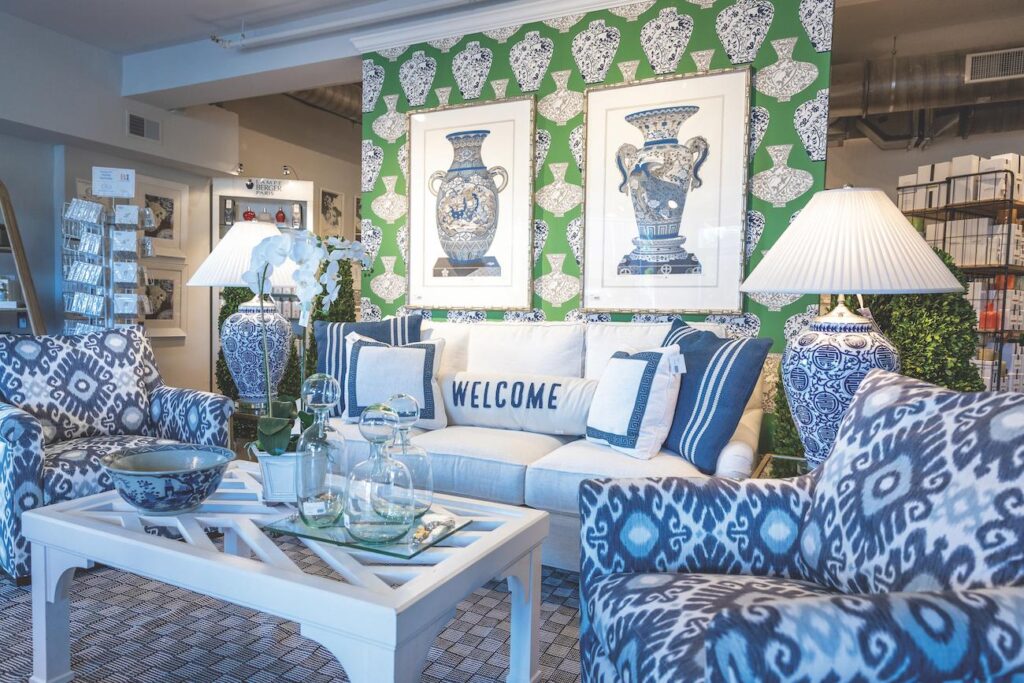
At a Glance:
- Jamie Merida owns Bountiful Home and Jamie Merida Interiors, based in Easton, Md.
- Bountiful Home won this year’s ARTS Award for Best Home Accents Store – East Region.
- Merida plans to introduce many new pieces in his Chelsea House furniture and home accents collection this year.
Jamie Merida is the driving force behind Jamie Merida Interiors and Bountiful Home, both based in Easton, Md. Founded in 2000, Jamie Merida Interiors has grown into one of the premier design firms in the Mid-Atlantic with a team of 30 professionals.
The designer also has a notable and long-standing collaboration with Chelsea House which includes a curated line of furniture, lighting and home accents. This year, he plans to introduce a large collection.
Bountiful Home recently received the ARTS Award for Best Home Accents Store – East Region, coinciding with its 25th anniversary. What did that moment mean to you personally?
I think it’s always nice to be recognized by our peers in the industry. It is actually the third time that we have won that award, which is a direct reflection of the quality of the team. We have grown to a team of 30 which includes designers, kitchen, bath, flooring and framing professionals as well as retail staff, marketing, a business manager and a logistics team.
Your design philosophy, traditional made modern, is rooted in your upbringing in Belgium and Kentucky. What specific memories or experiences from those places continue to shape your work today?
I grew up immersed in art, both of my parents were artists, and my father ran an art gallery in Louisville, Kentucky, for 30 years. Spending so much time in museums and galleries shaped my appreciation for classic design and led me to develop a “traditional made modern” aesthetic. In my product design work with Chelsea House, I gravitate toward traditional forms with a fresh perspective—especially classic English shapes reimagined with materials like raffia. That same approach carries into our Maryland store, which embraces color, layered styling, and visual richness rather than a neutral palette.
How do you define traditional made modern in today’s design landscape, where trends move faster than ever?
My “traditional made modern” aesthetic has become timeless in a way. Twenty-five years ago, we started off with heck of a lot of red and yellow, and blue and white toile. I can’t tell you how many red sofas we had, along with roosters and a country look. Although we have evolved away from that, there are elements that are still here. The shapes of sofas haven’t changed a lot, everything cycles back. For example, we have never left blue and white porcelain. But we have to stay on top of it.
I’m constantly looking in the marketplace because I never want to feel stuck. I’m fortunate, through Chelsea House, to travel abroad and visit the factories, as well as to attend Maison & Objet in Paris. My husband, Vincent and I also have a house in Normandy, so we’re back and forth quite a bit. All of this deeply influences my work and the historical references I draw from. I grew up surrounded by art and antiques, but I also love contemporary interpretations of modern design — for example, a Picasso print hung above an 18th-century chinoiserie table.
Your work is often described as refined yet approachable.
Many of our clients have purchased a second home on the Eastern Shore of Maryland. It’s kind of a laid-back environment, whereas their first homes are generally located in Washington D.C., Philadelphia or Baltimore and are more formal. We like to create a relaxed version of that and take traditional items and give them a new look, such as playful buttons on pillows and a lot of blue and white so it’s not as formal.
I believe there are two types of designers, both iconic. One works on a national or international level, and if you want them to do a yellow house for you, they can do that. You’ve seen their work in California and want to replicate it in your location, whether that’s New York or elsewhere. The second type of designer works differently and is mainly regional. We don’t give our clients just one version. Instead, we offer the best version of what our clients want. If they want a purple or a lavender house, we listen to them and give them what they are asking for. We bring visions to life in a way that makes sense.
We have a lot of designers that gravitate in different directions. They tend to have a wheelhouse where they like to be, whether it’s with modern things or traditional things. That offers us a good mix of perspectives that push us to try different things.

Bountiful Home has become a cornerstone of the Easton design community. What do you believe sets the store apart in an increasingly digital retail world?
I believe people like to shop, and I mean physically shop. It’s experiential. Now, experiential shopping is not as easy as it used to be. There aren’t many stores like Bountiful Home that carry everything from $4 notecards to $10,000 sofas. Our store runs the gamut, so it’s an enjoyable place to come. Many furniture stores aren’t an enjoyable place to come since they all look the same.. We have the right customer base that wants to see high-end gifts along with inexpensive pop-up toys. We do work at it. We sell a ton of Christmas items. Our goal is to elevate the experience and offer unique shopping with great customer service. That’s what we’ve done for a long time and we still enjoy it.
The in-person aspect also gives the customer a visual setting and often leads visitors leaving with things they didn’t know they needed. Shopping should involve seeing things you don’t know about. Many stores default to the same four or five brands. What I love is the store where you never know what you’re going to find. I like a store that surprises me.
Your firm has grown into a multidisciplinary design business with a team of 30. How has your role as a leader evolved over the years?
I’ve changed. I’m not as stressed out about things as I used to be. I’m more chill. A young man named Will Callahan runs our operations. He is really talented and quick as a whip. Over time, my role has naturally shifted into more of an oversight and mentoring position. I’m less involved in the day-to-day decisions and more focused on supporting the designers as they grow into their own voices. When challenges come up, I’m there as a resource – to help them think things through, offer perspective drawn from experience, and ensure the work stays thoughtful and well considered. It’s about creating space for creativity to flourish, while quietly guiding the process and upholding the standards we believe in. I’ve found that at least 60-75% of the time, if you don’t ask, you don’t get, so I encourage my team to ask questions. II also think it’s important to continually teach your customers and explain the cost and value.
Your long-standing collaboration with Chelsea House has become a major extension of your creative voice. What excites you most about designing products versus interiors?

With products, there is no limit. I have the creativity to run wild. But, of course, although everything is derivative, I work to design attention getters. I love Parsons tables, and Billy Baldwin covered in white raffia. It’s fresh and crisp. These are things that get people in the door and get media attention.
You plan to introduce many new pieces this year – what themes or inspirations are emerging in this latest collection?
I am playing a lot with traditional shapes. I had an introduction a couple years ago, a traditional English console table in black lacquer. I stripped it down and put in beige raffia. I got all kinds of great media coverage and the product sold like crazy. I just got back from India where I saw a lot of bone inlay. I am wondering how I can take that and put it on a form that’s traditional in a way that’s also creative and fresh, like a four-drawer chest with a cherry blossom going across the front, or a four-drawer chest that’s wrapped in leather and stitched. I made a traditional Louis Phillipe console table in a pale blue with a white marble top.
You and your husband, Vincent, divide your time between Maryland and France. How does that rhythm influence your creativity and perspective?
It’s kind of nice to get away from the constant buzz of modern life for four to six weeks. I can communicate remotely with my team. It helps to clear my head. I like to draw by hand, so we are often out and about going places, visiting churches and museums and houses. It helps me to step back from the day-to-day.
Fun questions
Where is your favorite place to travel?
Not surprisingly, it’s our house in Normandy, France.
What was your first job?
I have had a lot of unexpected jobs. One summer when my dad owned an art gallery, I worked for the summer putting hot tar on roofs. I got a great tan.
What is your favorite food?
My husband is a pastry chef. So, I love delicious French food.
What is your least favorite household chore?
I would have to say laundry and cleaning.
What are you reading now?
I am currently enjoying Circle of Days by Ken Follett, which is about how and why Stonehenge was built.