Ontario Premier Doug Ford stole the show at a Toronto mining conference earlier this month when he announced a dramatically accelerated timeline for four roads to serve the Ring of Fire region in northern Ontario, but delegates were also told of notable technical solutions proposed for the road system that day as well.
Stakeholders attending the Prospectors and Developers convention heard the proposed approach to construction will involve creating a “floating” road over peatlands rather than excavating the peat down to the base bedrock or clay.
A permeable embankment made of quarried rock or granular material will be placed over the peat, supported by a heavy geogrid blanket to help with settlement.
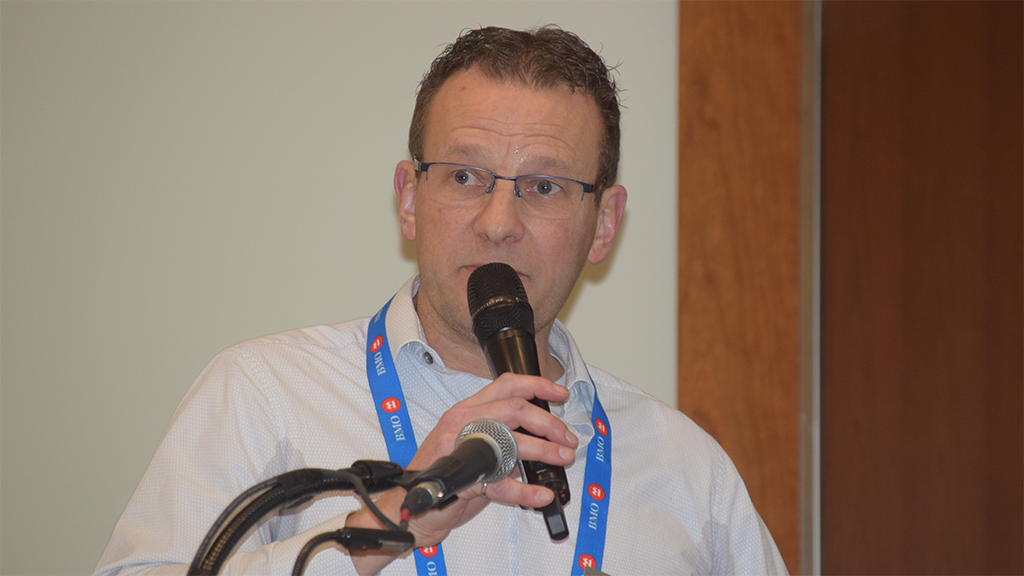
The preferred design was outlined by geotechnical consultant Dan Kuenstler, a partner with Manitoba’s Dillon Consulting, during a presentation titled Building on Peatlands. The session was part of a two-day convention showcase offering updates on the Northern Road Link Project from the two proponents, Marten Falls First Nation and Webequie First Nation.
No chasing peat
The favoured approach promotes natural water flow, Kuenstler explained.
“We thought we were pretty wise back in the day, chasing (removing) that peat, getting down to silt and clay, building on something solid, but that just introduced water management problems that affected our ability to maintain that hydraulic conductivity, and so we pivoted pretty quickly to rafting over top,” he said.
Descriptions of the strategy were included in the final Environmental Assessment/Impact Statements for the Marten Falls Community Access Road and the Webequie Supply Road projects, released Feb. 20 and Jan. 30 respectively.
Ford announced the 107-kilometre Webequie road is scheduled to start construction in June 2026 and open by November 2030, four years ahead of schedule; construction of the 190-kilometre Marten Falls is set to begin in August 2026 and launch by November 2031, four years early; upgrades to the existing Anaconda and Painter Lake Roads are scheduled to open by November 2030, two years ahead of schedule; and the 120-kilometre Northern Road Link is slated to start construction in spring 2028 and open by November 2031, five years early.
The Ring of Fire region in the Hudson Bay Lowlands is located 500 kilometres northeast of Thunder Bay; miners are eager to obtain access due to its massive proven deposits of critical minerals. The lowlands contain the second-largest peatland complex globally, with over 60 per cent of the territory consisting of muskeg, bogs and fens. The water-saturated organic material ranges from 40 centimetres to over five metres deep.
The right-of-way is expected to be about 100 metres wide with a road corridor 60 metres wide to be cleared and grubbed, Kuenstler told delegates.
A 2024 project newsletter included in the Webequie road impact statement explained the road does not actually float on the peat, but rather an equilibrium builds between the weight of the road and the strength of peat with the combined system reaching a balance.
Peat is too thick and poorly drained to be excavated and replaced with other soil, the newsletter explained.
Manufactured blanket
Engineering a floating road requires synthesized geotextile fabric or a geogrid layer placed on the surface of the peat before the road is constructed to give it a working platform to evenly distribute the load of the building material that will be placed.
Kuenstler said his firm worked on the all-season roads built a decade ago east of Lake Winnipeg in Manitoba to serve the Bloodvein and Berens River First Nations, with a similar floating road solution adopted to build over peat.
“When you’re building on the peat, fen, bog areas, it will settle 35, 40 per cent,” he said. “So let’s say you have that two-metres-thick bog layer, we overcompensate, we will over-build, knowing that it will settle almost a metre down.”
The predominant building materials will be blasted rockfill and composite excavation material capped with granular surface material. The majority of the rockfill will be obtained from rock outcrops near the right-of-way.
Equalization culverts will be installed at locations where it is determined that spring-melt or storm runoff needs to pass from one side of the roadway to the other to prevent flooding or erosion.
Kuenstler said at Berens River piezometric instruments confirmed the road strategy was successful in maintaining hydraulic conductivity.