As climate‑driven disasters become more frequent, many building owners still lack a clear roadmap for which resilience measures to pursue — or whether those investments will pay off.
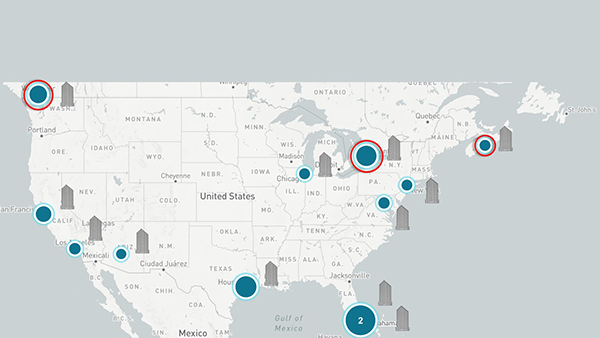
A recent study on the impacts of climate change on an identical multi-family residential building model in nine U.S. and three Canadian cities reveals some surprising findings: the right investments in resilience can result in significant monetary returns.
In Miami Beach, a city facing high risk to flooding, for example, the study, called Investing in Resilience, found for every $1 invested in flood resilience there was a $42 return.
Engineered deployable flood barriers were one of the priority measures in Miami, says Olivia Pink, the head of science and solutions at ClimateFirst, which conducted the six-month study.

“When you are able to quantify the risk and put numbers around it, you are able to prove the really positive financial impact that investing in adaptation at an asset level delivers,” says Pink.
A company of Guelph, Ont.-based RWDI, ClimateFirst applies software solutions to identify, quantify and manage physical climate risk. It down-scaled global climate models for the 12-city case study and then identified climate hazards at each of the sites.
Pink says there were a wide range of climate risks, with at least one “high to very extreme risk” at all the Canadian and U.S. sites.
While the study on U.S. cities has concluded, research findings on the three Canadian cities -Toronto, Vancouver and Halifax – won’t be released until the end of the month.
But Pink did say that over 10 years, the highest risk in Canadian cities was at the Toronto multi-residential building level.
It faced a $2 million risk due to due to localized flooding. Extreme heat in Toronto is also a climate-change concern.
Rain was identified as a high-risk factor in Vancouver and extreme wind and flooding in Halifax.
Pink says resiliency measures and adaptation strategies don’t always have to be “a massive” investment.
She says low to moderate measures to reduce risks that can have “a big impact,” include water sensors in elevators and attached to water-sensitive equipment.
More costly measures that can still pay off include flood barriers such as quickdams, a quick-install barrier that typically consists of a fabric tube with an absorbent filling. Flood gates in front of doors are other options.
Pink adds mechanical systems needing replacement should be sized for cooling and heating needs over the equipment’s lifespan, not for today’s climate.
“There are more things that can be combined with general maintenance etc. to make your asset more resilient.”
She says the ideal time to consider resiliency measures is during the design of a building.
ClimateFirst partnered with the BMO Climate Institute and the Investment Management Corporation of Ontario to conduct the study.
Pink says the report has been well received by asset owners, developers and others.
“This is something that folks responsible for managing climate risk have been looking for,” she says.
“It is a way to take climate risk to stakeholders who are making key decisions for assets and allow it to have a quantified understanding and business case around it the same way that other risks are managed so that true decisions can be made.”
Pink hopes the findings will promote discussions in the insurance world which could lead to asset owners and operators rethinking financial decisions.
“It would allow this conversation to move from a cost benefit analysis to a return on investment.”
Of all the 12 cities, Phoenix faced the lowest risk to climate hazards over a 10-year period of $70,000 while Miami Beach had the highest at $5 million, she says.