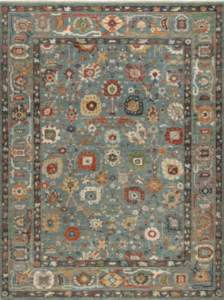
This rug from the Kalaty Adana
collection is hand-knotted in India using
a combination of premium hand-spun
wool and Silkette yarns.
 Rug importers are heading to court to recover millions of dollars in tariffs paid on Indian goods after the U.S. Supreme Court last month struck down the president’s duties imposed under the International Emergency Economic Powers Act (IEEPA).
Two companies, Jaipur Living and Rugs America, have already filed lawsuits against U.S. Customs and Border Protection seeking refunds on tariffs paid during the policy’s nearly five-month run. Although the Supreme Court ruled the tariffs unlawful, the decision does not automatically trigger refunds for importers, meaning companies must file individual legal actions to recover duties already paid.
“This action is necessary to ensure Plaintiff (Jaipur Living) obtains its own judicial relief. In a press conference, the President made clear that the administration will not issue refunds without a court order obtained through litigation,” according to the Jaipur Living court filing. “This action is also necessary because the entries under which Plaintiff paid IEEPA tariffs are at risk of liquidating and becoming final.”
“This separate action is necessary to obtain a declaratory judgment and refund, as the Supreme Court’s decision does not itself automatically provide refunds to individual importers,” as stated in the Rugs America court filing. “Accordingly, for itself, Plaintiff (Rugs America) seeks a declaration that the IEEPA Duties are unlawful and (requests) a full refund with interest, as required by law.”
India has long been one of the primary sources for handwoven rugs sold in the U.S., making the tariffs particularly disruptive for importers and retailers.
According to the Global Trade Research Initiative, India’s total exports to the U.S. market tumbled 37.5% during the period from May
to September 2025, reducing export value from $8.8 billion to $5.5 nbillion.
Tariff history
The tariffs were introduced in August 2025 when the administration imposed a 50% duty on Indian goods under the IEEPA, citing India’s continued imports of Russian oil.
The rate remained in place through January 2026 before being reduced to 18% in February as part of a trade agreement between the two countries. Following the Supreme Court’s ruling, the duties should revert to the baseline 10% tariff rate, although the administration has proposed raising them to 15%. The rapid policy shifts created uncertainty for importers and retailers.
“As far as the tariffs right now, I think the only thing certain is the uncertainty of it all,” said Wendy Reiss, Kas Rugs vice president of sales and national accounts. “It’s very hard to answer long-term strategy questions with things that are changing from month to month.”
Ariel Kalaty, spokesman for Kalaty Rugs, agrees that the lack of clarity on where the tariffs will land is not good for business. “Even now, there is confusion about the tariffs,” he said. “The prior tariffs were not sustainable over the long term, and even the supposedly lowered tariffs are too high. It is hard to make investments and plan future inventory for dealers and retailers with all this unknown.”
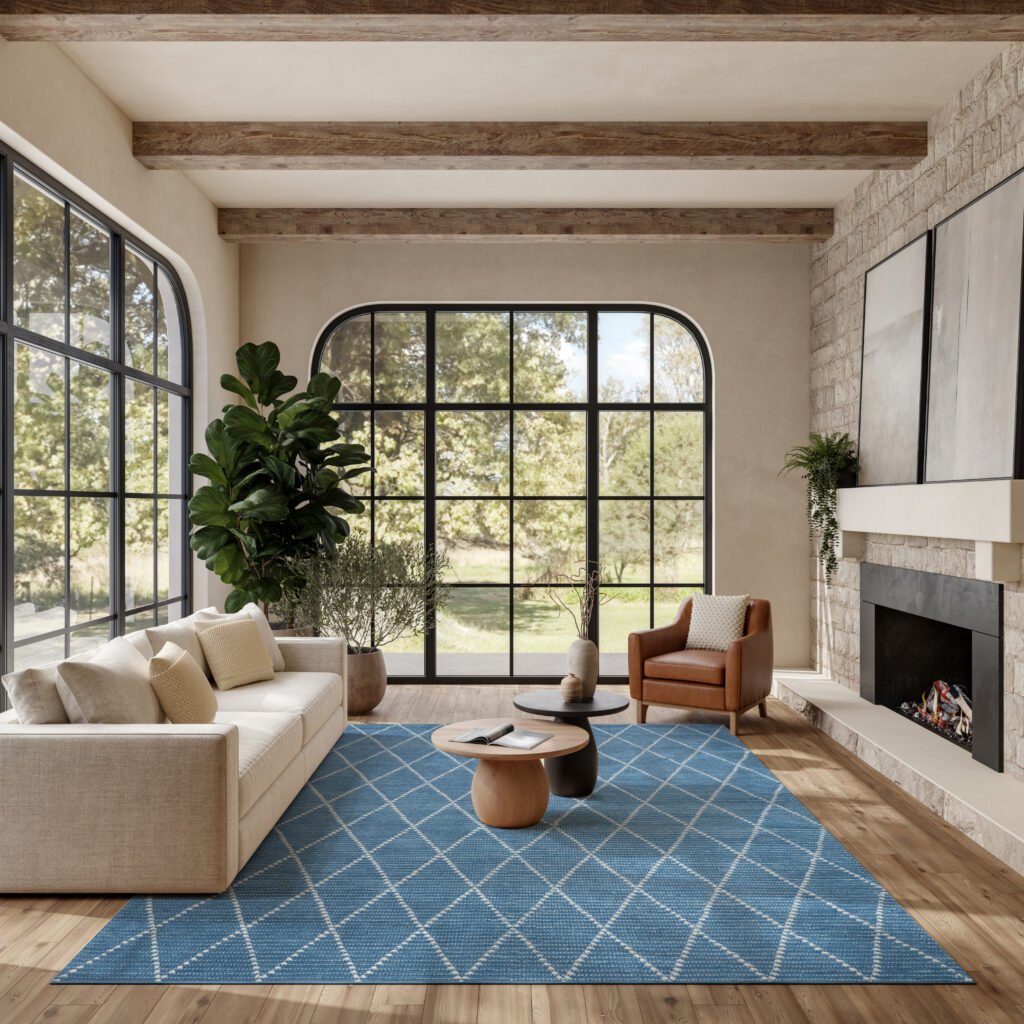
navy, is handwoven from wool in India
by Nourison Home.
Anderson Tuftex Vice President Bailey Walton agrees that predictability is critical, since rug production, especially the creation of handcrafted goods, operates on long timelines and pulls from deep artisan relationships.
“When policy is stable and transparent, companies can invest responsibly and build diversified supply chains that support domestic jobs while sustaining global craftsmanship,” she said.
Tariff management
Importers are required to pay the tariffs upfront and out of pocket, which in many cases forced them to pass along at least a portion of the added cost to their customers through price increases or surcharges. Some companies decided to fully absorb the increases, which in turn caused problems for the bottom line.
“Several of our clients with significant orders either canceled them or requested shipment delays,” said David and Lee Harounian from Harounian Rugs International (HRI). “This disruption caused a loss of supply and business that, unfortunately, cannot be fully recovered. From the outset, the tariffs imposed on Indian rugs were neither necessary nor justifiable.”’
Many in the industry said they believed that the 50 percent tariff rate would be gone by last November or December at the latest, so their strategy was to do whatever was necessary to get through that period.
“We were all absorbing the costs and had some price increases, but we couldn’t absorb the increase forever, so this is good timing,” said Satya
Tiwari, president of Surya Inc. “If it had gone on for six more months, it would have greatly impacted the newness that companies could bring.”
Nourison Home co-founder and chairman Alex Peykar said he believes that the reduction in tariffs is a positive and stabilizing signal for the industry.
“This is particularly true for our India-sourced assortments where tariff pressure had been a meaningful cost headwind,” said Peykar. “This move helps rebalance our landed cost structure and reinforces that our decision to take a modest price increase in August, while absorbing the majority of the impact, was both disciplined and consumer-centric, protecting relationships and long-term brand trust.”

Because of the overall uncertainty, some manufacturers shifted priorities during the high tariff months.
“At 50 percent tariffs, sourcing decisions shifted from optimization to risk mitigation,” said Walton. “As rates moderated, it allowed us to recalibrate, but it also reinforced the importance of evaluating our global supply chain more holistically.”
Rug importers said they are continuously assessing and diversifying sourcing partners to reduce concentration risk and build long-term
resilience, regardless of tariff levels.
“During the higher tariff period, we managed forward commitments conservatively. As rates eased, we regained the flexibility to deepen
inventory on select products,” she added.
Cameron Capel, president of sales and marketing at Capel Rugs, said that initially they put a hold on anything that hadn’t already shipped by August but eventually had to pay the 50 percent tariff once they released those shipments.
“We are still working through receiving the held product and our sold back orders, so we need more time to analyze (growth from India),” Capel said. “The tariffs have allowed us to strengthen what can be made here (in the U.S.), but handmade rugs from India should not be targeted (for tariffs), as they cannot be reproduced in the U.S.”
The Harounians said they carried substantial inventory at the time the tariffs were implemented, which allowed them to absorb most of the increase rather than broadly passing it along. However, for new and special-order programs, they were obliged to pass on a portion of the tariff-related costs.
Manufacturers said that for any orders that have not yet shipped, they plan to eliminate the tariff-related price increases or surcharges and return to previous pricing levels since the tariff rate has gone down. They are hopeful that this adjustment will help reinvigorate demand and allow them to return to the normal level of business.
Sourcing from India
Across the industry, importers still believe that India remains a meaningful sourcing partner for handcrafted rugs due to its unparalleled artisanal expertise.
“Over the past three years, the more significant shift (for us) has been diversification,” said Walton. “While India continues to represent an important portion of our premium assortment, we have put great emphasis on strengthening our domestic U.S. production of design-forward and on-trend custom area rugs.”
Capel said the tariffs have allowed them to strengthen what can be made here in the U.S., but “the amount of goods we bring in from India may have grown a few percentage points, now that quality machine-made rugs are also made in India,” she said.