The excitement among Artificial Intelligence (AI) platform developers surrounding its future role in concrete production is clear.
“We’re on the brink of a new era that’s driven by intelligence and innovation,” says industrial AI software company Ripki.ai.
Ripki.ai suggests AI has the potential to transform what has been in the past a lack of precision required for optimized concrete production. The company points to “fluctuations in raw material properties, fuel inefficiency and unpredictable equipment behaviour. AI has the potential to solve many persistent problems while simultaneously increasing cement manufacturing efficiency.”
Texas-based MK1 Construction, a supplier of specialized concrete products, agrees.
“Concrete, often referred to as the ‘bones’ of construction, sits at the intersection of Artificial Intelligence and the globalization of the technology at large.”
Manufacturing concrete has several challenges in today’s world. Its processes include multiple complex stages, such as raw material preparation, sintering, clinker formation and grinding. These are associated with high levels of carbon emissions. Inefficiencies can lead to increased fuel use and even higher carbon emissions. That is one of many reasons why Ripki.ai believes concrete production makes an ideal candidate for AI-driven optimization.
The industry is also under continual pressure to become more efficient and profitable. AI can help, MK1 says, “by providing real-time insights, automating quality control, optimizing operations and predicting maintenance requirements.”
As with all aspects within the construction process, equipment downtime can be very costly. AI can help by automating the monitoring of maintenance tasks and reduce the need for human intervention.
Ripki.ai cites the example of a concrete manufacturer whose inadequate material monitoring systems led to equipment damage, blockages and efficiency losses from oversized rocks. Human supervision was deficient and introduced bias, while manual sieve sampling resulted in irregular measurements and low levels of accuracy.
The result was “frequent downtime, higher maintenance costs and increased fuel consumption further impacted operations.”
The manufacturer deployed Ripik.ai’s Vision AI system to continuously monitor conveyor belts. This generated real-time alerts for oversized rocks via dashboards or sirens. The system seamlessly integrated with control systems (DCS/SCADA) to automatically halt the conveyor belt as required, ensuring proactive intervention and improved operational efficiency, the company explained.
Even before any manufacturing takes place, AI can play a role in the design of innovative concrete mixes.
Researchers at the Paul Scherrer Institute (PSI) in Switzerland report they successfully created an AI-driven model to speed up the exploration of novel cement composition. These are capable of maintaining high material standards while improving environmental impact by reducing carbon emissions.
“Instead of testing thousands of variations in the lab, we can use our model to generate practical recipe suggestions within seconds. It’s like having a digital cookbook for climate-friendly cement,” said PSI researcher Romana Boiger.
In fact, their AI model was able to calculate mechanical properties for an arbitrary cement recipe in milliseconds, a thousand times faster than with traditional modelling.
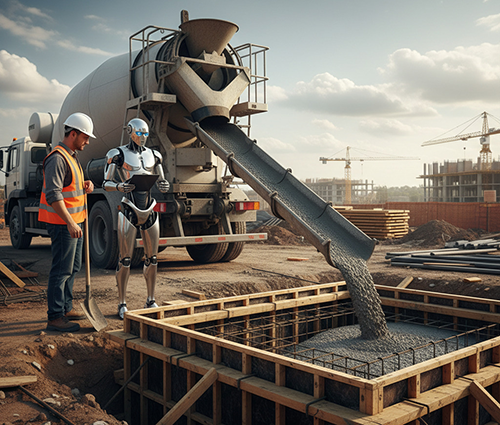
MK1 Construction points out other ways AI can fit into the future of the concrete industry. These include optimized concrete mix designs, enhanced quality control and advanced analytics and forecasting, all of which contribute to increased efficiency and reduced carbon outputs.
The company continues, saying onsite, “Autonomous equipment, guided by AI, can optimize the placement of concrete, ensuring precise application and reducing waste. Additionally, AI-powered drones can monitor the curing process, providing insights into temperature and humidity levels to ensure optimal strength development.”
As always, there are questions: “Where do humans fit into this new age of AI in concrete? How will AI impact the workforce?”
Craig Yeack, co-founder of the Bulk Construction Materials Initiative and a presenter at the 2026 World of Concrete in Las Vegas, spoke with dozens of attendees during the conference.
“Of the 43 individuals who approached me, none were overtly opposed to AI,” he writes. “Most, however, expressed concern, perhaps even fear, about their future and their company’s future in the shadow of AI.”
In response, MK1 offers an optimistic view of the AI future.
“Engineers and construction managers can use AI tools to simulate project outcomes, assess risks and develop strategies that maximize efficiency and safety.”
AI manufacturing platform developer Basetwo suggests two ways this could go.
First, smart factories, or fully automated and AI-driven cement plants, are becoming increasingly feasible, it says.
“Connecting these smart factories to an AI-enabled real-time optimizer elevates their capability, enabling fully autonomous operations while continuously enhancing optimization outcomes without human involvement.”
On the other hand, Basetwo suggests a more semi-autonomous approach to cement production “would provide cement manufacturers with directions and recommendations on how to best run their current operations, minimizing the need for physical testing of production processes and changes to blends, while reducing deviations within their real-time processes.”
Either way, implementing AI systems in cement manufacturing will require skilled personnel capable of managing and maintaining the technologies, the company says. That calls for professionals with expertise in AI and machine learning to support the industry’s transition to smarter manufacturing processes.
“AI-enabled robotics will eventually handle delicate, repetitive tasks, including elements of concrete finishing,” Yeack says. “In remote geographies or controlled industrial corridors, AI-driven truck platooning will mature. What feels incremental today often becomes inevitable tomorrow.”
In the near term, venture capitalist KP Reddy foresees human-AI collaboration with clear divisions.
“AI cannot replicate the judgment of an experienced concrete superintendent,” he writes. “It cannot build the relationship with a ready-mix supplier. What AI can do is handle the operational tasks that consume time without creating value.”
John Bleasby is a freelance writer. Send comments and Inside Innovation column ideas to [email protected].