Tunnelling and station construction are advancing concurrently on the Ontario Line’s 6.7-kilometre subway segment that extends from Exhibition Place east through downtown Toronto, terminating at the Don Yard, a major construction tunnel and portal site near the Don Valley Parkway.
The twin subway tunnel project started at the tunnel launch shaft, a deep reinforced structure, east of Exhibition Station.
The two German-manufactured 150-metre-long tunnel boring machines (TBMs) will cut through rock and soil at depths of up to 40 metres to a terminus six kilometres east of Exhibition.
Called the Ontario Line Southern Civil, Stations and Tunnel project, it is the largest construction project ever awarded to Ferrovial Construction, which is delivering the P3 project through the Ontario Transit Group, a joint-venture with Vinci Construction Grands Project.

With six deep underground stations, one major at-grade station and 6.7 kilometres of twin-bored tunnels, the level of complexity sets the project apart from most international subway projects the big constructor has worked on, says Ignacio Gastón, CEO of Ferrovial.
Engineering and construction in the downtown section is particularly complex in part because the excavation of deep shafts and caverns is adjacent to many office skyscrapers.
Using the sequential excavation method, or SEM, caverns have been created at station sites with roadheaders to support tunnelling. Roadheaders are especially useful in urban areas as they create less noise and surface vibration than traditional tools like jackhammers, says Gastón.
In addition to facing difficult ground conditions, there are co-ordination challenges with existing assets, buildings, heritage requirements, utilities and transit infrastructure. At the same time minimizing impacts on local communities is critical, he says.
The project also integrates civil construction, mechanical, electrical and plumbing (MEP), and architectural works under a single delivery scope.
It “creates highly complex interfaces within the design itself and requires an exceptional level of co-ordination across disciplines,” he explains.
Gastón says excavation is nearly complete for most of the shafts and caverns and crews at some stations have started permanent works, building the reinforced concrete structures. Roadheader machines employed to carve the caverns to house the station platforms will also serve to connect the tunnel through each site.
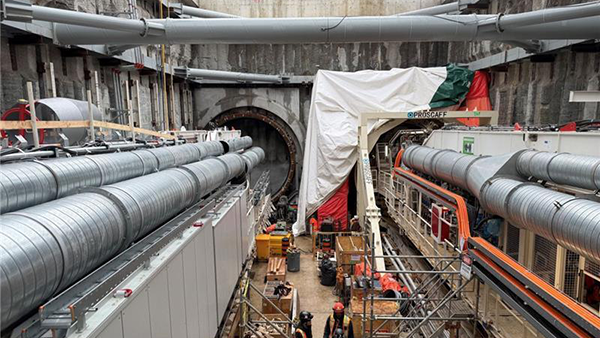
The boring machines are comprised of seven gantries, a bridge, shield, cutterhead and they operate with continuous monitoring systems that track performance and subsurface conditions.
The TBMs were shipped from Germany several years ago and stored off-site. Getting them to Exhibition Station involved extensive co-ordination with local authorities because many of the components were “exceptionally heavy and large,” says Gastón.
Throughout the construction period, excavated material will be continuously removed from site, while construction materials are brought in on specific schedules.
“We manage these flows around the clock to maintain productivity and limit disruption to surrounding streets, neighbourhoods and active transit infrastructure,” says Ferrovial’s CEO.
To reduce rework and improve safety, the contracting joint venture also uses digital platforms and AI-supported tools to manage teams, monitor progress and identify risks as early as possible.
Gastón adds the contracting team is exploring the deployment of robotics, using them, for example, in the stations for inspections and data collection.
Ontario Line South is for Metrolinx and Infrastructure Ontario as part of a design-build-finance contract for the new 15.6-kilometre Ontario Line, a rapid transit project that connects Exhibition Place to the Eglinton Crosstown LRT at Don Mills Road.
It is expected to be completed in the early 2030s.