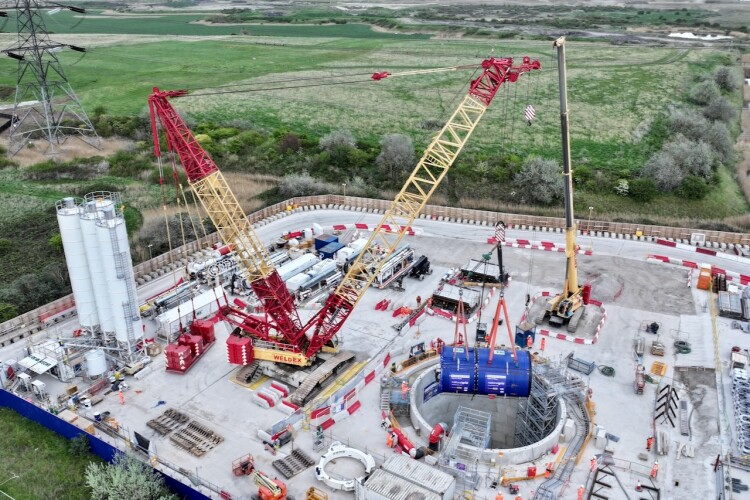
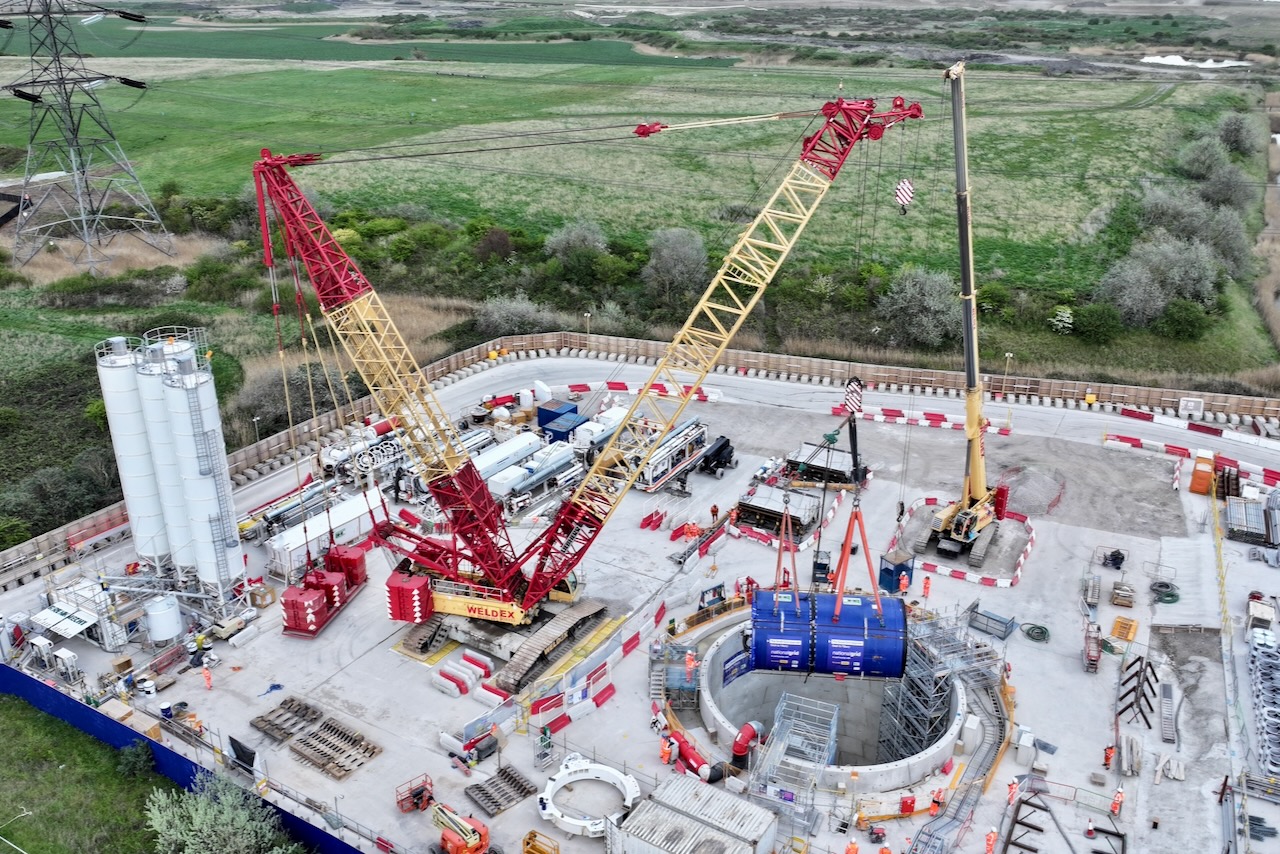
The 2,200m cable tunnel under the Thames from Gravesend to Tilbury is a key part of National Grid’s ‘Great Grid Upgrade’. The launch and reception shafts for the cable tunnel are being constructed using Europe’s largest shaft sinking system, also supplied by Herrenknecht.
Herrenknecht supplied the machinery for Grain to Tilbury, a key project in the grid upgrade. Herrenknecht Vertical Shaft Sinking Machine had excavated the launch shaft, allowing tunnelling to begin at the start of May.
The mixshield TBM was tailored to the job. It has a diameter of 4,730mm, is 108m long, and weighs 464t in total. Beneath the Thames, the TBM is predicted to encounter a mixed ground of chalk and flint up to a compressive strength of 1000 MPa. Additionally, the high water pressure beneath the Thames, poses a challenge. It will be working close to the mouth of the river, in its tidal estuary.

The TBM is designed to withstand a water pressure of 4.5 bar, partly due to the tidal range. While water and earth pressure prevail at the cutting face, the rest of the machine is maintained at atmospheric pressure. The highly sophisticated Mixshield, a technology developed by Herrenknecht, offers maximum tunnelling safety thanks to precise tunnel face support. It is also sealed against water pressure 41m below the Thames with a multiple sealing system. For work at the tunnel face, such as changing the cutting tools on the cutting wheel, the Mixshield features a personnel airlock that allows workers to gradually acclimate to the different pressure conditions – similar to a scuba dive.
The TBM not only excavates the tunnel but also lines it with precast concrete segments, known as lining segments. The tunnel will have an internal diameter of 4m and an external diameter of 4.50m. Using a hydraulic overcutter, the excavation diameter can be increased. This enables the machine to navigate curves and make course corrections more easily. The tunnel’s curve radius is 350m.

Due to the complex geology, the Mixshield is designed including a Mini gripper and Anti-roll fins. This allows the machine to be secured so that the cutting wheel can be retracted if necessary. Additionally, the Mixshield is equipped with a drilling rig for preliminary exploration and a telescopic camera to inspect the tunnel face without hyperbaric interventions needed by the personnel. This allows obstacles in the ground to be detected in a timely manner and the necessary precautions to be taken.
The delivery package for the tunnel construction includes a separation plant, navigation technology from Herrenknecht’s subsidiary VMT and multi-service vehicles that transport the segments from the launch shaft to the TBM inside the tunnel.
Got a story? Email [email protected]