The Stephenson Building at the Newcastle University, named after engineering pioneer George Stephenson, was opened by HRH The Duke of Edinburgh in 1951. Today, the school’s curriculum highlights digital manufacturing, sustainable propulsion and biomedical engineering.
However, the building was due for a serious review. Although it had undergone numerous minor modifications over the years, the structure had remained largely unaltered until 2022, project builder Bowmer + Kirkland explains.
Transforming the five-storey building into a world class hub for leading research, cutting-edge innovation, teaching and cross disciplinary collaboration meant adopting a novel approach, says project architects NORR. This included working with Newcastle University to develop a bespoke sustainability assessment that permitted the reuse of half the original floor space.
“Marrying a refurbished, modernized original frontage with a highly contemporary extension, focusses on turning the building ‘inside out’ by transforming an inward focused, cellular and traditional academic building into an outward facing and collaborative facility, centered around a vibrant collaborative atrium space,” NORR says.
This new interior ambience was conceived deliberately to “inspire the engineering students in an uplifting environment that proudly expresses the building’s engineering throughout its construction.”
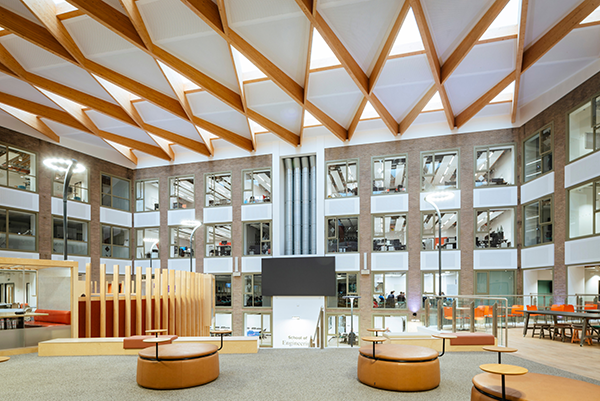
To achieve this, a unique blend of materials was selected.
Teamwork between critical supply chain partners was also vital to the success of the project. B&K Hybrid Solutions, a specialty firm owned by Bowmer + Kirkland, delivered both the steel and engineered timber elements of the hybrid package, thus ensuring simpler and smoother project delivery.
Supply chain partners Stora Enso and Hasslacher manufactured the CLT and glulam components, while specialist timber engineer Engenuiti was appointed to design the intricate connections and other timber details.
The added structural elements feature numerous timber components and CLT timber floorplates. Particularly visually striking is the complex roof structure constructed of glued-laminated beams and CLT elements.
In addition, hybrid steel was used for critical elements, notably for the Y-branched steel columns that support a large atrium roof over diagonally-arranged cantilever beams supporting a composite metal deck at the rear of the building.
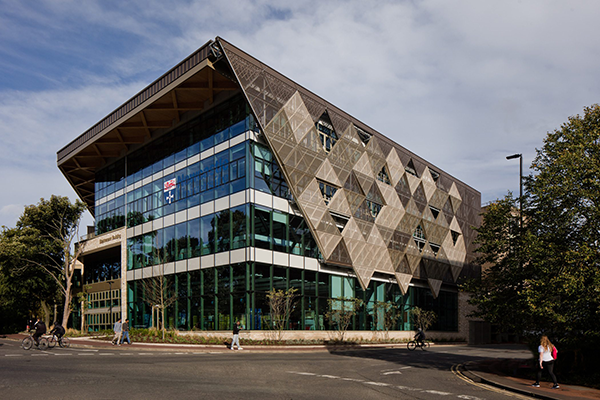
Hybrid steel is a process that combines hot and cold rolled steel. Its light weight and strength makes it suitable for use in buildings with large, clear spans. Seamless transitions between the engineered wood components and the steel columns were another notable design and construction achievement by the project team.
Further efforts to create what NORR calls “a sustainable exemplar project” include a Biomass CHP system (Combined Heat and Power). This achieves eco-friendly power and heat generation for the Stephenson Building itself while also helping to decarbonize six additional existing buildings on the campus in order “to achieve a net-zero impact in-use.”
In-use carbon reduction has been further achieved by improving overall air tightness levels and minimizing the use of mechanical ventilation, the university says. The overall result is a substantial impact on the university’s NZC 2030 target.
To achieve its goal of providing a quality environment for teaching and learning, acoustics had to be considered.
“The building’s complex layout included spaces likely to generate a lot of noise, such as engineering laboratories, situated adjacent to highly sensitive classrooms and meeting rooms,” said Adam Cooke, director at Apex acoustics.
The large-volume triple-height spaces presented significant challenges in controlling reverberant sound.
These were all spaces that needed to adapt to the changing demands within the ever-shifting environment of teaching and research, explained senior architect Mal Lorimer.
The installation of Ecophon Solo™ free-hanging panels, together with a linear track lighting system, met the demand for high levels of noise absorption for speech intelligibility and auditory comfort.
The reimagined Stephenson Building fully reopened in September 2024.
Its success has been recognized by several prestigious awards, including those at the national level such as the 2025 Royal Institution of Chartered Surveyors (RICS) UK Awards 2025 for Project of the Year, and the 2025 RICS UK Awards 2025 for Refurbishment/Revitalization.
“The Stephenson Building excelled against every judging criteria, resulting in a stunning world-class engineering facility for teaching, research and industry partnerships,” said the RICS awards committee.
“The redeveloped Stephenson building will be the place for future engineers, researchers, designers and visionaries to come together and tackle world challenges together,” says Newcastle University. “Stephenson is the home for people who make things work.”
For NORR the new Stephenson building has created, “a landmark gateway building for the university and the city of Newcastle upon Tyne itself.”
John Bleasby is a freelance writer. Send comments and Climate and Construction column ideas to [email protected].