For decades, data centres were large, hidden, anonymous boxes on the edge of town, quietly powering email, banking and cloud services.
However, AI has changed that calculus.
Today, these AI-driven hyper-scale projects arrive not as single buildings but as entire industrial campuses, demanding unprecedented scale in power, cooling, land and public infrastructure.
Few projects illustrate this shift more clearly than the Port Washington “Lighthouse” campus, a 672‑acre, $15‑billion-plus AI data centre about 30 minutes from Milwaukee, Wis.
The complex is being engineered for nearly one gigawatt of power in its first phases. The buildings will have sustainable features like closed-loop cooling and renewable energy. Construction on the project began earlier this year and is expected to be completed in 2028.
“We are proud to bring forward a data centre campus that sets a new standard for sustainability,” said Tracye Herrington, vice-president, new site development at Vantage Data Centers which is building the sprawling complex. “This project reflects our commitment to environmental stewardship and community investment — and to achieving net-zero carbon emissions across our global operations by 2030.”
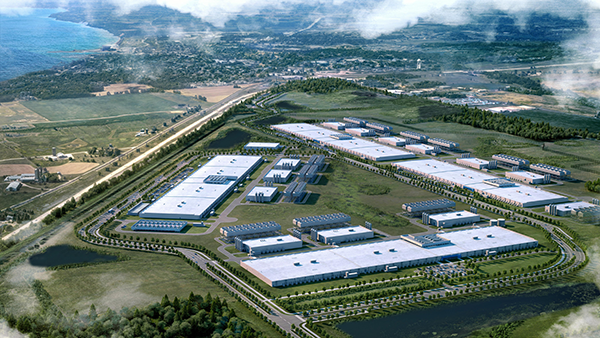
The project offers a window into what designers, engineers and builders now face as AI reshapes the built environment. Large AI campuses are vast, energy-intensive, technically complex projects.
In Port Washington, the Lighthouse project required the creation of an entirely new layer of public infrastructure – much of it sized not for today’s city, but for a gigawatt‑scale future. Under a development agreement approved in 2025, Vantage committed to approximately $175 million in public‑works upgrades, paying all upfront costs and assuming construction risk.
At the heart of the venture is sheer physical scale.
Phase one alone comprises roughly 2.5 million square feet spread across four single‑storey data centre buildings, along with a 50,000‑square‑foot warehouse and dedicated visitor centre. Each data hall measures well over half-a-million square feet, constructed using precast concrete panels and long‑span structural systems optimized for dense mechanical and electrical loads.
AI workloads driven by GPUs and accelerators are far more power‑dense than traditional cloud computing, forcing buildings to be wider, flatter and more modular.
Structural engineers must design floor slabs and column grids to support not only heavy IT equipment, but also massive rooftop cooling arrays, electrical galleries and redundancy systems – all while allowing rapid, repeatable construction across multiple halls.
The Lighthouse site was formerly farmland, requiring large‑scale grading, soil stabilization and stormwater management across hundreds of acres.
Retention ponds, berms and restored prairie areas are integral to the site plan, designed to manage runoff and mitigate flooding after increasingly frequent extreme weather events.
Roads, access points and internal circulation must be built to industrial standards, accommodating nonstop construction traffic during multi‑year buildouts and long‑term operations afterward.
But nothing defines modern AI projects more than electricity.
The total electrical capacity of the Lighthouse campus will reach about 1.3 gigawatts – enough to power a mid‑sized city.
Upgrades being undertaken included new high-voltage transmission connections to the regional grid, dedicated onsite and off‑site substations, utility‑scale feeders and protection equipment built specifically to serve the campus, and power infrastructure engineered for expansion.
Meeting that demand requires entirely new grid infrastructure. Vantage has committed more than $175 million to local upgrades. A customized utility rate ensures the campus pays for all of the power infrastructure.
Onsite, utility power feeds step down through dedicated substations into medium‑ and low‑voltage distribution, backed by uninterruptible power supplies and on‑site generation. AI facilities require enormous amounts of power, driving enormous volumes of switchgear, transformers and busways – often rivaling the cost of the building shell itself.
Cooling is the most visible engineering challenge. Traditional evaporative cooling systems, which consume significant water, are increasingly incompatible with AI campuses sited away from major water sources.
At Port Washington, the design centres on a closed‑loop chilled‑water system using a combination of air‑cooled chillers and liquid‑to‑liquid cooling that will save billions of gallons of water per year compared to water-based cooling systems.
The complex will have a water utilization efficiency near zero, with peak water use equivalent to roughly 65 homes. Mechanical engineers must integrate this system across massive floorplates, balancing airflow, thermal density and energy efficiency while ensuring maintainability at scale.
Meanwhile, the complex requires enlarged sanitary sewer watermains and expanded wastewater treatment capacity. Plumbing is equally critical. Beyond minimal process water, systems must support fire protection across millions of square feet, often with dedicated onsite storage and pumping capacity.
Sustainability is equally important in such projects. The Lighthouse campus is structured to source about 70 per cent of its power from newly built zero‑emission energy resources – including solar, wind and battery storage – while matching the remainder with renewable purchases.
As part of the plan, thousands of native trees will also be planted at the Lighthouse site to protect wetlands.
Noise and light pollution will be mitigated through berms, landscaping and tightly controlled exterior lighting.