A new Amtrak station with long-desired service to Canada could be part of a major intermodal transportation development in southwest Detroit near the Ambassador bridge.
Ford Motor’s Michigan Central R&D center, the City of Detroit and the State of Michigan are collaborating on the still preliminary transit hub.
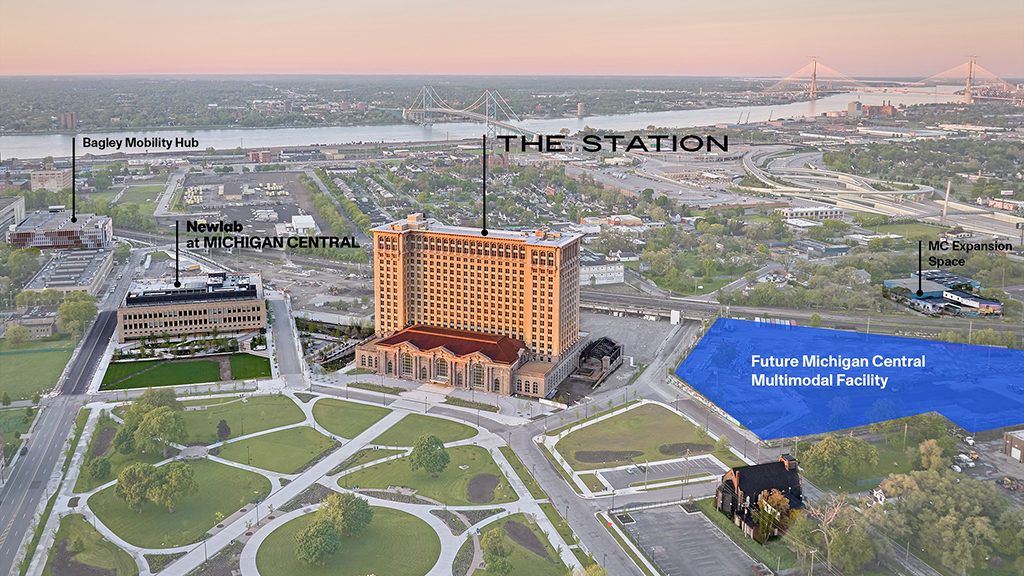
But it would add to the Michigan Central campus 30 acres centered around the 18-storey former train station, which stood empty for decades before Ford revitalized the building in 2024.
The campus already encompasses several ancillary buildings and the hub itself would only be two acres.
The State of Michigan has already kicked in $40 million and will oversee “secure environmental clearances and unlock additional federal funding by fall 2027,” state spokesman Michael Frezell said.
The City of Detroit transportation department will be the development lead for what’s officially called the Michigan Central Multimodal Facility (MCMF). This includes design, engineering, site circulation and public consultation. The department runs the city’s bus and downtown People Mover light rail systems.
While the terminal would likely see conventional train and bus connections, planners will explore “all modalities” and “create a transformational gateway to Detroit, the region and the State of Michigan,” a city press release said.
But Michigan Central will play a central role.
Beth Kmetz-Armitage, Michigan Central’s director of commercial development, said her campus was selected several years ago because of its strategic location. The surrounding area has largely been deindustrialized and depopulated in recent decades though is now reviving.
The hub abuts an active freight rail line.
“Our site offered the same rail adjacency and freeway access, but a little more area to handle the bus circulation and other needs for the center,” she said.
The state had long been looking for a replacement for the existing Amtrak station in central Detroit which is hemmed in with little parking.
After signing an MOU with Detroit and the state the parties are in 18-month due diligence. It includes civil engineering and whether there is market support for a station relocation of the Detroit-Chicago line with possible future connections to Toronto using the existing rail tunnel – currently only carrying freight – under the Detroit River.
“We’re doing all of the formal studies on paper that will enable us to enter into an actual design construction phase,” she said.
Kmetz-Armitage said the hub could host passenger rail, city and intercity buses, a car parking deck and other “modalities” like bike share and e-scouters, even “aerial mobility for either items or people depending on how that particular sector develops.”
She said there us “an emerging market” for drones that could carry people.
The Michigan Central site will also host a NoMad Hilton hotel chain and retail tenants that will create a denser commercial neighborhood.
Meanwhile, a Michigan Central R&D partner like Newlab is working to “commercialize mobility technologies in real-world environments and affords access to unique aerial pilot space,” according to its website.
A major challenge is geography.
Most of the adjacent site is landlocked, particularly leading to busy Michigan Avenue, a key corridor to the interstate freeway network.
“Right now, those streets don’t exist,” Kmetz-Armitage said. “So, there’s a major infrastructure delivery component to this project.”
This in turn could “unlock” future development to a “re-invasion a life” for the land that up to now has been a storage site for construction and public works equipment.
Moreover, besides being near the Ambassador Bridge it is proximate to the new Detroit City Football Club stadium, AlumniFi Field, with surrounding retail and housing, targeted for opening next year.
“We know that our neighborhood to the west of the station is going to become a major entertainment and travel and leisure destination with our hotel,” she said. “We can see a future that involves events, travel and leisure, sports and entertainment, commercial development, supporting our innovation ecosystem.”
So those “landlocked, underutilized parcels” are beginning to take shape “with these major developments.”
A Detroit transportation lobby group is hopeful.
“Metro Detroit transit riders and supporters are very excited about the potential to have both an updated multimodal station and eventually having a rail connection to Windsor and even Toronto,” Megan Owens, executive director of Transportation Riders United, said. “I just hope the City of Detroit, the SMART suburban bus system and Amtrak can all increase frequencies of their service through there to truly make it convenient and attractive.”