Achieving high levels of energy efficiency in buildings is as important today as ever, made even more important given the current conflict between the U.S. and Iran and the resulting energy supply concerns.
The other global issue impacting building projects are ongoing supply chain interruptions and the uncertainties created by changing tariff structures. This has made it increasingly difficult to price and execute contracts on budget when costs over the life of a multi-year construction project are hard to predict.
In his presentation at the ZAK World of Façades held in Calgary, Alta. this past April, Peter Dushenski, managing director of Canadian-based GlasCurtain Inc., brought these two issues together. He used the recently-completed $250 million Red Deer Justice Centre in Alberta as an example of how procurement of Canadian building components can support high-performance public infrastructure.
Dushenski had two important points to make.
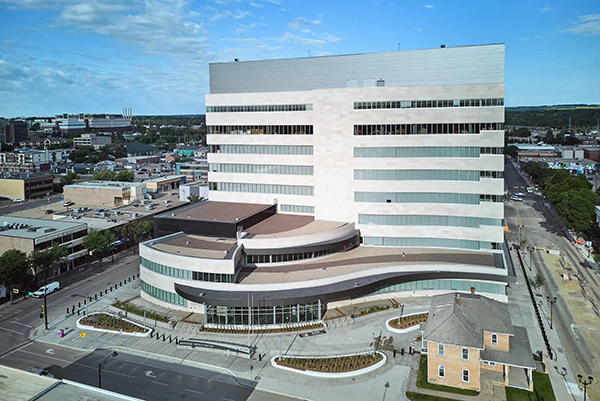
First, and in reference to his company’s own products, he suggested continuing to meet zero carbon standards and reducing life cycle costs to improve the quality of the interior environment represents the positive stewardship of public funds. As he has said many times before, Dushenski emphasized the critical importance of the building envelope towards achieving this objective.
Referencing his company’s involvement in the 313,200-square-foot Red Deer Justice Centre, Dushenski explained, “the building envelope had to be of central importance. The façade therefore had to be more than just esthetically attractive. It needed to make meaningful advances towards operational efficiency, cost certainty and climate goals. It also needed to be best in class on day one and then consistently for decades and even generations to come.”
Public buildings have the advantage of being able to demonstrate leadership in energy efficiency and lifetime carbon reduction, he explained. Commercial interests, driven by market forces, can learn from public projects like the Red Deer facility and bring those lessons forward to their own new or retrofit projects.
In terms of façades, Dushenski commented that up until recently, curtain wall specifications only looked at a few narrow performance metrics such as solar heat gain coefficients.
However, he explained several important payback benefits of using a façade product with higher specifications. For example, his company’s Thermal Frame 7, a fiberglass-framed, triple-glazed, curtain wall used for the Red Deer project, delivers R7 performance overall, including frame and glass.
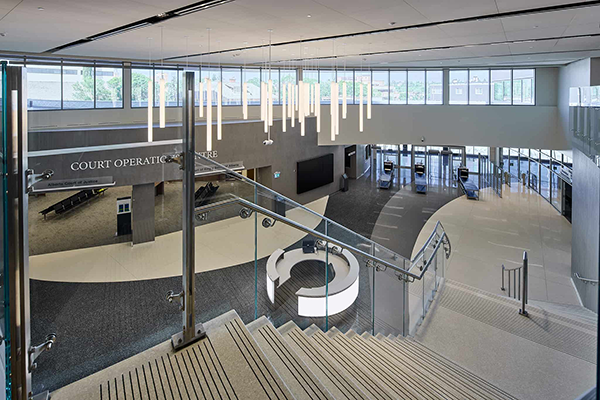
Dushenski noted the local Red Deer climate ranges from -40°C in winter to over 30°C in summer. Using a triple-glazed, fibreglass framing system for the façade improved the building’s energy performance to the point that the mechanical systems didn’t need to be over-sized to compensate for this extreme range.
This saved a considerable amount of money both at the outset and will save even more over time through operational cost reductions, something commercial developers should keep in mind.
This led Dushenski to make his other point about sourcing the best building products.
“It wasn’t so long ago that the best glazing solutions in the world had to come from overseas, whether Europe or Asia or elsewhere,” he said. “However, GlasCurtain’s fiberglass-framed curtain wall systems are manufactured and fabricated right here in Alberta, ensuring a predictable, local supply chain with no customs or tariff delays, and no need to translate foreign standards to our markets. This was a glazing system purpose-built for our climate, our construction realities and our ambitions on a project like this.”
Dushenski pointed out the glazing system was delivered and installed on time and on budget, further supporting his argument procurement of Canadian building solutions can reduce the need for time contingencies and resultant extra costs.
In this particular case, the decision to use GlasCurtain also supported an additional 15 local manufacturing jobs during construction and resulted in savings of over 4,000 tons of carbon because of reduced shipping.
In terms of overall project recognition, the Red Deer Justice Centre won the 2025 Minister’s Infrastructure Award, an achievement that recognizes and celebrates excellence in the design, construction and innovation of public, vertical infrastructure projects, such as schools, hospitals and government facilities. From an energy efficiency standpoint, the project achieved LEED Gold certification.
“The Red Deer Justice Centre demonstrates that high-performance façades developed and manufactured locally here in Alberta are already succeeding,” said Dushenski. “It stands as proof that in this frequently crazy world, we actually have a unique opportunity to achieve and create lasting value together.”
John Bleasby is a freelance writer. Send comments and Climate and Construction column ideas to [email protected].