Canadian wood producers and manufacturers say they know how to solve the country’s housing shortage and, at the same time, increase demand in the construction industry for their products.
The “two-fer” solution is laid out in a recent report published by the Canada West Foundation (CWF).
The report is based on a December 2025 roundtable at which the Canadian Wood Council (CWC) and the Forest Products Association of Canada (FPAC) convened leaders from construction and forestry to discuss how to increase the use of wood products in prefabricated, modular and panelized wood construction in residential multi-storey buildings.
In the CWF report, these methods of construction are identified collectively as Modern Methods of Construction, or MMC.
Eric Johnson, senior VP of federal government relations and communications for FPAC and CWC, says factory-built components make better use of materials and skilled labour, reducing waste and increasing productivity.
“Prefabrication also accelerates project timelines by allowing site preparation and building fabrication to happen at the same time,” says Johnson. “By shifting more construction into controlled manufacturing environments, MMC reduces delays caused by weather, site conditions and labour shortages, while improving quality control and creating greater cost certainty for project teams and owners.”
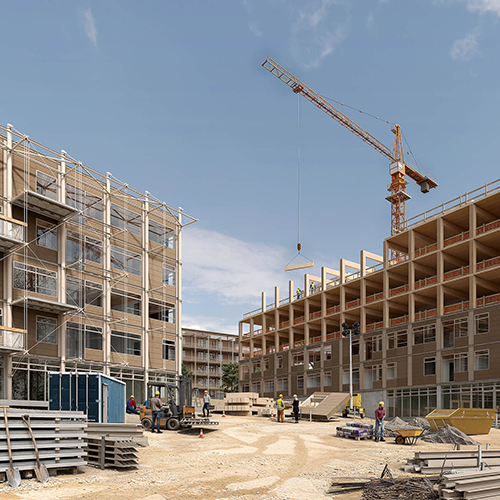
Johnson says wood plays a critical role in the “Goldilocks” range of housing: Low- to mid-rise building types.
“These forms of housing are highly repeatable, quick to deliver and well- suited to introducing gentle density into established neighbourhoods without placing undue strain on existing infrastructure,” says Johnson.
The biggest barriers to scaling up wood-based housing in Canada are not technical, he says, but regulatory and organizational.
“CWC’s analysis shows that if we remove adoption barriers – code fragmentation, approval delays, inconsistent municipal interpretation – there is an incremental domestic wood demand opportunity of over 500 million board feet under current housing starts,” says Johnson.
Perkins&Will architects are enthusiastic supporters of modular housing systems.
The company’s research team recently received funding from DIGITAL, Canada’s Global Innovation Cluster for Digital Technologies, to develop modular timber housing systems.
Perkins&Will says recent changes to building codes that allow unenclosed mass timber construction up to eight storeys and enclosed mass timber construction up to 18 storeys provide a way to address housing demand by streamlining the production of mid-rise residential buildings, strengthening domestic industry and reducing embodied carbon.
Many Canadian housing watchers believe the country’s real housing problem isn’t inadequate supply, but the lack of new housing that can be built for a price that most families can afford.
Adrian Watson, Perkins&Will design director and principal, says, “Because manufactured housing systems are faster than traditional construction methods, and time is money, they have the potential to create multi-family housing that is more affordable. But the problem is complex, because housing affordability is affected by many variables.”
Joe Geluch, president of Naikoon Contracting Ltd. in North Vancouver, says his company has been practicing MMC for 15 years.
“We’ve been doing it long enough to have opinions about what works and what doesn’t,” says Geluch.
He says MMC can make housing more affordable, “but I’d be lying if I said MMC by itself solves the affordability problem. It doesn’t.”
What MMC does is compress schedule and improve labour productivity, he says.
“On a typical multifamily wood-frame, schedule compression alone can take 10 per cent to 15 per cent out of carrying costs. That’s real,” says Geluch. “And the productivity gain matters more every year as the trades shortage gets worse.”
Geluch says what MMC doesn’t touch is the 60 per cent to 70 per cent per cent of housing cost that comes from land, development charges, financing terms and regulatory friction.
“Those are policy problems,” he says. “You can build the most efficient wall panel in the world and it won’t matter if it takes three years to get a permit.”
Vancouver developer and retired architect Michael Geller says the gap between what people can afford to pay for housing and what it costs to build housing today is increasing.
“The cost of construction, municipal fees and the cost of land have all been going up. But wages and salaries have not kept pace,” says Geller.
Economist Jack Mintz says housing will become more affordable when
after-tax incomes go up.
“Incomes go up when productivity goes up, and productivity goes up when capital investment goes up,” says Mintz, who is the president’s fellow of the school of public policy at the University of Calgary. “Business in Canada hasn’t been investing in capital, and some capital has even left the country to get better returns elsewhere.”