Modular construction in Canada has come a long way in a short period of time. Moving from perceptions of low-cost cookie-cutter buildings, modular construction today features finished results that deliver design customization and high levels of energy efficiency.
The federal government recognized that when it created the Build Canada Homes program, which seeks to increase the demand for factory-built housing through bulk procurement, long-term financing and support for Canadian technologies. While factory-built home construction has been the focus of these and other government incentives and policy encouragements, other beneficiaries include hotels, commercial buildings and institutional projects.
Overall, modular construction in Canada accounted for approximately 6.14 per cent of the total square footage for sectors of new construction in 2023, says the Real Estate Institute of Canada, increasing at a CAGR of 6.7 per cent. Accounting for this volume are several dozen factories of various sizes and levels of sophistication across the country.
While automation is becoming more common in Canada’s modular factories, meeting the future demand for more panelization and increased volumetric modular output will require Canadian producers to take a big step forward in robotics.
Canada can look to the United States and Europe for specific examples regarding where modular fabrication is headed. Different approaches can be observed. One is small and mobile, the other is massive in scale. Common to both is a high level of robotics.
The small, mobile approach is being demonstrated by Reframe Systems, a 2022 start-up founded by MIT MSc alumnus Vika Enti. The principle behind Reframe is to create highly robotic microfactories that bring housing fabrication and production closer to where new homes are needed. The company has two microfactories currently operating in Massachusetts, one in Andover and another in Somerville. A new facility is planned for California.
Projects at the Andover facility begin with a process that Reframe calls a “Pixels to Parts” end-to-end digital design pipeline that turns a floorplan into a detailed 3D model. Programmed robotics then create wall and ceiling structural panels.
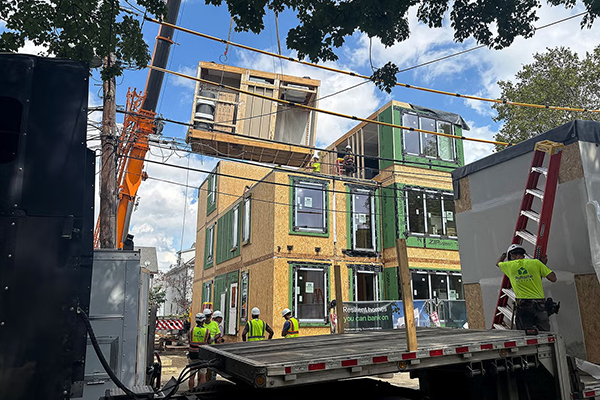
“Our robotic paneling workcell is fully software-defined, enabling it to build walls in any configuration,” Reframe says.
Humans complete the rest of the work such as wiring and plumbing.
At Reframe’s Somerville location, the company’s software-assisted design process and the adjustability of its microfactory means local zoning and building codes can be met in order to create complete volumetric homes that align with the local architectural esthetic.
Taking robotic modular fabrication to another level is KUKA, the German automation corporation with roughly 14,000 employees around the world.
KUKA has earned a major role in modern manufacturing. Notably, it plays a crucial role at Tesla by providing the robotics that weld and assemble vehicles as well as those used extensively in high-speed lithium cell production and battery module assembly.
KUKA has collaborated with GROPYUS, a German-Austrian proptech specializing in sustainable and modular construction, to transform the GROPYUS production facility in Richen, Germany into a fully automated and fully digitally integrated modular manufacturing site.
GROPYUS was founded in 2019 and today operates multiple subsidiaries and locations within Germany. The company’s smart factory in Richen develops and produces multi-storey, sustainable apartment buildings using timber construction methods on an industrial scale.
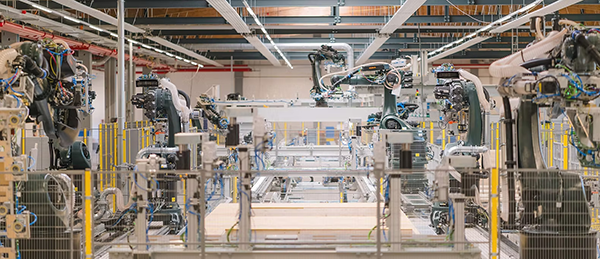
These buildings are planned entirely digitally, manufactured using highly automated processes and then assembled on construction sites, partly using automated methods.
Today, 48 KUKA robots at the GROPYUS factory manufacture wall and ceiling elements on two production lines using digitally controlled processes and over 120 specially developed robot tools, says KUKA.
“A central sawing and distribution centre forms the logistical heart of the facility,” GROPYUS explains. “Materials are cut to size there and transported to the right stations by driverless transport systems. Finished building components, ready for assembly, are prepared for transport to the construction site.”
This use of innovative end-to-end digitalization has optimized GROPYUS’ construction process from planning and production through to construction and building operation. It has enabled GROPYUS to reduce construction time by up to 50 per cent compared to conventional construction methods.
“With 86 per cent automation, GROPYUS will be able to manufacture a wall element in 17 minutes,” says KUKA. “A ceiling element will be ready in just 16 minutes. The new house construction factory can produce around 3,500 apartments per year, representing a gross floor area of 250,000 square metres.”
Reframe and GROPYUS offer views into the future of modular processes. Reframe’s microfactories might appeal to many regions of Canada who need closer access to the actual point of fabrication. GROPYUS illustrates how modern mass-volume manufacturing techniques can adapt to home and building construction.
John Bleasby is a freelance writer. Send comments and Inside Innovation column ideas to [email protected].