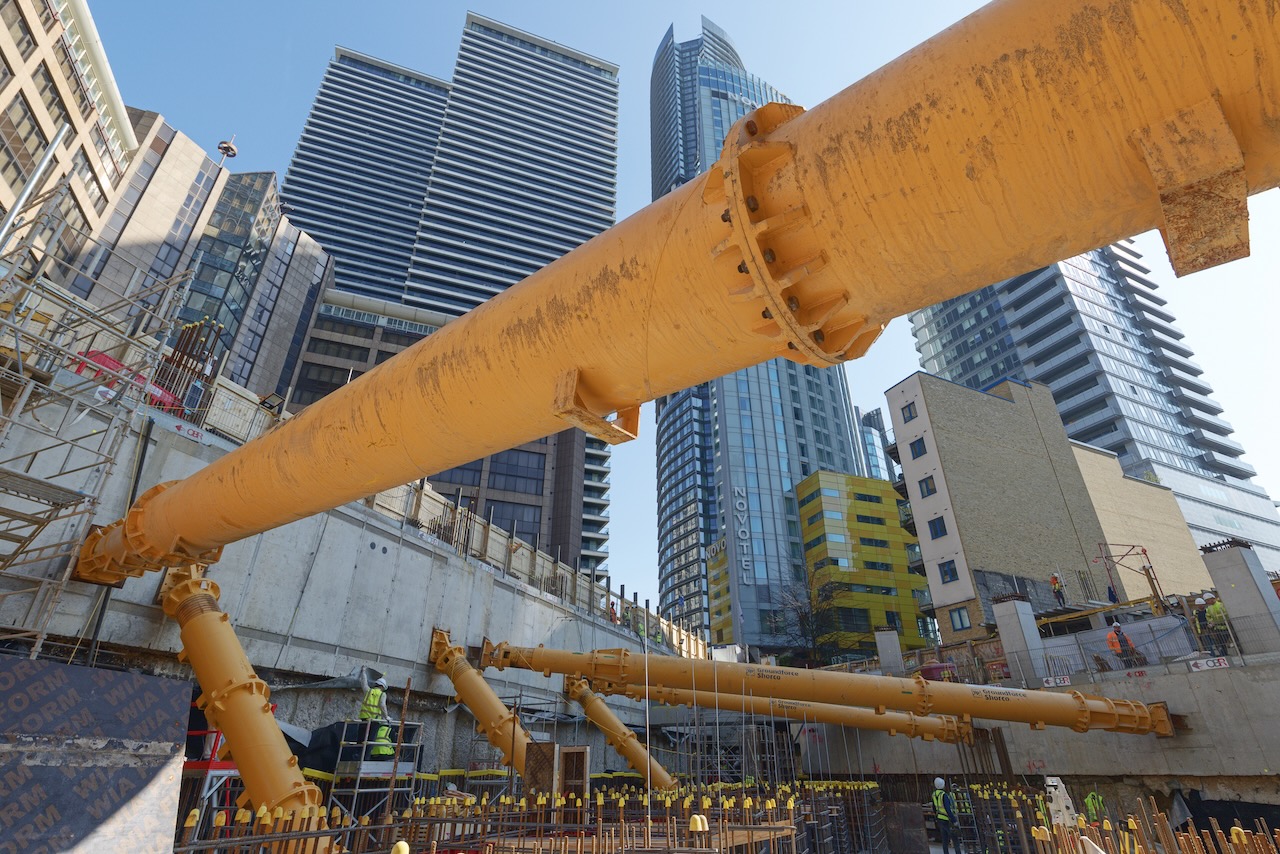
OBR Group has the reinforced concrete contract for 30 Marsh Wall, a new 48-storey student accommodation scheme just south of West India Dock.
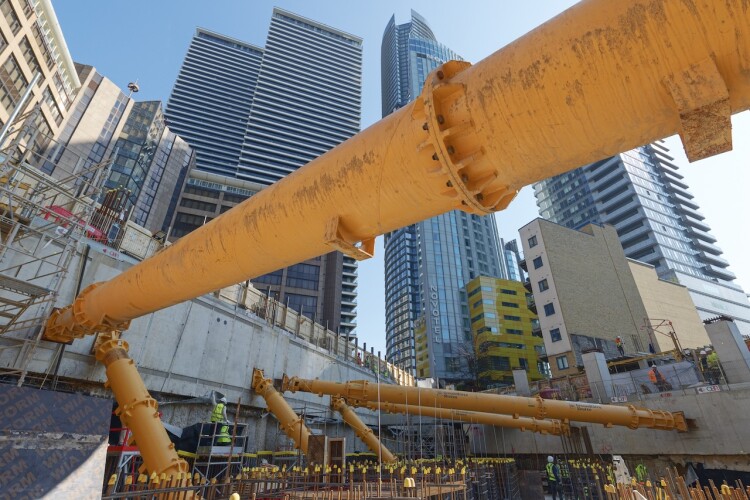
The building is being built on a confined site hemmed in by existing buildings on all sides. Temporary support for the 7m-deep basement excavation is being provided by Groundforce modular hydraulic props.
Murphy Group has installed a secant piled retaining wall and capping beam around the perimeter of the excavation, which is triangular in plan with sides measuring approximately 50m, 37m and 39m.
The challenge for OBR Group was to find a method of supporting this deep and irregularly shaped excavation without crowding it with equipment that would interfere with the construction of the concrete basement slab and other permanent structures.

Having worked together successfully on several previous projects, OBR brought Groundforce Shorco on board to brainstorm with temporary works designer Niall Keely Engineering and consulting engineer Barrett Mahony and produce an optimised solution.
“We had been aware of this project for some time so we understood the challenges and had some ideas ready,” says Groundforce Shorco area manager Ken Sandell.
“We worked closely with Barrett Mahony to value-engineer a solution that minimised the quantity of props required on site.”
The final design of the supporting structure involved a combination of flying shores and raking props installed in two phases. Special steel corbels designed by Niall Keely were manufactured and cast into the concrete capping beams to brace the four flying shores, and steel stub columns were cast into the basement slab and capping beams to brace the four raking props.
Phase 1 of the operation required the installation of five MP250 modular hydraulic props, four of them bracing the 50m-long headwall against the two opposite walls. These four props ranged in length from 12.9m, through 13.2m and 18.0m to 18.4m. The two longest props employed 813mm-diameter extension tubes (instead of the standard 610mm tubes) to increase their stiffness and reduce deflection.
These two props are also fitted with Groundforce Shorco’s remote load monitoring system to detect any deviation in loadings that would indicate ground movement.
“There is a high stiffness requirement in the design,” says Ken Sandell. “The actual loadings are not particularly high but there are stringent deflection criteria. We have had to match our system stiffness to a [3D geotechnical engineering software] Plaxis model produced by Barrett Mahony.”
The fifth MP250 measures 14.6m in length and spans between the two shorter sides of the excavation. In addition to the MP250s, two Groundforce Shorco MP150 props, 6.6m and 5.7m long respectively, were also installed as knee braces across strategic corners of the excavation.
Phase 2 of the operation has seen four heavy-duty MP375 props installed as raking props against the 50m-long headwall, directly below the four MP250s.
The MP375 is one of the strongest props in the Groundforce Shorco fleet, with a load capacity of 375 tonnes (3,677kN). These four MP375s are each 6.3m long and are fixed at an angle of 45°, with their base plates welded to specially-made stub columns sunk 1,200mm into the basement slab at one end and the capping beam at the top.
The two phases overlap and are coordinated with the casting of the basement slab, which was also in two phases. A section of the basement slab furthest from the headwall was then poured and the MP150 flying props removed once the slab has reached design strength.
The remaining section of basement slab has now been cast and OBR Group has commenced slip forming the concrete core walls. As this progresses, the remaining flying props will be removed, leaving just the four Phase 2 raking props in place to support the headwall.
“Groundforce Shorco has worked very closely with us and our design team to produce the most efficient solution to this task,” comments OBR Group project manager Stephen Logan. “The resulting methodology has simplified the design and allowed the permanent works to get off to a quick start.
“Some flying props have already been taken out and soon we will have just the four raking props, which will remain in place until we have cast the lower ground floor slab,” he adds.

Got a story? Email [email protected]