The climate is changing and it is having an impact on education and training in the construction industry too.
Driven by an increasing number of ambitious net-zero goals, and a growing demand for people who are familiar with climate change, new training and education programs have been created to give building professionals and tradespeople the skills they need to work in today’s industry.
Below are three training programs that take climate change into account.
Building It Green
Created by Canada’s Building Trades Unions (CBTU) and SkillPlan, Building It Green (BIG) is a national project that puts climate literacy and net-zero construction practices into unionized skilled trades training in more than 200 training centres.
Lindsay Amundsen, CBTU director of workforce development, says BIG training consists of a two-and-a-half-hour online foundation course and 23 trade-specific one-hour modules that can be taken online or in the classroom.
Amundsen says 1,800 people have taken the course since it started in 2012.
The program is being updated now with new content and Indigenous perspectives.
“We’ve been pleasantly surprised that there has been so much enthusiasm for the course,” says Amundsen. “It’s an important source of climate change education for tradespeople, many of whom have already been adjusting for climate change in their work, but without knowing the reasons why they’re doing it.”
For more information, click here.
Climate change resilience course
Climate Change Resilience for Building Sector Professionals is an e-learning course that was developed by the Climate Risk Institute (CRI) and Engineers and Geoscientists British Columbia (EGBC).
The course covers climate-risk assessment and adaptation for Part 3 buildings, which are structures more than 600 square metres in area or taller than three storeys.
CRI says the course is the first of its kind in Canada about capacity building and climate up-skilling for buildings sector practitioners to measure climate resiliency.
The course is for engineers, architects, building scientists, planners, policy-makers and procurement specialists.
It consists of five modules of 1.5-hour online lectures over five consecutive weeks.
The modules are on building resilience, climate change for buildings, risk assessment, climate resilience strategies and climate resilience planning.
Instruction consists of weekly readings, videos and pre-recorded lectures.
Students can test their knowledge on discussion board questions, activities and quizzes.
The weekly modules conclude with live presentations, a review of study material, a case study and facilitated discussions.
Climate Change Resilience for Building Sector Professionals will be added to an existing suite of courses that make up the Infrastructure Resilience Professional credential that is delivered by CRI in partnership with Professional and Continuing Studies at Royal Roads University.
Paul Cobb, CTI lead of training, says the course has been tested in several pilot programs from which 70 students have graduated.
“It’s time to start building for climate change now and in the future,” says Cobb. “The sooner, the better.”
EGBC, a BC regulatory body, collaborated with CRI on the project.
Harshan Radhakrishnan, acting manager of the EGBC professional practice advice program, says the course is for EGBC members and other building-sector professionals who are involved in planning, design, construction, procurement and regulation of larger buildings.
“The course responds to a practical need, because engineers and geoscientists are increasingly being asked to consider climate risk and resilience in buildings,” he says. “Many of them need clear, practice-oriented training on how to use climate data, assess risk and apply resilience measures.”
The course, which begins in September, and runs for five consecutive weeks, costs $795 per student.
For more information click here.
Net-zero learning
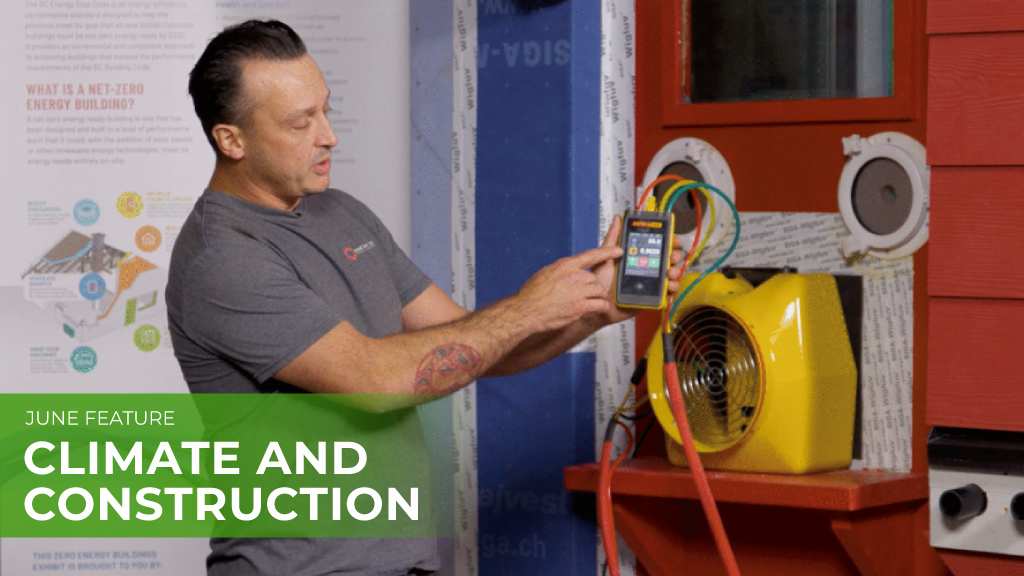
The Zero Energy and Emissions Buildings (ZEB) Learning Centre at the British Columbia Institute of Technology provides training in net-zero energy and zero emissions design and construction, energy management and building retrofits.
ZEB offers microcredential programs, individual courses and private group training.
It also manages the High Performance Building Lab, where it does training in zero energy and emissions building.
ZEB offers microcrediential programs on zero-waste buildings, the essentials of net-zero and Passive House construction and the principles of regenerative building.
The microcredential programs are designed to be taken across two terms and completed within eight months.
Courses are delivered online with virtual live sessions and independent work on a varied schedule of weekday afternoons and evenings.
Alex Hebert, manager of the ZEB Learning Centre, says the most popular microcredentials are Essentials of Net-Zero and Passive House Construction, Residential Air to Air Heat Pump Specialist and Whole-Building Life Cycle Assessment Professional.
Since 2017, more than 5,000 students have received microcredentials.
For more information click here.