BuildForce Canada has released its annual Construction and Maintenance Looking Forward reports for the residential and non-residential construction sectors. This particular story pertains to Ontario and covers the forecast period from 2026 to 2035. The Daily Commercial News will have more provincial breakdowns from across Canada as well as national coverage in upcoming articles throughout the week.
OTTAWA – BuildForce is reporting construction activity in Ontario is expected to rise through 2035, largely due to strengthening residential construction activity combined with elevated levels of non-residential construction investment, driven by a pipeline of major institutional, commercial, heavy industrial and civil engineering projects.
While there will be an initial slowdown in residential construction activity, driven by uncertainty created by the ongoing tariff dispute between Canada and the United States, a period of sustained growth is projected in the medium and longer terms.
Investment in new-housing construction is projected to return to growth by 2028. At the same time, investment in residential renovations and maintenance activity is projected to rise continuously over the forecast period.
“By 2035, province-wide residential construction employment is expected to rise by 11 per cent compared to 2025 levels, with gains greatest in new-housing construction and residential renovation activity,” a release reads.
Non-residential construction sees a slightly different outlook. Investment has risen notably since 2022 and is expected to continue growing into the late 2020s and then remain at those high levels into the early 2030s.
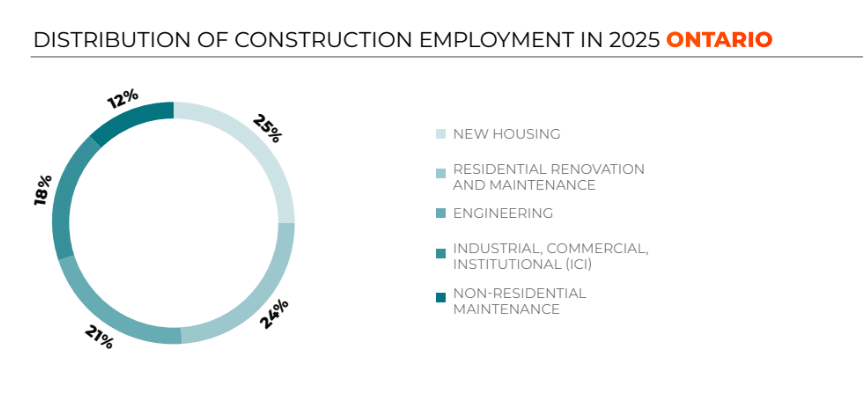
Investment in ICI construction is expected to rise steadily, driven by planned investments in institutional and government buildings, including health care and education projects across multiple regions. Activity is projected to peak around 2030 before moderating.
Commercial building is expected to see significant growth, largely in response to previously high levels of population growth, while the outlook for industrial buildings remains subject to uncertainty, the release adds.
Engineering construction activity is expected to grow through the forecast period, driven by major transit projects, mining activity in the North and a range of utility-sector investments, including nuclear generation and refurbishment projects. Growth in roads, highways and bridges construction is more modest.
By 2035, non-residential construction employment is projected to increase by five per cent compared to 2025 levels.
“Ontario’s construction outlook reflects strong underlying demand across both residential and non-residential sectors,” says Irwin Bess, executive director of BuildForce Canada, in a statement. “Although activity in the residential sector is projected to be constrained in the short term by key factors such as uncertainty created by the ongoing tariff dispute between Canada and the United States, by reductions in immigration levels, and, in some regions, an abundance of unsold multi-unit residential dwellings, the outlook is strongly positive in the middle and longer terms.
“Meanwhile, construction activity in the non-residential sector is projected to rise into the late 2020s and remain elevated to the end of the forecast period as work continues on a long list of significant projects across all six regions.”
Ontario’s six regions – central, eastern, Greater Toronto Area, northeastern, northwestern, and southwestern – each feature different labour market conditions.
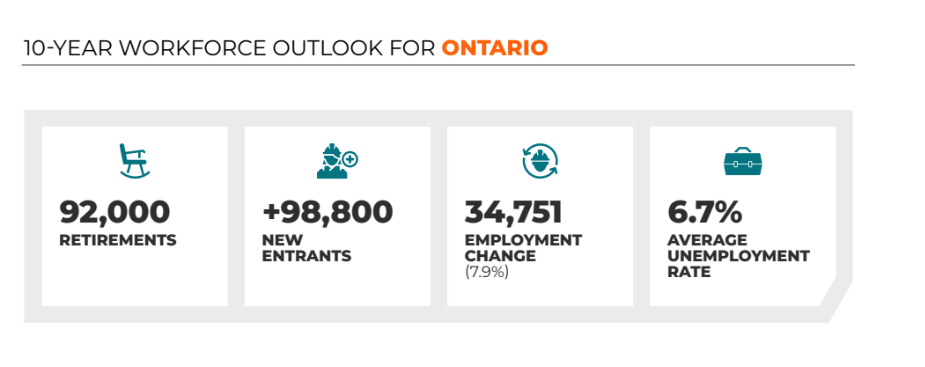
Here are some highlights.
CENTRAL ONTARIO
Activity in the residential sector, which enters the forecast period on a downward trend, is projected to rise significantly after 2027 with renewed growth in new-housing activity and strong demand for residential renovations. Activity in the region’s non-residential sector is expected to rise between 2027 and 2031, with ongoing work on major institutional and industrial projects. Activity in engineering construction is projected to be driven by major transit projects in Hamilton and Kitchener-Waterloo-Cambridge as well as a series of utility-sector projects. By 2034, employment is expected to rise in both the residential (+21 per cent) and non-residential (+11 per cent) sectors.
EASTERN ONTARIO
Increases in the residential sector are projected to be driven by growth in the new-housing component in 2027 and beyond. The region’s non-residential construction sector continues to function at an historically high level, the release notes. Levels are projected to peak in 2030, after which they remain sustained at an elevated level to the end of the forecast period. Construction employment is expected to grow by 2035, with gains expected in both the residential (+10 per cent) and non-residential (+7 per cent) sectors.
GREATER TORONTO AREA
Construction activity contracted in the Greater Toronto Area in 2025, driven by a residential sector that continues to be affected by elevated costs, slowing population growth and unsold condominium inventory. Non-residential construction continues to be driven by a large volume of major projects that are underway in both the engineering construction sector (in the form of public transit systems, utilities projects, and work on roads, highways, and bridges projects) and in the construction of ICI buildings (on health care and education sector projects). The outlook calls for trends to diverge to 2035. After 2028, investment in the region’s residential sector is projected to return to growth. Activity in the non-residential sector, meanwhile, recedes from peak levels in 2029 as work concludes on known projects. Compared with 2025 levels, construction employment in the GTA is projected to rise in both the residential (+5 per cent) and non-residential (+4 per cent) sectors.
NORTHEASTERN ONTARIO
Activity in the residential sector is projected to grow across the outlook period. The outlook for the non-residential sector calls for investment levels to decline modestly into 2035. By 2035, residential construction employment in the region is projected to contract by three per cent compared to 2025 levels, while employment in the non-residential sector is projected to rise by one per cent.
NORTHWESTERN ONTARIO
The outlook for northwestern Ontario calls for the sectors to chart different paths to 2035, states BuildForce. The region’s residential sector is projected to expand with growth concentrated in new housing. Investment in the non-residential sector is projected to rise to a peak in 2028 with ongoing work on several key mining projects. Levels contract thereafter and into 2035. Employment is projected to contract by two per cent in the residential sector and by five per cent in the non-residential sector.
SOUTHWESTERN ONTARIO
Across the outlook period, investment in non-residential construction is projected to decline after 2027. A strong outlook for the construction of ICI buildings is projected to offset slowdowns in engineering construction. In contrast, activity in the residential sector is expected to grow significantly after 2026. Employment rises in the residential (+10 per cent) sector but declines in the non-residential sector (-2 per cent).