A recent LEED-certified data centre announcement might come as a surprise to some observers, given the controversy surrounding the environmental impact of such facilities.
U.K.-based FiveNines Group has recently completed a 9.6 MW data centre project in Amsterdam in the Netherlands that attained LEED Gold certification, a globally recognized standard for sustainable construction covering energy efficiency, water conservation and responsible material use.
The project achieved even more. Delivered on time under a full general contractor model, the project also stands out for its exceptional safety performance.
A peak workforce of 560 people logged an impressive 832,000 working hours without a single lost-time incident, a success driven by proactive wellbeing initiatives, daily leadership tours conducted by the EHS (Environmental, Health and Safety) team alongside management and a Positive Safety Recognition program.
With the Taking Over Certificate now issued for final handover, FiveNines CEO Gerry Curran took time to praise the achievement, crediting the project team and supply chain partners for their professionalism and commitment.
“We are delighted to have successfully delivered a data centre in partnership with an international client,” said Curran. “This milestone demonstrates the capability of FiveNines to execute complex infrastructure projects while maintaining exceptional safety and environmental performance.”
In fact, LEED-certified or approved data centres are increasingly becoming the norm around the world.
There are currently over 1,797 LEED-certified or registered such facilities worldwide, representing more than 542 million square feet of digital infrastructure.
As AI and cloud computing demands scale globally, tech giants and colocation providers are increasingly relying on the U.S. Green Building Council’s (USGBC) LEED framework to mitigate their immense energy and water footprints.
The USGBC says LEED registrations for data centres grew 188 per cent between 2021 and 2024, while certifications increased 97 per cent over the same period. LEED certifications at the Platinum level doubled in just two years.
“If building more data centres is inevitable, building better ones is essential,” says the USGBC. “That’s where LEED certification has become a crucial tool. LEED provides a globally recognized framework for designing and operating high-performance buildings by reducing energy use, improving water efficiency and lowering carbon emissions without compromising operational reliability.”
China ranks as a top global player for total LEED-certified data centre square footage, with North Asia delivering the highest overall percentage of top-tier, high-performance green facilities among its peers on a regional basis.
India has also emerged as a global frontrunner in sustainable digital infrastructure, with over 60 per cent of its certified data centres achieving the highest LEED Platinum rating. As an example, the ITC Sankhya Data Centre in Bengaluru was the first facility in the world to be awarded LEED Zero Carbon certification.
North America is playing catch-up to some extent, although notable LEED-certified data centres are being completed or are on the way.
In the United States, federal legislation was introduced in late July requiring new facilities to achieve LEED certification to be eligible for existing federal tax incentives.
Currently, the State of Virginia has one of the largest concentrations of data centres in the world, although only a handful are LEED-certified. There are high-profile LEED-certified examples such as the Advanced Data Centres facility in Sacramento, Calif. (pre-certified Platinum) and the geothermal-cooled American College Testing data centre in Iowa.
In an effort to streamline global deployment, some of the largest hyperscale tech companies have created standard blueprints around the certification.
For example, Microsoft has developed an authorized and standardized facility design template that automatically complies with LEED criteria across its international sites. Its high-density hubs, like the Microsoft Singapore Data Centre, leverage 100 per cent recycled water and water-cooled chillers to achieve LEED Gold.
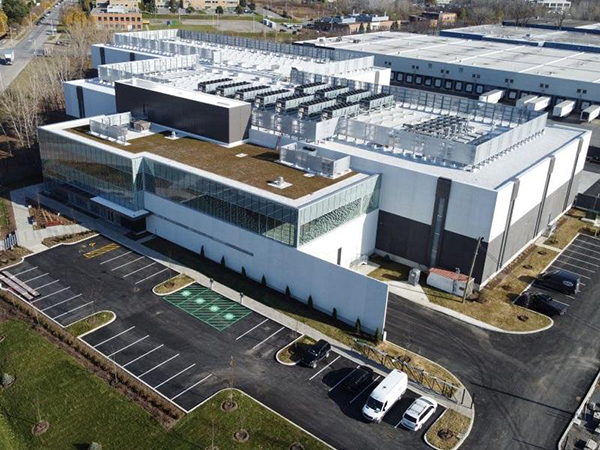
Data centre expansion is picking up pace across Canada, some with LEED certification. The newly opened Cologix MTL8 Facility in Montréal recently earned Gold Certification under LEED, meeting all of the requirements of LEED v4 BD+C: Core and Shell rating system.
However, criticism has been leveled at Meta’s recently-announced 1,800 MW data centre in Sturgeon County north of Edmonton, Alta.
The Pembina Institute says Meta’s new data centre will require more electricity than the entire city of Calgary and will be powered by a combination of grid power and a new natural gas plant.
“That generation shouldn’t have to come from natural gas,” Pembina says. “Meta and the Alberta government could have announced cheaper, low-carbon solutions that wouldn’t expose consumers to higher and more volatile energy rates. Instead, the project will advance and lock in new gas generation – just as costs for developing these power points have doubled.
“The new natural gas power plant would emit 3 megatonnes of CO2,” Pembina continues, “which by itself is equivalent to 10 per cent of Alberta’s total electricity sector emissions.”
Pembina compares this to Texas and Minnesota where data centre proponents, “are considering hybrid supply options, pairing data centres with wind, solar and energy storage, with natural gas and grid connections providing backup.”
The USGBC applies unique rules for data centre calculations because their server infrastructure uses far more energy than typical building operations.
In the LEED rating system, self-generated natural gas power penalizes a data centre’s score by adding directly to its Scope 1 (direct) emissions and directly increasing its total energy consumption.
This severely limits points in the Optimize Energy Performance credit and prevents qualification for LEED Zero Carbon certification. To maximize points, data centres must procure green power through Power Purchase Agreements, Renewable Energy Certificates or carbon offsets.
“Investing in LEED-certified facilities is no longer just a mark of corporate responsibility, it’s a strategic imperative,” says the USGBC.
“Future-proofing digital infrastructure means designing for resilience, efficiency and sustainability from the start. In a world where the cloud keeps growing, the path to a greener digital future begins on the ground.”
John Bleasby is a freelance writer. Send comments and Climate and Construction column ideas to [email protected].