The Conference Board reports a slight decline in the US Consumer Confidence Index to 90.8 in July, reflecting ongoing economic concerns and mixed outlooks.
WASHINGTON — Although consumers seem to have adjusted to constant talk of war, they are still concerned with rising gas, oil and food prices, according to a new consumer report, and the realities have shoppers pessimistic about current conditions.
“Consumer confidence moderated slightly in July, continuing a general downward-sloping trajectory since late 2021,” said Dana M Peterson, chief economist at the Conference Board. “The Present Situation Index was less positive for a third consecutive month, while the Expectations Index remained in negative territory.
The Conference Board Consumer Confidence Index decreased by 1.4 points to 90.8 (1985=100) in July, down from an upwardly revised 92.2 in June. The Present Situation Index — based on consumers’ assessment of current business and labor market conditions — fell by 3.6 points to 114.9, its third consecutive monthly decline. The Expectations Index — based on consumers’ short-term outlook for income, business, and labor market conditions — remained unchanged at 74.7. The survey period for this month’s preliminary results was July 1-22, encompassing ongoing conflict in the Middle East.
“Consumer appraisals of current business conditions and, to a lesser extent, perceptions of the current labor market both softened,” added Peterson. “Looking ahead, consumers anticipate little improvement in business conditions over the next six months, but expectations for the labor market were slightly less negative. Expectations for household incomes moderated but remained optimistic overall.”
The Present Situation Index declined in July. Net views of current business conditions — the share saying conditions are “good” vs. “bad”—fell by 2.6 percentage points to 1.1%, barely holding onto positive territory. Perceptions of current employment conditions also declined, with the share of consumers saying jobs are “plentiful” minus the share saying jobs are “hard to get” dipping to 3.1%. This downshift was driven by fewer consumers reporting that jobs are “plentiful”, while those saying jobs are “hard to get” dipped slightly over the month.
The Expectations Index remained unchanged in July. Two of its three components declined — with net expectations for business conditions dipping by 1.5 points to -3/3%. Net expectations for household income also softened by 0.5 points, to 7.3%. Net expectations for labor market conditions improved by 1.3 ppts but remained in negative territory.
On a six-month moving average basis, by age, confidence for consumers under 35 remained the highest, while confidence among those aged 35-54 showed the greatest improvement. By income, confidence was mixed, but generally higher-income groups were more optimistic. By generation, confidence for Gen Z and Millennials remained the highest, while confidence fell the most for the Silent Generation on a six-month moving average basis. By political affiliation, confidence among Independents and Democrats softened while Republicans were somewhat more positive.
What consumers are concerned about
Consumers’ write-in responses on factors affecting the economy continued to be mostly pessimistic in July. References to prices and oil and gas eased in frequency but remain elevated. Comments about food and grocery prices increased. Mentions of war, geopolitics and conflict eased during the sample period.
However, as the fighting has reaccelerated quite recently, there could be an increase in these mentions in the revised data for July. Notably, references to jobs and unemployment picked up slightly.
Consumers’ average and median 12-month inflation expectations were less elevated in July. Most consumers — 61.3%, unchanged from June — still expected higher interest rates over the next 12 months. Notwithstanding recent volatility in the equity markets, consumers still expected higher stock prices a year from now.
Consumers’ net views of their Family’s Current Financial Situation improved after deteriorating for three consecutive months. Views of their Family’s Future Financial Situation were healthy but slightly less optimistic in July compared with June. Meanwhile, the share of consumers who said a U.S. recession over the next 12 months is “somewhat likely” continued to rise, but overall recession expectations remain low, with those saying recession is “very likely” declining. (These measures are not included in calculating the Consumer Confidence Index).
Home buying and auto purchasing expectations continued their upward trend on a six-month moving average basis. Among consumers’ planned purchases of durable goods within six months, furniture and smartphones remained the most desired items, but expectations for smartphones moderated in July. Spending plans for TV sets, refrigerators and washing machines rose on a six-month moving average basis.
What consumers will still spend on
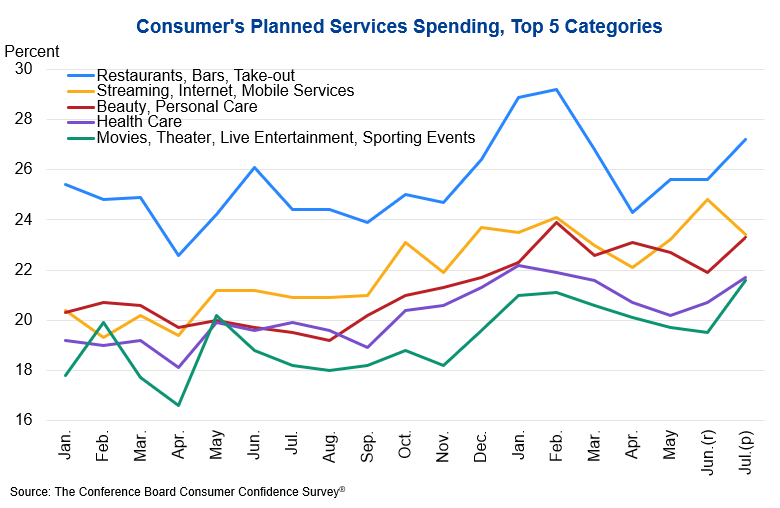
Consumers planned to spend more on services over the next six months, including spending on restaurants/bars/take-out, streaming/Internet/mobile services, and beauty and personal care. Travel intentions within six months perked up in July after easing for most of the year. Domestic travel plans recovered while foreign travel plans softened a bit.
The monthly Consumer Confidence Survey, based on an online sample, is conducted for The Conference Board by Toluna, a technology company that delivers real-time consumer insights and market research. The cutoff date for the preliminary results was July 22.