A three-day torrential downpour in British Columbia in 2021 so damaged a wooden bridge in a popular provincial park that it could no longer be used.
Fortunately, engineering innovation and creativity came together to create a durable and environmentally friendly replacement.
This is how it happened.
The coast of B.C. gets a lot rain in winter, but the November 2021 atmospheric river event was a natural disaster that dropped months’ worth of precipitation in just 48 hours.
The drenching caused massive floods and landslides and cut off Metro Vancouver from the rest of B.C.
It also killed more than 600,000 farm animals and five humans.
Major routes, including the Coquihalla Highway (Highway 5) and Highway 1, were damaged or washed away, severing land and rail connection to the B.C. Interior.
The storm also damaged two bridges in popular Coquihalla Canyon ParkCoquihalla Canyon Trail/Bridge Improvements and Rock Works – Phase 2StatusPost-BidValue$0.1MLocationCoquihalla Canyon Provincial Park, Hope BCSectorPublic – State/ProvincialTypeBridges/Tunnels · New Construction · DemolitionData as of August 5, 2026View Project Page →.
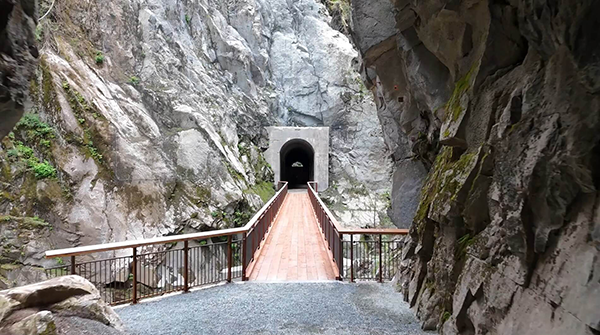
The provincial park in southwestern B.C. contains a series of historic rail tunnels – the Othello Tunnels – that were built in 1914.
The tunnels are connected by pedestrian bridges that together form a continuous public pathway through the canyon.
Following the 2021 storms, the bridges – Bridges 1 and 2, as they are called – were checked for damage.
The flood had caused Bridge 1 to suffer erosion and material loss. In addition, rockfalls undermined its stability and led to partial structural failure.
It was determined the bridge was at the highest structural risk and was closed immediately.
“The flood damaged the bridge’s centre support, causing the bridge deck to separate and making it unsafe for continued public use,” says Damian Liebeknecht, project manager of Tetra Tech Canada Inc., which was hired by the B.C. Ministry of Environment and Parks, the owner of Coquihalla Canyon Park and the bridges, to undertake the rehabilitation of Bridge 1.
Tetra Tech provided structural and geotechnical engineering design and construction and engineering support during construction.
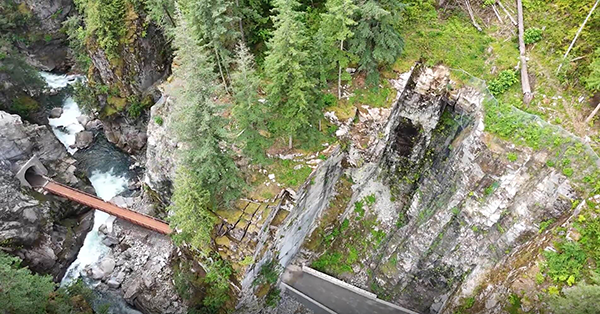
The project team considered a number of different repair options for Bridge 1, such as rehabilitation of the existing two-span bridge, replacement in-kind and removal of the centre pier.
The possibility of retaining an in-channel pier was rejected because that left the bridge vulnerable to erosion, floods and river blockage.
The project team also considered modular systems, but it concluded modular’s fixed geometry, the modifications to the abutment that were required and their industrial appearance were incompatible with the bridge’s historic setting.
In the end, it selected a custom 45-metre long clear-span structure that is supported on existing abutments, because it addressed structural risk, heritage context and the constraints posed by the bridge’s location.
“The project had to protect the Coquihalla River by avoiding in-water construction while minimizing impacts in a sensitive park and heritage corridor,” says Liebeknecht.
The project team had to deal with environmental constraints that governed construction methods and timing, including restrictions on in-water work in the Coquihalla River that would have required crews to work either in the river or below the high-water level.
“The bridge was assembled in sections in Tunnel 2 and progressively pushed into its final position from one side of the canyon,” says Liebekecht.
The risk of rockfalls was mitigated by removing loose rock; a combination of pinned and draped mesh systems were used to provide rockfall protection to retain loose rock on the slope and guide falling rock away from areas of public access.
Western Red Cedar was selected for the bridge’s exposed timber elements, reflecting local traditions and cultural significance while providing durability.
The project was completed in November 2025.
The replacement restored continuous public access through the Othello Tunnels while avoiding in-water works and strengthening long-term climate resilience.
Not forgetting Bridge 2, full deck and railing replacement of it, and targeted rockfall mitigation enhanced the bridge’s structural safety, durability and user experience.
Liebeknecht says the innovation in the project lay not so much in a single feature rather than in the overall engineering solution.
“The replacement bridge was purpose-designed for the site’s unique conditions, eliminating the centre pier while improving long-term resilience,” says Liebeknecht. “The design balanced extremely limited site access, environmental protection requirements, heritage considerations and rockfall hazards, resulting in a constructible solution that minimized impacts to the surrounding park and river.”
The Coquihalla Canyon Park – Bridge Replacement won a 2026 Award of Merit from the Association of Consulting Engineering Companies British Columbia in the bridges category.