The modernization and expansion of today’s digital infrastructure is offering major opportunities for the construction industry for years to come, an investment McKinsey estimates to be worth about $19 trillion by 2040.
Much emphasis is being put on the billions of dollars targeted for data centre construction. Yet the construction of the buildings themselves involves perhaps only 25 per cent of the huge numbers presented in the media.
The remaining 75 per cent represents the technology housed within the buildings. However, the growth of AI, and in particular those aspects of data centres concerning connectivity via fibre, satellites and cables, will require major investments in power generation and distribution. Here lies a huge, long-term opportunity for the construction industry that is often overlooked.
“We are not paying enough attention to the less glamorous reality underneath it: the physical infrastructure required to make AI work,” writes George Sakellaris, founder and CEO of energy infrastructure solutions provider Ameresco. “We can build the world’s best models, write the world’s best code and design the world’s fastest chips. But none of it matters if we cannot power the data centres.”
While AI is rapidly creating an electricity-heavy new industry, Sakellaris says today’s power grid runs on assumptions from an earlier era. Meeting the growing demands will require an expanded energy infrastructure, a modernized grid and new power generation and storage.
Expanding the power generation capabilities of North America to accommodate the new wave of hyperscale data centres is time critical. Traditional grid expansion timelines in the United States involving new high-voltage interconnection approvals range from five to 15 years. Many hyperscale developers are unwilling to wait and are taking matters into their own hands by building “behind-the-meter” onsite generation to bypass grid congestion.
Behind-the-meter power generation refers to the electricity produced either on or adjacent to a data centre site and consumed directly by the facility. This avoids the public utility grid or a retail electricity tariff structure.
As international power generation designer, builder and operator US Power & Environment (USP&E), explains, “This approach eliminates grid dependency, avoids utility interconnection delays, provides the operator with direct control over fuel supply and generation costs, and enables the facility to operate continuously regardless of public grid outages or curtailment events.”
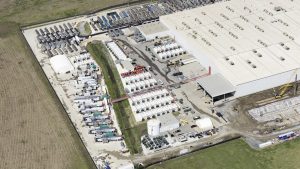
Behind-the-meter generation is the primary power strategy that has been widely adopted by hyperscalers, bitcoin mining operations and AI infrastructure developers who cannot wait for grid expansion, or whose power reliability requirements exceed what a utility can contractually guarantee.
The capital costs to construct the generation facilities, be it a modern 100 MW AI facility up to a next-generation 1 GW supercluster, varies sharply across technology options.
The least expensive power generation option is simple cycle/reciprocated natural gas generation. With estimated costs of $1,200 to $ 1,500 per kW, the investment required for a 100 MW data facility is between $120 and $150 million. Make that a 1 GW data centre and the cost jumps to between $1.2 and $1.5 billion.
Although debate surrounds the environmental impact of natural gas power generation, USP&E says natural gas is the preferred fuel for behind-the-meter AI data centre power generation.
“Natural gas turbines offer high power density, lower emissions relative to diesel or heavy fuel oil, fuel price stability through long-term supply contracts, and compatibility with hybrid configurations including solar photovoltaic and battery storage.”
Fast-track gas turbine power plant installations for AI data centres typically require 12 to 24 months from contract signature to commercial operation, USP&E says, depending on whether new-build or verified surplus equipment is used. Sometimes power generation completion takes even less time.
Natural gas generators for Elon Musk’s xAI data centre dubbed Colossus were reportedly up and running in 122 days.
Costs increase as other generation types are considered. For example, a solar PV and battery storage system with 24/7 firming — the combination of photovoltaic arrays, large-scale battery storage and overbuilding to provide continuous, round-the-clock electricity — can cost three or more times the natural gas option.
Analysts are only beginning to understand and quantify the infrastructure opportunity for the construction industry represented by the behind-the-meter power generation option.
“The Behind-the-Meter (BTM) Market Size was valued at US$105 billion in 2025 and is expected to reach US$520 billion by 2035, growing at a CAGR of 18 per cent from 2026 to 2035,” says private market research and business consultancy S&S Insider.
“For developers, operators and infrastructure investors, understanding AI data centre power requirements has become the most consequential planning question in the energy sector today,” says USP&E.
Electrical generation demands are forecast to grow quickly in Canada as well. However, to this point Natural Resources Canada is focussed on traditional grid expansion.
“Canada is entering this critical moment with a strong competitive advantage: a reliable, low-cost, low-emission electricity system that ranks among the most affordable in the world, with abundant, affordable natural resources to help generate additional power.”
Natural Resources Canada goes on to say Canada’s power generation and distribution system has been built over decades and reflects the leadership and sustained investment of provinces and territories, utilities, generators, system operators and ratepayers.
“This foundation must now be both protected and strengthened in the face of rising demand and a more complex global environment.”
Even if that protectionist outlook means behind-the-meter power generation lags the pace of the United States, it nevertheless presents a powerful opportunity for the construction industry.
John Bleasby is a freelance writer. Send comments and Climate and Construction column ideas to [email protected].