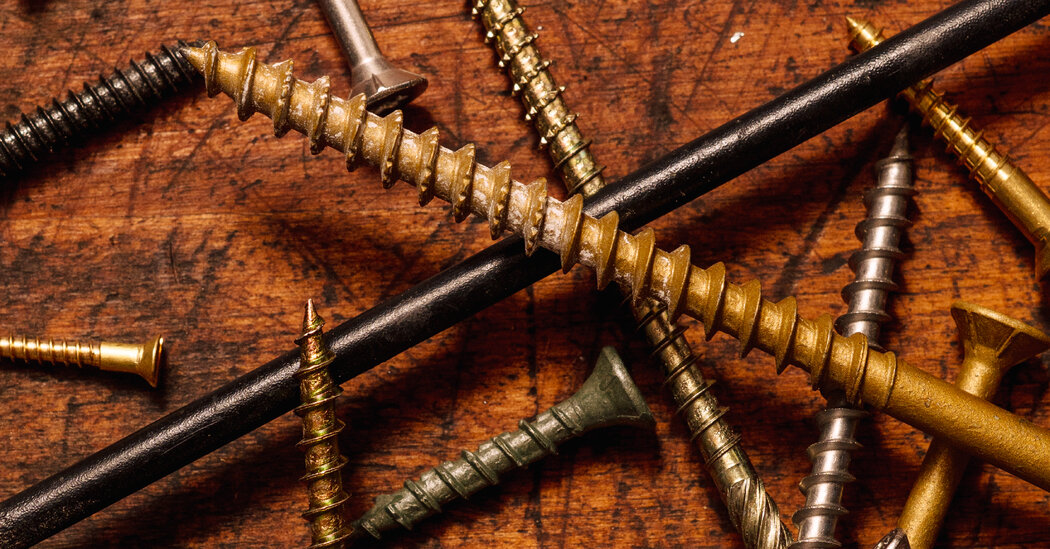
If you’re craving confusion in your life, visit the screw aisle of a big hardware store.
The long racks are packed with screws in dozens of sizes and lengths; in standard and metric versions; for wood, metal or concrete; and in brass, zinc-plated and stainless steel varieties. The abundance can turn a seemingly straightforward decision into an ordeal. You enter the aisle with the humble goal of hanging a curtain rod, and soon you’re wondering if it would be easier to just hire someone else to do it.
But picking the right screw doesn’t have to be hard. Three basic varieties are all you need for many home projects. Keep them on hand, and you’ll be ready to hang shelves, repair furniture, fix simple machinery, install bathroom hardware — and put up curtain rods.
Knowing which screw to use is also important from a safety standpoint. A previous occupant of my house repeatedly used the wrong fasteners to hang heavy objects; someone could have been hurt if any of them had failed.
For hanging: Sleeve anchors
Plastic sleeve anchors are the simplest, least destructive and most versatile way to hang moderately heavy things on walls. They consist of small screws and plastic sleeves that slip into small holes drilled in the wall. The sleeve expands as the screw is driven into it, wedging the anchor solidly in place. Sleeve anchors are typically rated to hold from 20 to 25 pounds apiece in drywall and plaster, and considerably more in concrete.
They’re exactly what the previous occupant should have used to put up the bookshelves that hung high above the staircase in my home. Instead, he drove three-inch wood screws through the half-inch drywall and into the empty air behind it. They provided almost no anchorage, and I was easily able to pull the shelves off by hand when renovating.