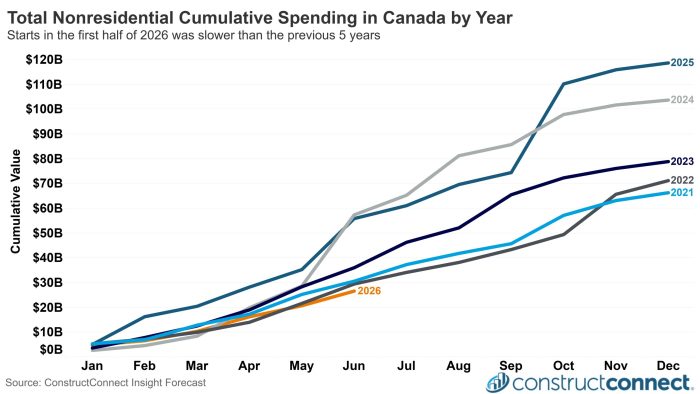
Canadian nonresidential construction starts have totalled $26.6 billion through the first half of 2026, the slowest pace through June in the last five years.
The declines have been widespread, with seven of nine construction categories posting lower starts compared to the same period last year. However, it is worth noting some of that decline reflects the high baseline set by a record 2025.
The pullback reflects broader economic conditions weighing on the Canadian construction market. For contractors and developers, identifying which categories and geographies may be positioned for growth is increasingly valuable as the overall market softens.
Macroeconomic headwinds
The headwinds facing the Canadian economy have been steadily building in recent years, with more recent developments compounding the pressure. Cross-border trade with the United States has been turbulent over the past year-and-a-half, beginning with U.S. tariffs levied against a wide variety of goods.
The Canada-United States-Mexico Agreement (CUSMA) has shielded agreement-compliant goods from most of those tariffs. However, even CUSMA is becoming more complicated.
The United States did not renew the agreement by the July 1 deadline, pushing it to annual review through 2036. While that leaves years before expiration, the uncertainty makes long-range business planning more difficult.
These trade hurdles and future murkiness weighed on the Canadian economy, dragging real exports down 5.2 per cent in Q1 2026 compared to the same period in 2025. That, along with broader economic weakness, pushed Canada into back-to-back GDP contractions in Q4 2025 and Q1 2026.
Beyond the trade pressures, Canada is also facing a declining population. Statistics Canada’s population estimates have declined for three straight quarters, and the Q2 2026 population was 0.5 per cent lower than a year earlier. A major part of this decrease has been the exit of non-permanent residents, who have declined 17 per cent over the past year.
Bringing it all together
For the construction economy, this environment does not provide a ton of support. U.S. trade policy has hurt Canadian exports, and the uncertainty over that relationship has softened investment as businesses wait on the outcome.
A shrinking population adds to the pressure on two fronts. Fewer people means less demand for residential, education and commercial construction. The falling population could also weigh on available labour for the construction industry, which has only seen a 1.5 per cent increase in employment over the past year.
What could support the market
Despite the weakness early in the year, there are still positive signals in the construction market. A main reason for this has been the current federal goernment’s focus on directing significant investment toward major projects. A key element of that effort has been the Major Projects Office (MPO), which has supported large-scale projects since its inception last year.
Several MPO-referred projects broke ground last year, lifting total nonresidential construction starts significantly in the back half of 2025. Something similar could happen in the second half of 2026, as several MPO-referred projects are again nearing groundbreaking, including the Ksi Lisims liquefied natural gas project.
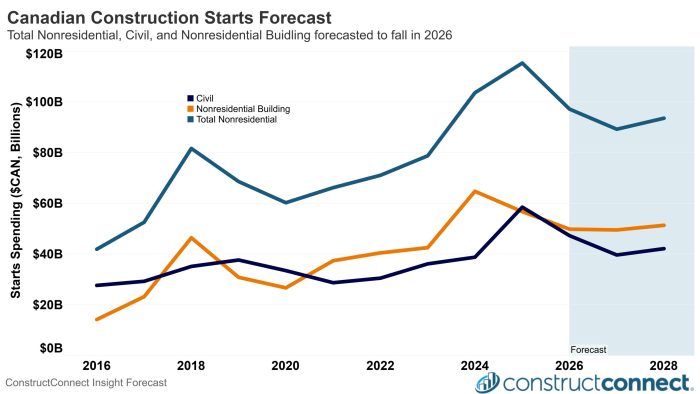
In addition, full-year forecasts for total nonresidential starts remain above levels seen before the 2024 and 2025 jump, and starts are forecast to return to growth as the economy strengthens.
What it means for firms in the industry
This environment is difficult for the construction industry. A weak economy, ongoing trade policy uncertainty from the country’s largest trading partner, and a shrinking population have all dampened construction activity.
However, these headwinds may not last, and support is building. The current government has pushed to decrease reliance on the United States through public investment and incentives to the private sector. These initiatives should stimulate investment in energy, transportation, export, community and other types of construction.
For construction firms, a targeted approach to business planning will matter more than usual. With headline declines in construction starts, firms will need to carefully target the categories and geographies that are seeing growth to capture opportunities.
Devin Bell is the associate economist for ConstructConnect.