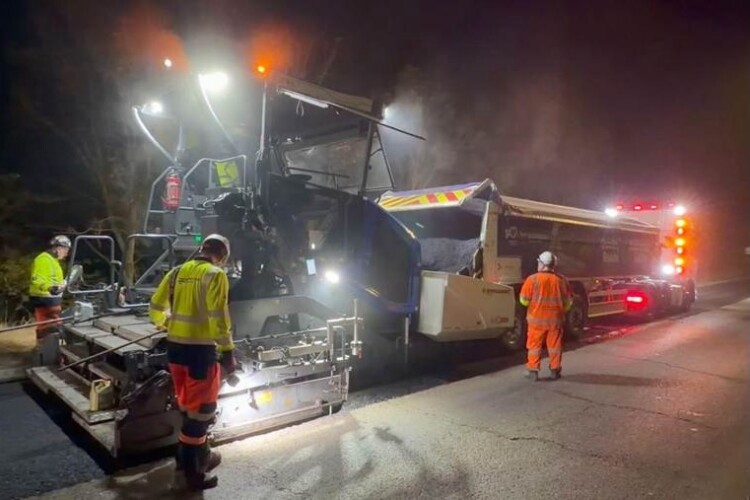
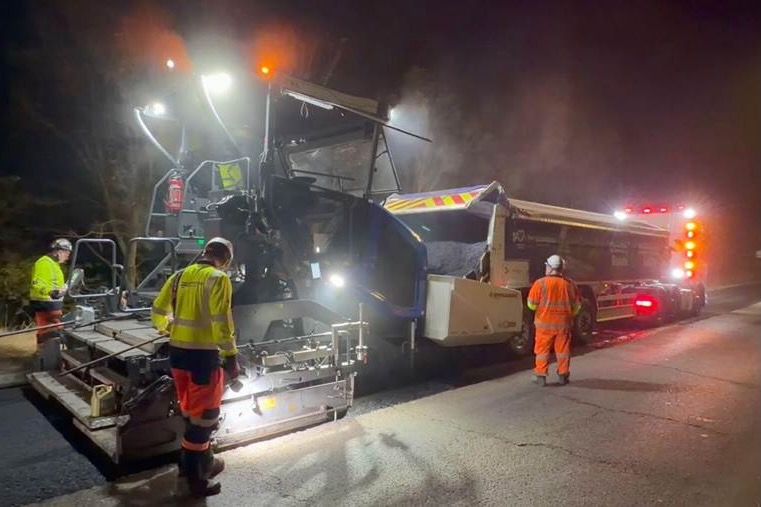
The paver showed it had the battery power needed for overnight working. Eurovia detailed that it had installed 240.32 tonnes of asphalt across the binder and surface courses without requiring additional charging. Binder-course paving began at 22:05, with the machine installing 139.58 tonnes of AC 20 HDM Binder Course 40/60 Tempera warm-mix asphalt.
It then installed 100.74 tonnes of Fibrovia 10 Surface Course PMB 68 PSV, completing the final load at 01:08. Having heated its electrically powered screed and installed both asphalt layers, the machine completed the operation with 57% battery capacity remaining.
Powered by a 294 kWh battery, the SD25 80C e delivers up to 235 kW through five electric motors. It can operate for up to 10 hours on a single charge and can lay more than 1,000 tonnes of asphalt during a shift.
While the machine proved its capacity on this shift, Paul Goosey, MD, Eurovia Surfacing, warned more work was needed to establish their commercial viability.
“The transition to lower-carbon construction is one of the most important opportunities facing our industry, and trials such as this help us understand how emerging technologies can support that journey.
“While the environmental and operational benefits of electric plant are clear, these machines currently require significantly greater upfront investment than conventional diesel-powered equipment. Understanding charging infrastructure, utilisation and whole-life costs will therefore remain critical as we evaluate future fleet-investment decisions.
“The findings from this trial will help shape our future investment strategy and provide valuable insight into how electric plant can work alongside warm-mix asphalt, higher recycled-content materials and other lower-carbon construction techniques.”
Got a story? Email [email protected]