The Ontario Stone, Sand & Gravel Association (OSSGA) has launched a new video campaign to rally Canadians to push back against the on-again, off-again tariffs imposed by U.S. President Donald Trump and show support for initiatives of the federal and provincial governments.
The organization maintains Canada is in a fight that puts industries, workers and the future of the country on the line.
“Being Canada proud means recognizing the incredible people, industries and communities that contribute to our nation’s success,” explains OSSGA executive director Michael McSweeney. “Our members work tirelessly to support the infrastructure that strengthens Canada – and more specifically Ontario.
“We built this great province, and we are proud to stand up for it. We’re also proud of the work our governments – both federal and provincial – are doing to support Canadian workers and protect the strength of our economy. In challenging times, that leadership matters.”
The video campaign shines a spotlight on the work and national pride that define the stone, sand and gravel industry and notes that, in a time of economic uncertainty and trade pressures, it’s more important than ever that all sectors of the construction industry work together.
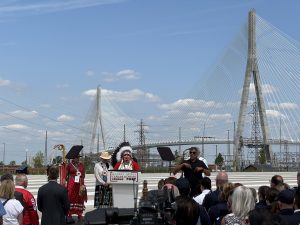
The OSSGA notes the CN Tower, Queen’s Park, Casa Loma, the Rideau Canal and the Gordie Howe bridge were all built with Ontario sand, stone and gravel.
“Ontario aggregate powers our progress,” the video states, panning to a shot of Niagara Falls and highlighting that even the paths around Ontario’s natural wonders were built with stone, sand and gravel.
McSweeney says the OSSGA is taking a stand because it wants to show the world that Canada’s foundation – literally – is strong, united and ready to push back.
A lot of critical building materials like steel and aluminum which affect the stone, sand and gravel industry are manufactured in the province, he says, and the OSSGA wanted the province to know that its members fully support the work the premier is doing and that Canada is not for sale.
“We want to have a strong relationship with the United States. Our countries have fought side by side to defend democracy. We have human capital, financial capital and supply chain materials going back and forth across the border and we wanted to support the premier.”
The aggregates industry forwards five to six per cent of its materials to the U.S. Tariffs on steel and aluminum also affect the price of trucks and equipment.
“All our equipment, for example, whether it’s Caterpillar loaders, bulldozers, steamrollers, is affected, and even the pickup trucks that our industry uses to serve customers.”
Canada also exports about 40 per cent of its cement to the U.S.
According to McSweeney, the industry is taken aback the U.S. is imposing tariffs on Canadian materials.
“There was a lot of surprise and shock that it happened so quickly and unilaterally. I think people are just generally concerned that we’ve had this allied relationship with the United States for 200 years or more, so it comes as a shock that at the end of the day. There’s an understanding that Americans have to protect their industry, but we have to protect our industry.”
The recently announced 50-per-cent tariff on copper proclaimed by Trump is also throwing a wrench into the works, as it is used in many applications such as piping and semi-conductors.
McSweeney said the OSSGA just wants fair trade and to ensure there is some business certainty.
“I would think that’s what the Americans would want, too, is fair trade. All governments need certainty and businesses need certainty as well.
“If the MTO puts out a tender now for work to be done a year from now, we need to know what the tariffs will be for steel and aluminum for vehicles. We need to know whether or not we will be able to sell stone, sand and gravel into the U.S. market without tariffs. It’s all about having a level of certainty.”
A lot of stone, sand and gravel companies are investing shareholder money, or their own funds, and are looking for assurances they can attract investors to their companies, says McSweeney.
The OSSGA is presently waiting to see what happens with the July 21 deadline set by the governments of Canada and the U.S. for a trade deal. The association works closely with the Association of Municipalities of Ontario and will use the video to remind people of the need to remain vigilant.
McSweeney is encouraging the public to send letters to governors of states that do business with Canada.
“You need to build a relationship that is constant, consistent, co-ordinated and with a compelling story. You build these relationships up over time so that during a crisis you can use the goodwill that you’ve built up. Trying to build a relationship in the time of a crisis, generally speaking, it doesn’t work. So, it is incumbent upon us to build relationships all the time.”