Recent shifts in North American attitudes towards Battery Electric Vehicles (BEVs) may leave building owners and project developers planning parking facilities wondering if the battery is half full or half empty.
Globally, BEV sales increased 14 per cent from 2023 to 2024, according to research firm Rho Motion, marking the end of multi-year increases. In Canada, growth of BEVs was notably higher, up 41 per cent over the same period, with Quebec representing over 50 per cent of sales. However, BEV sales in the United States were up only 7.3 per cent.
North American BEV sales face headwinds in the near future.
U.S. President Donald Trump’s “Big Beautiful Bill Act” put an end to BEV purchase subsidies. In Canada, the Incentives for Zero Emission Vehicle Program offering $5,000 rebates for purchases and leases officially paused on Jan. 12, as the allocated funds were fully committed.
Government subsidies in both countries for EV charging have also disappeared.

U.S. government support for Level 2 EV charging infrastructure was eliminated as part of Trump’s bill. In Canada, federal funding supporting EV charger deployment in public places, on-street, in multi-unit residential buildings and at workplaces closed for applications in September 2024. No announcements have been made concerning reinitiating the program.
The contrast between optimistic sales projections versus an uncertain future is leaving property and project owners with the delicate decision of how to handle EV charging.
Aside from the cancellation of purchase incentives, one major challenge holding back BEV sales in Canada is the availability of recharging stations. This can place pressure on building owners to install EV charging stations in their parking garages or lots, not only to meet today’s demand but to make their commercial and residential buildings more appealing to tenants and occupants in the future. Shopping and work patterns have also changed as a result of COVID, with less in-person shopping and more hybrid employment. Landlords counting on parking revenue may be tempted to look at EV charging as an income boost.
Municipal regulations are also pressuring owners of new buildings to install charging.
For example, under the City of Toronto’s Green Standards Version 4, all shared parking spaces in both new low rise and mid-to-highrise residential buildings must have, “an energized outlet or full Electric Vehicle Supply Equipment capable of providing Level 2 charging.”
In non-residential buildings, 25 per cent of parking spaces must be equipped with energized outlets capable of Level 2 or higher EV charging.
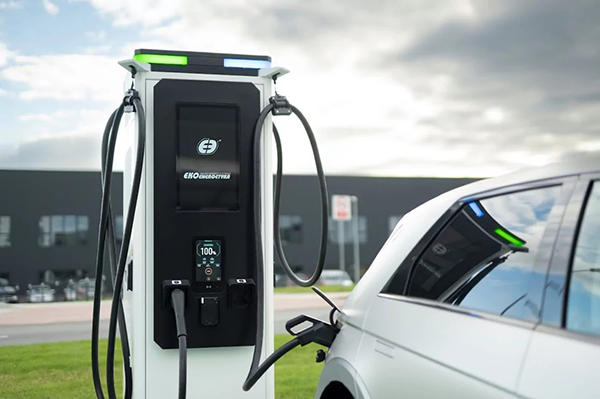
Toronto is not alone. Across the country, over 40 Canadian municipalities also have their own EV charging requirements for new MURBs and other developments.At the provincial level, Québec has gone further, recently proposing draft EV charging regulations under the Québec Building Authority (RBQ). This targets BEV readiness when existing buildings undergo renovation and upgrades in an attempt to bring discipline to an often fragmented process.
“For building owners, this means fewer surprises mid-project. For residents, it increases the likelihood that charging will eventually be available to all,” writes David Corbeil, president and co-founder of Québec-based Recharge Véhicule Électrique. “For contractors, it provides a consistent framework for scope, budgeting and communication across stakeholders.”
There are physical considerations as well which could have an impact on the layout and construction of a multi-level parking facility in the age of BEVs. Most serious are those surrounding the increased weight of BEVs over their ICE counterparts.
For example, most parking garages allow for a live load of 40 pounds per square foot. Some suggest this should increase to 50 pounds. However, with BEV sales representing only a modest number of new vehicle sales, the need for increased load capability is being questioned.
In addition, if several EV charging stations are introduced into a parking facility, the width of spaces needs to increase beyond current standards to allow recharging access.
In the face of possible decreasing BEV demand, it makes for difficult decisions. Estimating the economic payback for facility owners can be complex.
One must consider the combination of costs associated with new design calculations and structural enhancements, the price for charging stations hookups, the absence of government incentives and any mandatory municipal requirements.
John Bleasby is a freelance writer. Send comments and Climate and Construction column ideas to [email protected].