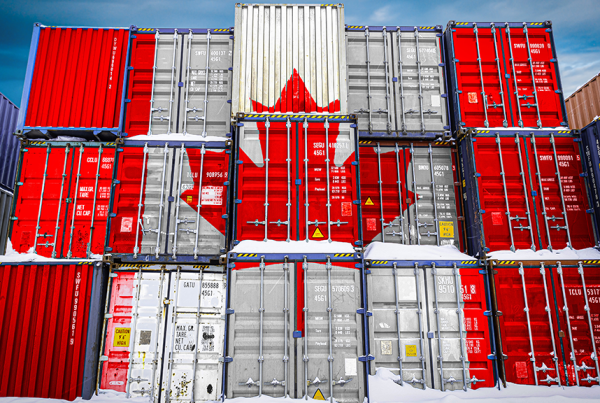
Economists with Oxford Economics believe Canada is already in the midst of recession due to the trade war with the United States, with exports “falling off a cliff” in April and capital expenditures by business including project spending in the construction sector on hold.
The consulting firm presented its latest analysis July 29 in a presentation titled Trade War-Induced Downturn Underway in Canada, three days before the Donald Trump adminstration’s latest deadline for a trade deal with Canada.
Director of Canada economics Tony Stillo and senior economist Michael Davenport spoke to journalists via webcast and responded to questions on Canada’s construction sector.
“We think the trade war with the U.S. and globally has already likely pushed Canada into a recession, barring a deal which looks less and less likely by Aug. 1,” said Stillo, forecasting a possible loss of 140,000 jobs.
“If we did have an immediate deal, the second half could look better, maybe avoid a full recession, but we expected the third quarter, the fourth quarter, also to see contractions as the trade war broadens to the households and housing sector, but not a deep recession, still about 0.8 per cent on a peak-to-trough basis, over three quarters.”
Under the firm’s baseline macro forecast, which includes current levels of tariffs on products such as steel and aluminum and 25 per cent on non-USMCA-compliant products, industrial production will contract 2.1 per cent in 2026. Most tariffs are assumed to be removed by Q3 2026 as the USMCA is renegotiated.
Stimulus through defence spending
Stimulus measures promised by the Liberals during the spring election campaign are mainly on hold as Prime Minister Mark Carney has delayed his government’s first budget until the fall, Stillo noted.
The only measures the Liberal government has announced to date are the cut to the middle-income tax bracket and the break on the GST on new home purchases, Stillo said, “and now, of course, defence spending, the defence spending will take defence as a share of the GDP to two per cent by the end of the fiscal year…but that’s all going to be later in the year.”
The defence spending and temporary counter-tariff relief will soften the downturn but won’t prevent a recession through to the end of the year, Stillo said.
New tariffs will lead to fewer exports, Oxford Economics believes, while uncertainty and a weaker labour market will weigh on domestic demand.

The uncertainty is weighing on business sentiment towards investment and hiring plans, Stillo said.
“Uncertainty has eased a little bit, but it still is quite elevated,” Still said, referring to reduced capex spending.
“You may retool and keep your machinery operating, but any new equipment or new expansions, a lot have been put on hold.”
Davenport said his firm thinks a multi-year downward trend in residential construction will continue in the second half of this year, as many factors including uncertainty among builders, high costs and the cost impacts of Canadian counter tariffs play out.
“That will be a factor that causes firms to either delay, shelve or cancel entirely new residential product projects,” he said.
Other factors affecting housing starts include the expectation that borrowing costs will edge higher as bond yields rise in the second half of this year, and the probability that the Bank of Canada will maintain interest rates at their current level, Davenport said. Reduced immigration will also contribute to lagging demand.
But the story changes in the medium term, Davenport said.
“We do expect a significant pickup in housing starts and new housing construction as we move through the second half of this decade, into the early 2030s,” he said. “What’s really driving that is our expectation that this big push by governments to facilitate greater housing investments, greater housing construction, will ultimately add more units to that housing stock.”
Worst-case scenario
On the ICI side, if the trade war persists, in a worst-case scenario, a range of projects including transportation and warehousing would be affected, Stillo said.
Within the next five years or so, Stillo said, the federal-provincial major projects initiative will provide a boost to the ICI sector on both the public and private sides. The federal government will provide incentives to the private sector so “it isn’t going to just be purely government. There’ll be a private element of this as well,” said Stillo.
“We have a pickup in growth, the end of the trade war, middle of next year…because it partly is the fiscal stimulus, and that’s what we need. It’s going to be a lot on infrastructure and government contracts.”