Hi, Vicki and Tom of Duo Home here with some more thoughts on running a successful home store in 2025.
Tom: I was recently talking with Vicki (my wife and biz partner) regarding our expansion plans into our second floor. Our store and production art company are located in a 1911 five-story warehouse that we purchased in 2014. As you all know, any project like this in an old building has a lot of moving parts, which leads me into the subject of this month’s column. Do not let perfect get in the way of good! Case in point: I had a $27,000 estimate to replace a gutter on the west side of our building five stories up. That would be perfect, however I went to the rooftop myself 60 feet above street level and patched the gutter. Cost, $14. That is good, not perfect. The gutter will need to be replaced at some point but we now have $26,986 to use on inventory, marketing or any number of items we might need.

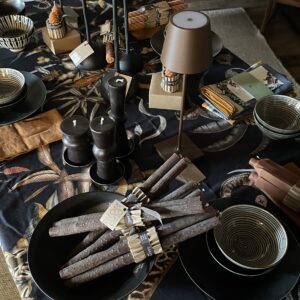
Vicki: That’s a great example of good working better than perfect, until Tom falls off the roof! You have to keep an eye on him! In terms of merchandising, I’m thinking of how I had an expectation of what I needed to display product in our store. I could have easily spent all my budget fitting out the space to make it look exactly as I had pictured it in my mind – or how Instagram told me it should look. Instead, I went to work with what I had right here in our building, as well as items my friends or family had available. Once I made the mental shift from “perfect” to “good,” things really started to come together. The most interesting part of this is, once the store was open, I received countless comments on how beautiful the table displays looked and questions about how I thought of setting it up like that. Mind you, our store does not have an industrial nor country theme, but these vintage pieces worked beautifully with our more modern offerings. And most importantly, it allowed more money to be spent on products that we could sell. I learned that the merchandising of those products was more key than the table they were on.
Tom: Two items come to mind as I recall what needed to be done to make our store space look perfect. The first was the large wood support beams holding up the floors in the building. They had layers of different paint, and I felt they all needed to be sanded and painted white. As the store opening date approached, it became obvious there were more important items that needed my time. When the store opened on October 1, the support beams had a light sanding and cleaning and that was it. They look great and if we determine they need to be painted in the future, we can do it.
Another big item on my list was redoing the restrooms. This was going to be expensive and require a lot of my time. Again, as the opening date got closer, we just did a good cleaning on the one public restroom and closed the other to the public. You get the idea — we all have a vision as to what the perfect store is, especially in this age of social media. But do our potential customers really care about the color of the restroom or support beams? Hopefully they are looking at our amazing products, noticing the great ambiance and thinking “dang, this store smells good!”

Vicki: This is not a concept that we only dealt with as we prepared to open our store. It’s an ongoing battle in the daily operation of the company. Recently, we turned some production space in our building into additional retail area for rugs. All the space in our building is unfinished, brick and stone walls, wood or concrete floor and ceilings. As we prepared the area for the transition “perfect” once again was getting in the way. I wanted the vibe to match the store and had some very strong feelings about what it needed to look like. However, new products were coming in and I needed the space, so I cleaned it, painted one wall, and then moved the carpets in. No sooner did the front door open and a customer wanted to look at the carpets. When I took them into the carpet area, I apologized for the look and started saying what I wanted to change. They were surprised and said they loved the space. Since then, everyone that looks at the carpets comments on how interesting the carpet gallery is. Doesn’t mean I am not going to zhuzz it up or add to it, but I didn’t need to keep the entrance to that gallery closed while making it exactly as I had envisioned, hence losing sales and access to our awesome rugs for who knows how long. And I think that is the key — balancing the need to have this perfect space with just getting things done and letting your customers in. Often, we hold our own stores to a different standard than the places we love to shop. Or in many cases, we simply don’t notice those “non-perfect” areas in other shops because we are simply enjoying the store experience.
Tom: We also own a production art company, Itinerant Studio, and I remember setting up for the NYNow market and stressing over how the walls looked in our showroom. My brother-in-law Fernando was listening to me fuss over the walls when he said, “If people are noticing your walls more than your artwork, you have bigger problems than the walls.” After a good laugh I quit worrying about the walls. Vicki and I still quote Fernando whenever one of us gets too caught up in making something perfect.
Editor’s note: This essay first appeared in HAT’s September print issue.