
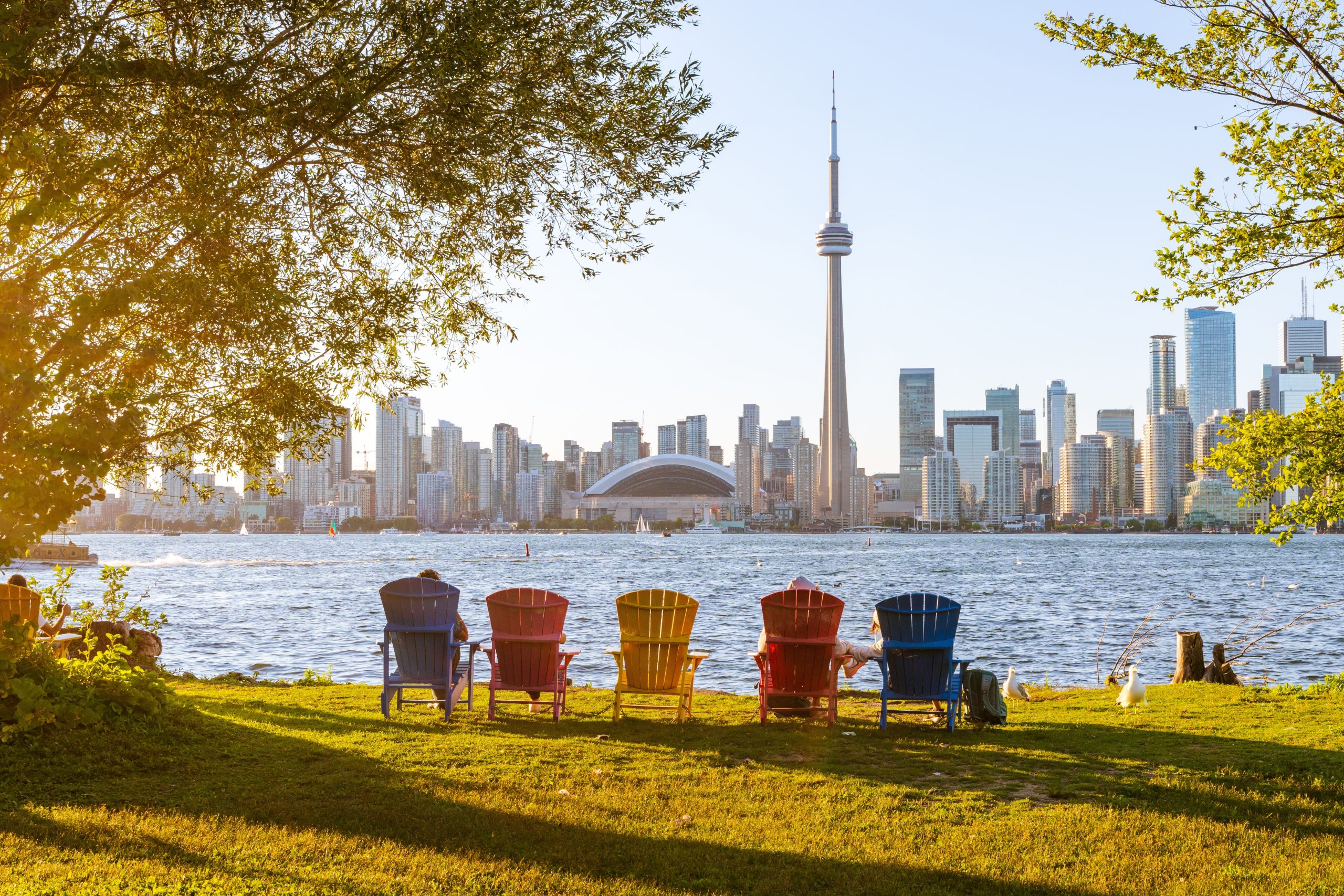
A task force is being set up to explore how to improve access to Toronto Island, including the possibility of a fixed link such as a high or floating bridge, tunnel or even a gondola over the Eastern Gap.
It’s an idea that’s been considered for more than a century. A pedestrian tunnel spanning the Western Gap opened in 2015 that exclusively provides access from the mainland to Billy Bishop Airport, but no formal proposal for a fixed link over the Eastern Gap has been developed.
Senior staff at the city have been directed to convene a Toronto Island Access and Inner Harbour Transportation Task Force for the purpose of “actioning, accelerating and co-ordinating” short- and medium-term access improvements and advancing due diligence related to long-term opportunities, including a fixed link and inner harbour transportation services.
The Eastern Gap area is a 220-to-260-metre section of waterway that connects the inner and outer harbours and runs between the Port Lands at Cherry Street and Unwin Avenue and Ward’s Island Park.
The task force will include senior leaders from Waterfront Toronto and seek input from appropriate city divisions, the staff of CreateTO, Ports Toronto, the Toronto and Region Conservation Authority and Harbourfront Centre, and consult on a regular basis with local councillors.
The consultations will be wide-ranging, as the task force has also been directed to speak with users of the inner and outer harbours, including businesses that rely on shipping and boating, community organizations and organizations that represent the recreational boating community.
Talks will also be held with labour unions at the City of Toronto, and engagement and consultation sessions will be undertaken with the public and Indigenous groups.
Senior staff are scheduled to report back to the city’s executive committee in the first quarter of 2027.
The Toronto Island Park is a signature destination for residents and tourists, with more than 1.5 million visitors taking the city’s ferries every year and approximately 485,000 trips taken by water taxi. On peak weekends and holidays in July and August, Toronto Island Park sees almost 18,000 visitors per day.
A Toronto Island Master Plan that was approved by council in July 2024 identified improved access as a priority and discussed opportunities for reducing economic barriers for accessing the island and expanding affordable programming and rentals park-wide.
Over the years, private architects, planners and other individuals have touted a fixed link as a way to complement waterfront revitalization.
A staff report that provides a high-level review of proposals notes while conceptually appealing, a fixed link would face a number of constraints, and it would be expensive.
According to the report, “A fixed-link should therefore be thought of as a potential long-term project, possibly to coincide with the future development of planned mixed-use precincts in the Port Lands, with the potential to complement, not replace, existing initiatives.”
Four distinct proposals have been put up for consideration: a high bridge that would allow sail boats to pass underneath at any time, a lower bridge that would open to let vessels through, a tunnel, or a gondola.
A high bridge would connect Ward’s Island to the Port of Toronto and lift or open as needed for boats such as cruise ships 80 to 90 feet high and cargo vessels about 120 feet high. A floating bridge could be a swing bridge that would only allow small crafts such as canoes and kayaks underneath but would open on a regular schedule to permit all other boats to cross.
A high bridge would require extensive ramp structures while a bridge that opens and closes would require complex machinery and an operator day and night all year. One drawback is the lack of predictability as to when the bridge would open and close which may drive some users away.
There have not been any public proposals for an Eastern Gap tunnel but it would likely be similar to the one that travels under the Western Gap and serves the airport.
The gondola proposed would be a cable-drawn affair and could land at Centre Island and in multiple locations in and around the Port Lands or elsewhere on the waterfront. The gondola would have to be above the height of cargo and cruise ships and below the flight path of airplanes.
To provide clearance for ships, the gondola could be no lower than 39 metres above the water, and to allow for safe airplane landings the top of the structure could be no higher than 76 metres.
A high bridge could cost a minimum of $100 million, according to an estimate provided by the city’s engineering and construction services staff, while a gondola could cost more than $100 million. A tunnel design was not analyzed but it’s expected the cost would be similar to the $82.5-million tunnel spanning the Western Gap.






Carney pushes back on calls to use energy as leverage in U.S. trade talks