HIGH POINT – Currey & Company comes to High Point Market this week with lamps that celebrate the beauty of glass and a focus on its newest lamp shades.
No exact date can be given to the invention or discovery of glass, Currey noted, but educational studies show the origin dates to at least 4000 B.C. Glass was a by-product of ceramics production in the ancient world, first known to be produced in the Near and Far East. A solid in a liquid state, glass is made by melting fine sand (silica) in a furnace and adding various oxides to produce stability, clarity, and color. Over the centuries, many techniques and processes were developed to create glass vessels, decorative medallions, and mosaics but when the glassmaker’s blowpipe was invented, it was a turning point for glass design and production. The hollow metal blowpipe sped up the glassmaker’s craft and simplified the process to be more functional – all attributed to the Phoenicians. Phoenicia was a mighty culture located in present-day Lebanon, Syria, and Northern Israel. They were known as shipbuilders, merchants along the Silk Road, and the inventor of an alphabet that is the basis for Latin and other languages. They spread glassmaking techniques and knowledge to other parts of the world through the trade of the glassware they manufactured. Fast-forward to the 12th and 13th centuries and we find there were extensive trade connections between the Near East and Italy, especially Venice. From there important technological influences penetrated the European continent.
Currey & Company is keeping the traditional craft of hand-made glass alive with new products created with glass including chandeliers, lamps and accessories.
Made of glass with brass stems, the Glass Dark Blue Pear Set includes large and small matte glass sculptures in the shape of the juicy fruit for which they are named. The texture along the surface that provides the distressed matte gray sculptures with added decorative value is hand-cut, which makes these textural accessories very artisanal. They are hollow inside, so placing them in a well-lit spot means they will glow from within when reflecting natural or man-made light.

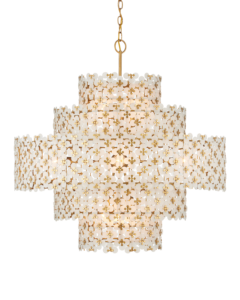
The Spring Flower Chandelier has five tiers of pert white flowers fashioned from frosted glass. These are attached to the frame with four-leaf-clover-shaped metal brads in a brass finish. Each petal is individually cut, sand-blasted, drilled, and pinned by hand, and each flower requires four pins to secure it — a complex process that takes many hours to complete. With its 12 lights, it will be luminous when lit from within.
The Danza Blue Cordless Table Lamp is crafted from clear, amber, and blue mouthblown art glass, its layered colors and organic form reflecting the influence of midcentury Scandinavian design. With a bold 1950s–60s aesthetic, the lamp is topped with a white hardback shade and fitted with a rechargeable bulb, combining vintage-inspired style with modern convenience. The fixture is dimmable.


The Baobab Wall Sconce has luminous leaves that are made of recycled glass and pressed into shape. The biophilic design is made even more graceful by the placement of glass pieces that seem to be fluttering in a breeze. These are attached to wrought iron stems in a contemporary silver leaf finish. The three-light fixture is dimmable to create a softer ambience in the evenings.
Shown above, the Veneto Large Chandelier, which has midcentury Italian lines, is made of metal in a polished brass finish. Sitting atop arms that arc outward are colorful glass discs in blue, yellow and red, each of which is painted to be more translucent than colored glass so that light will shine through them. The Milano-inspired gold chandelier is a large-scale fixture with 21 lights, “which means it’s an excellent choice for a tall space without a great deal of natural light,” Currey noted.
The Henrietta Pink Table Lamp shown above is made of mold-blown glass that narrows at the base and swells dramatically toward the top to create a bold, sculptural profile. The glass body rests on a stepped optic crystal base and is finished with a polished nickel cap. Its striking form is inspired by a vase designed by Heinrich Löffehardt in 1970, bringing a touch of vintage modern design into the piece.

Last year, Currey Company introduced lamp shades in two sizes and two styles in 14 fabrics. Partnering with Lacefield Designs, the collection consists of two types of shades in each category: pleated/tapered and drum shape with trim on the top and bottom. The full-sized shades work with both table and floor lamps. All are 100% cotton and are printed and assembled domestically. This is a freestanding program, which means customers may purchase the shades and use them how they like.
Creative Director Cecil Adams said, “Lacefield Designs can easily customize fabrics for us because they are digitally printed, which means the company’s wide array of patterns and colors can be bumped up or toned down.”