A major $400-million renovation project at Camping World Stadium in Orlando, Fla., which includes reconfiguring the upper bowl to permit more seating, is expected to start by the end of the year.
The improvements will increase capacity at the 90-year-old stadium to 65,000 from 63,000 seats. The north end zone will also be upgraded and retractable seating will be added to the south end.
Suites on the east and west sides of the stadium will be rebuilt, and a $55-million multi-purpose indoor field house will be added. A new metallic skin consisting of steel frame substructure and metal louver panels will wrap and swoop around the entire structure for a new look. The louver skin will become a solid cover at certain corner areas to hide the escalators.
Builders will also be adding hurricane bracing to support new upper bowls.
Plans also include the addition of new premium suites and amenities, updated building systems, code and life safety updates to current standards, and a retractable stage pocket in a section of the south seating bowl to enable the stadium to increase concert capacity by 7,000.
A new waterproof system will top the terrace level and restrooms and concessions will be added.
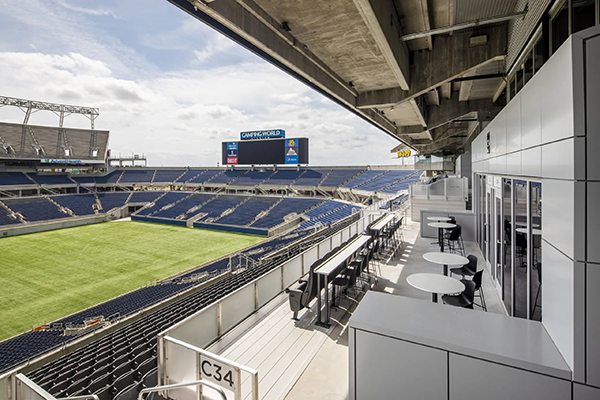
Allen Johnson, chief venues officer at the City of Orlando, says in addition to the expansion work, the scope of work includes providing new amenities and elevating the back-of-house experience.
The stadium sits on a 20-acre site near downtown Orlando. It is bound on the north by West Church Street, on the east by North Rio Grande Avenue, and on the west by Tinker Field. To the south is Lake Beardall and the 408 Expressway. There is an additional parcel of land to the west and south that includes Tinker Field, McCracken Field and Lake Beardall and surrounding land.
A Barton Malow-AECOM Hunt Construction joint venture was chosen for the project. The group was selected over a Balfour Beatty/Austin Construction joint venture, Gilbane Building Co. and Whiting-Turner. A bid by PCL and Manhattan Construction was withdrawn before final presentations.
DLR Group was selected as the project’s architect in November 2024.
The construction manager will be on a tight schedule, as the project is expected to be completed by summer 2027 in preparation for the NFL Jacksonville Jaguars’ first season in Orlando that fall.
The move by the Jaguars to Orlando is temporary due to a $1.4-billion renovation project at EverBank Stadium which began this past February and is projected to be completed by August 2028.
In mid-November, city council in Orlando paved the way for construction at the Camping World Stadium to begin and also released renderings of the revamped stadium which show an expansive venue with sloped seating and sleek premium boxes with large windows and balconies.
The revamp will be funded entirely through a six-per-cent tourist development tax imposed by Orange County, a so-called “bed tax” applied to hotel and short-term lodging stays.
County commissioners unanimously approved the tax at the request of the Appearance Review Board.

According to a report prepared by Richard Forbes, an architect and an appearance review official at the City of Orlando, the proposed work “will create an iconic design that is a signature destination for the City of Orlando that will elevate the fan experience and increase revenue generation.
“The project will optimize operations of the facility to support a venue that is designed for a wide range of sports and entertainment events in a single-sale ticket environment.”
The project also aims to modernize and increase the lifespan of the building by replacing some of the oldest existing components.
On the outside of the stadium, on the underside of the bowl, there will also be colour-changing LED lighting. The stadium will also have new scoreboards, general signage and large digital screens.
Transformation of the stadium will enable Orlando to attract global events and generate significant economic benefits.
The stadium, built in 1936 for $115,000, has undergone multiple upgrades over the past decade. In 2014, a $207-million reconstruction was undertaken and in 2021 a further $60 million in improvements was done that included end-zone seating upgrades, modernization of restroom and concession space, improvements to clubhouse seating, new premium mezzanine clubs on the east and west ends, upgrades to the parking lot and building systems, and more.
During that earlier work, live events were still hosted at the stadium while extensive renovation work was going on, which presented challenges. To mitigate problems, the contractor implemented safety techniques that separated construction activities, visitors and staff.