HMP Millsike, a new 1,500 cell prisoner facility covering 50 acres in East Yorkshire, officially opened in March.
In an unexpected twist of recognition, the £400 million prison, built for the United Kingdom’s Ministry of Justice, recently won two national building industry awards, one for outstanding achievement in construction methodology and a second for overall project sustainability.
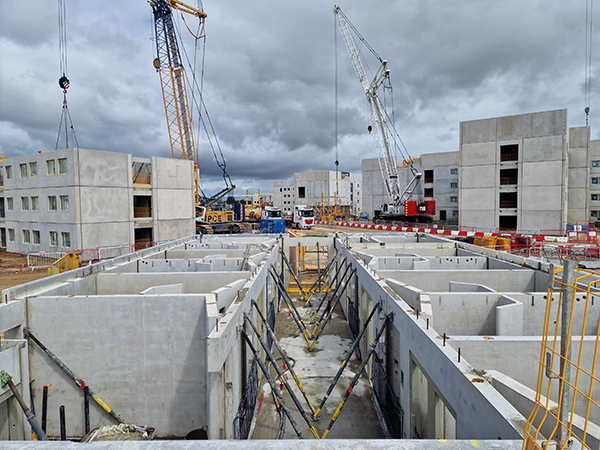
While the overall project timeline was 128 weeks, the superstructure and façade installation for the six houseblocks was completed in only 45 weeks. This was made possible through the extensive use of the offsite manufacturing of 16,500 building components sourced from supply chain partners across the U.K. and Ireland.
For this, Millsike earned the first of its two awards, the U.K.’s Modern Methods of Construction (MMC) Award.
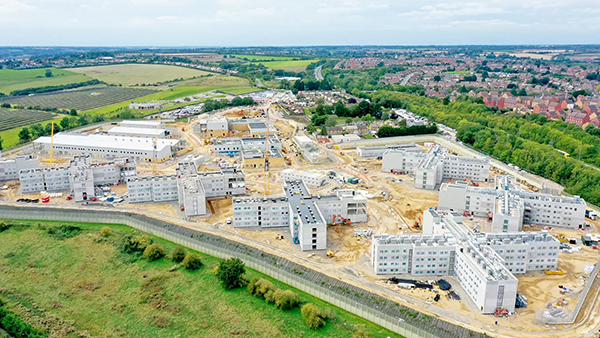
The MMC Awards is an annual program held in partnership with the Modular and Portable Building Association (MPBA) that recognizes projects, companies and individuals who are driving the use of MMC across the U.K.’s built environment. The awards highlight best practices in offsite manufacturing, modular construction and the use of innovative technologies and materials that improve efficiency, quality, sustainability and safety in construction.Prefabricated M&E risers, precast ground beams and offsite assembly of plant and services saved weeks of onsite time and labour, while also reducing the embodied carbon associated with the construction by an estimated 14.9 per cent.
“Innovative digital processes and programs were used to deliver HMP Millsike, including OpenBIM and digital standardization,” says Keir Group, the main contractor responsible for the facility’s construction and delivery. “A 3D digital twin was created to visualize every component, ensuring the use and performance of each one was monitored in real time during the build, saving considerable time and money.”
This helped achieve zero defects after completion and an average of only six snags per building.
HMP Millsike also won the Net Zero Award at the 2025 Building Awards, recognizing its status as the U.K.’s first all-electric prison.
The facility marks, “a significant milestone in the Ministry of Justice’s drive to create modern, sustainable facilities that support prisoner rehabilitation,” says Jenny Curtlin, a director at project lead designer Pickard.
Pickard’s website explains the prison will operate on 70 per cent less energy than traditional prison facilities, thanks to air-source heat pumps, solar panels and energy-efficient lighting systems. The facility can generate over 8,500 kwh of renewable energy onsite. The U.K.’s Infrastructure and Projects Authority (IPA) estimates these together will reduce energy costs by £1 million annually.
“I’m incredibly proud of our HMP Millsike team that won both the Net Zero and Modern Methods of Construction (MMC) awards in partnership with the Ministry of Justice UK and Pick Everard,” Keir Group CEO Stuart Togwell wrote on LinkedIn. “This recognition is a testament to the team’s strong commitment to innovation, sustainability and delivering real value for our customers.”
The project went beyond the achievements acknowledged by its two national building awards by also setting high standards for local engagement at many levels.
Local spending by Kier represented 45 per cent of the project. The company also says about 800 jobs were created for local residents within 50 miles of the site, with 91 apprentices and trainees employed.
“We engaged with over 1,300 school children locally, encouraging students into careers in construction, sharing personal experiences from the site team, and talk about apprenticeships and further education opportunities.”
Through the company’s prison retaining program called Making Ground, several dozen prison leavers were trained, upskilled and reskilled.
“Employment opportunities have been provided for 29 prison leavers and a further 44 prisoners released on temporary licence. Eighty-five per cent of prisoners who worked on HMP Millsike were employed at the six week post-release mark,” the company says.
“The balance of commitment to local labour and efficiency that HMP Millsike has demonstrated, through national supply arrangements as well as seeing how ex-offenders had the opportunity to play a crucial role in the building of the prison, the huge social value that the building of the project brings,” said Jon Loveday, IPA director of infrastructure, enterprise and growth.
John Bleasby is a freelance writer. Send comments and Climate and Construction column ideas to [email protected].