It was a year of major movement for some of the country’s most notable megaprojects. See what projects reached substantial completion and made headlines as engineering marvels, along with some others who made headlines for different reasons altogether.
Site C
The Site C hydroelectric dam on the Peace River near Fort St. John, B.C., is one of the biggest infrastructure projects in Canadian history but it didn’t come without its share of controversy as the Journal of Commerce highlighted in this retrospective article.

The 83-kilometre-long reservoir was filled in November 2024 and the sixth and final generating unit came online in August 2025, allowing the dam to produce more than 1,100 megawatts of electricity.
Earlier this year, BC Hydro said in a “lessons learned report” it was on track to complete the project on the Peace River within a $16 billion budget. But that’s almost double the original 2014 budget of about $8.8 billion. BC Hydro blamed the huge overrun on the pandemic as well as a failure to budget for low-probability risks that included significant geotechnical problems.
Gordie Howe bridge
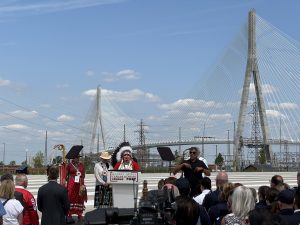
After more than six years of construction the $6.4 billion Gordie Howe International Bridge linking Windsor and Detroit is now expected to open in “early 2026.”

Construction began in October 2018 and the twin “hockey stick” arc like concrete bridge towers were topped off in December 2023. The bridge deck linking the two countries – the longest cable-stayed bridge in North America at 853 metres or 2,800 feet – was joined in a ceremony in June 2024.
According to officials, 98 per cent of work has been done. However, completion of the port of entry buildings like toll booths, customs and warehouses, along with landscaping, are in the final stages.
The six-lane bridge was touted to open late this year but construction delays, including the COVID-19 pandemic, have been blamed for the later opening.