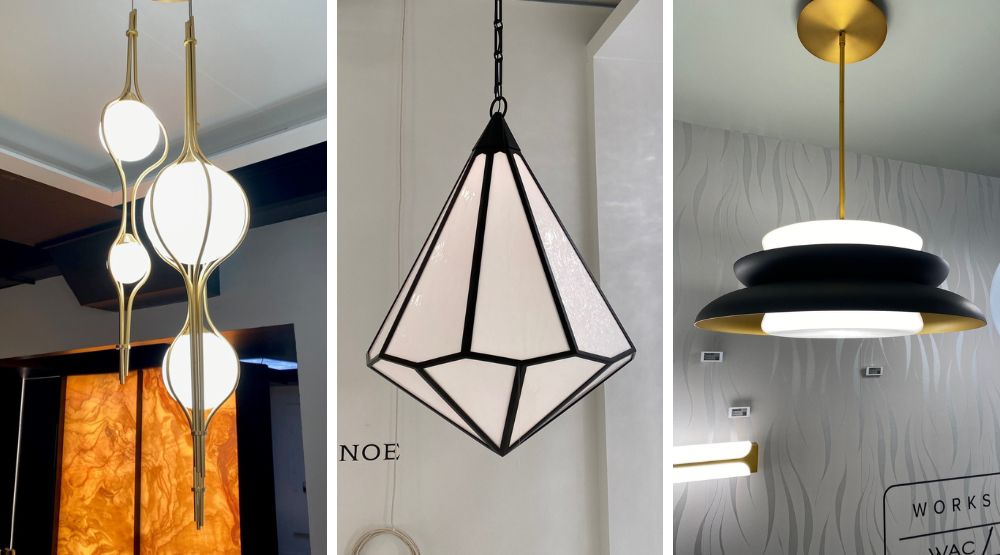
Lighting manufacturers regained their footing at Lightovation this month, no longer as stymied by tariffs as they were last June but still cognizant of economic headwinds and ready to support their lighting showroom partners in new and more vigorous ways.
They launched hundreds of new lighting collections, some of them made more price conscious through new or substituted materials or techniques. “Affordable luxury” was a buzzword in several showrooms.
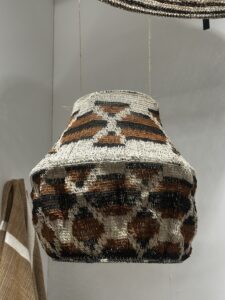
In terms of aesthetics, introductions reflected a few dominant design directions: updated traditional looks, softened forms, textured finishes (particularly in glass), more color and more ceramics.
Quorum, which toasted its 45th anniversary with champagne on Sunday, knocked down walls within its showroom to blend its Oxygen and Quorum lighting brands, and it separated its builder-market product from its more decorative lighting options to simplify the buying experience and make its lineup more digestible and easy to understand, said Field Bradford, sales director. It is delivering to both channels “service, speed, design and inventory procurement,” according to Bradford, who said the company’s in-stock position is 96%. “Our goal this year is to serve our customers better,” he said. “By doing so, we can continue to be a wonderful partner.”
Tony Wang, founder of WAC Group, said, “We’re going to smart, technical product to help more showrooms and give them the opportunity to sell more product.”

At this market, it added more than 60 of its existing decorative lighting fixtures to its connected, smart WAC Home system, which had previously been geared toward the interior design and architectural market. Smart home tends to have two segments — the low-level, direct-to-consumer products that tend to be “clunky to use,” according to Thomas Wang, head of global development for WAC, and the high-end custom integrator. WAC Home saw a gap in the marketplace in the middle where lighting showrooms operate, said Thomas Wang. “We wanted to introduce this to the showroom market because they are known for service,” he said, and are adept at explaining more complex, technical systems to their customers.

California-based Avenue Lighting, whose ownership of a factory in China helps keep overall costs under control, is building an 8,000 square-foot facility behind its warehouse in Chatsworth, Calif., where it will manufacture certain lighting components like canopies and pans and enable it to assemble some of its fixtures in the U.S., according to Taleen Titizian, chief financial officer.

Varaluz, now under firmer financial footing with its acquisition by Utah-based Ciana Lighting last spring, launched hundreds of new SKUS, including the reinterpretation of 20 of its iconic collections over the past two decades, and more outdoor product. It highlighted its showroom preferred partner program, a tiered benefits program that is connected to spending levels but also recognizes the loyalty of longstanding partners, regardless of spending, according to Ron Henderson, president. The program includes store installation credits and offers showroom styling assistance.
“We’re trying to figure out things to help the retail side,” Henderson said.
Austrian lighting giant Eglo launched a new sub-brand, Thesis, to addresses the tastes and specific needs of the American market. It is headed by former Kichler and Elk Home executive David Pamer. Former Kichler design director Greg Martin joined the company in late 2024 and serves as vice president of design for Thesis. Thesis aims to fill in gaps it did not completely fill with Eglo, which caters to more European taste, Martin said. That means scale in fixtures, more traditional chandelier formats and American finish preferences. It launched more than 400 SKUs in interior, exterior and vanity lighting.
Design partnerships
The show provided a stage for new design collaborations in the industry, including a partnership between Savoy House and designer Dann Foley on a collection of lamps and fixtures, and one between Studio M, a division of Maxim Lighting, and German ceramicist Stephanie Hering, who created portable lights, pendants and chandeliers made from porcelain.

“When they approached me [about doing a line], I just jumped at the chance,” said Foley.

The collaboration includes several table lamps, which is a relatively new category for Savoy House, in a range of materials from ceramic to wood to stone. There are also chandeliers in the mix, also in a variety of mixed materials. The two product categories are coordinated and being shipped together as a cost-saving measure, according to Foley. “We’re giving retailers and designers the opportunity to increase their margins,” he noted.
Foley is not shy about the role price plays in consumer buying decisions, and he is a strong proponent of value.
“Value has to be part of the equation, no matter what price point you’re at,” he said. “Luxury, details and quality come first, but value remains part of the equation.”
New looks and materials
Material substitutions are part of that value equation for many manufacturers. Some, including Avenue Lighting, Visual Comfort and Quoizel, offered chandeliers and pendants with acrylic rather than glass or crystal LED housings, but the difference was barely perceptible. Alabaster remains a popular material across all lighting segments, but some manufacturers offered man-made and less expensive substitutions for the stone, such as resin alabaster or mineral opaline. Painted steel was offered in a few instances as a more affordable option than brass.
Alteck featured new outdoor lighting made from Fiberglas, a weather-durable material used in speedboats and cars.


The return to traditional shapes, albeit updated for 2026, continues to be the biggest design shift in the market, exemplified by candelabra-style chandeliers (although with considerably thinner, streamlined arms), the return of pendant chains, often highly styled to complement the pendant, and lantern shapes. There were more scalloped shapes and softer forms, linen or printed fabric shades, hidden bulbs and an emphasis on a softer, more candlelit glow (readily achievable through LED technology).
Glass is a dominant material, and it is highly textured — fluted, seeded, or with a granulated, “sugary” texture. Round, opaque globes have superseded clear ones and swirled, milky glass is popular. Colored glass fixtures were also spotted throughout the market.

Finishes are warm and burnished, hewing more brown than gray or black.
Although traditional looks are making a comeback, there is a wide variety of style options in the market.
“The marketplace is very fractured, but supportable,” noted Henderson of Varaluz. “It’s hard to be just one thing and survive.” The differentiation process, however, “is fun,” he said.